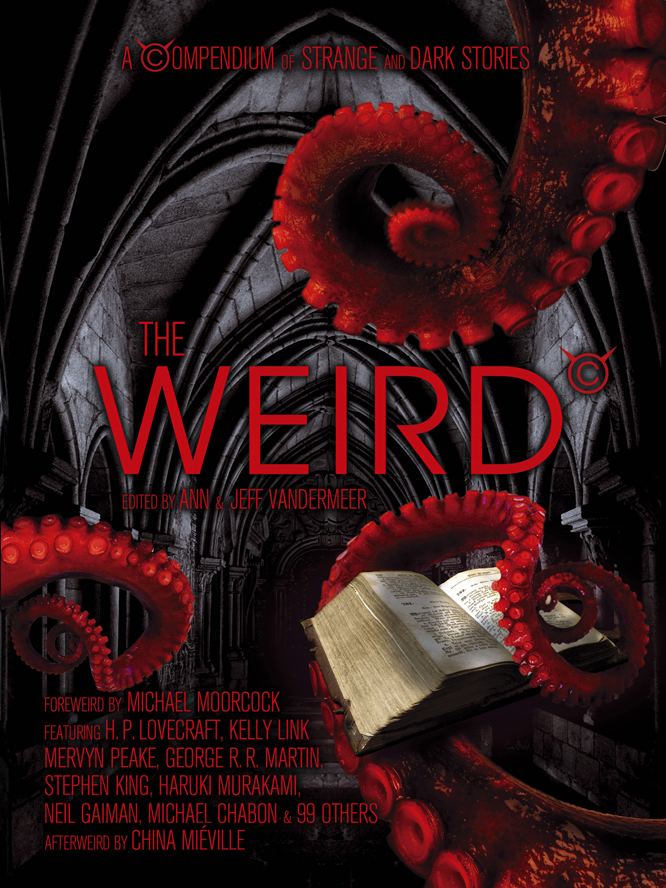
 The Weird weighs in at 1152 pages. This huge volume contains 110 stories–some classics, some new to me–and this wonderful book can be had for less than $20! Talk about bargains! I could quibble about certain stories I would have liked to be included, but I’m not going there. I’m here to praise this great anthology. There’s something here for everyone. It would certainly make a wonderful holiday gift!
TABLE OF CONTENTS:
Alfred Kubin, “The Other Side” (excerpt), 1908 (translation, Austria)
F. Marion Crawford, “The Screaming Skull,” 1908
Algernon Blackwood, “The Willows,” 1907
Saki, “Sredni Vashtar,” 1910
M.R. James, “Casting the Runes,” 1911
Lord Dunsany, “How Nuth Would Have Practiced his Art,” 1912
Gustav Meyrink, “The Man in the Bottle,” 1912 (translation, Austria)
Georg Heym, “The Dissection,” 1913 (new translation by Gio Clairval, Germany)
Hanns Heinz Ewers, “The Spider,” 1915 (translation, Germany)
Rabindranath Tagore, “The Hungry Stones,” 1916 (India)
Luigi Ugolini, “The Vegetable Man,” 1917 (new translation by Anna and Brendan Connell, Italy; first-ever translation into English)
A. Merritt, “The People of the Pit,” 1918
Ryunosuke Akutagawa, “The Hell Screen,” 1918 (new translation, Japan)
Francis Stevens (Gertrude Barrows Bennett), “Unseen—Unfeared,” 1919
Franz Kafka, “In the Penal Colony,” 1919 (translation, German/Czech)
Stefan Grabinski, “The White Weyrak,” 1921 (translation, Poland)
H.F. Arnold, “The Night Wire,” 1926
H.P. Lovecraft, “The Dunwich Horror,” 1929
Margaret Irwin, “The Book,” 1930
Jean Ray, “The Mainz Psalter,” 1930 (translation, Belgium)
Jean Ray, “The Shadowy Street,” 1931 (translation, Belgium)
Clark Ashton Smith, “Genius Loci,” 1933
Hagiwara Sakutoro, “The Town of Cats,” 1935 (translation, Japan)
Hugh Walpole, “The Tarn,” 1936
Bruno Schulz, “Sanatorium at the Sign of the Hourglass,” 1937 (translation, Poland)
Robert Barbour Johnson, “Far Below,” 1939
Fritz Leiber, “Smoke Ghost,” 1941
Leonora Carrington, “White Rabbits,” 1941
Donald Wollheim, “Mimic,” 1942
Ray Bradbury, “The Crowd,” 1943
William Sansom, “The Long Sheet,” 1944
Jorge Luis Borges, “The Aleph,” 1945 (translation, Argentina)
Olympe Bhely-Quenum, “A Child in the Bush of Ghosts,” 1949 (Benin)
Shirley Jackson, “The Summer People,” 1950
Margaret St. Clair, “The Man Who Sold Rope to the Gnoles,” 1951
Robert Bloch, “The Hungry House,” 1951
Augusto Monterroso, “Mister Taylor,” 1952 (new translation by Larry Nolen, Guatemala)
Amos Tutuola, “The Complete Gentleman,” 1952 (Nigeria)
Jerome Bixby, “It’s a Good Life,” 1953
Julio Cortazar, “Axolotl,” 1956 (new translation by Gio Clairval, Argentina)
William Sansom, “A Woman Seldom Found,” 1956
Charles Beaumont, “The Howling Man,” 1959
Mervyn Peake, “Same Time, Same Place,” 1963
Dino Buzzati, “The Colomber,” 1966 (new translation by Gio Clairval, Italy)
Michel Bernanos, “The Other Side of the Mountain,” 1967 (new translation by Gio Clairval, France)
Merce Rodoreda, “The Salamander,” 1967 (translation, Catalan)
Claude Seignolle, “The Ghoulbird,” 1967 (new translation by Gio Clairval, France)
Gahan Wilson, “The Sea Was Wet As Wet Could Be,” 1967
Daphne Du Maurier, “Don’t Look Now,” 1971
Robert Aickman, “The Hospice,” 1975
Dennis Etchison, “It Only Comes Out at Night,” 1976
James Tiptree Jr. (Alice Sheldon), “The Psychologist Who Wouldn’t Do Terrible Things to Rats,” 1976
Eric Basso, “The Beak Doctor,” 1977
Jamaica Kincaid, “Mother,” 1978 (Antigua and Barbuda/US)
George R.R. Martin, “Sandkings,” 1979
Bob Leman, “Window,” 1980
Ramsey Campbell, “The Brood,” 1980
Michael Shea, “The Autopsy,” 1980
William Gibson/John Shirley, “The Belonging Kind,” 1981
M. John Harrison, “Egnaro,” 1981
Joanna Russ, “The Little Dirty Girl,” 1982
M. John Harrison, “The New Rays,” 1982
Premendra Mitra, “The Discovery of Telenapota,” 1984 (translation, India)
F. Paul Wilson, “Soft,” 1984
Octavia Butler, “Bloodchild,” 1984
Clive Barker, “In the Hills, the Cities,” 1984
Leena Krohn, “Tainaron,” 1985 (translation, Finland)
Garry Kilworth, “Hogfoot Right and Bird-hands,” 1987
Lucius Shepard, “Shades,” 1987
Harlan Ellison, “The Function of Dream Sleep,” 1988
Ben Okri, “Worlds That Flourish,” 1988 (Nigeria)
Elizabeth Hand, “The Boy in the Tree,” 1989
Joyce Carol Oates, “Family,” 1989
Poppy Z Brite, “His Mouth Will Taste of Wormwood,” 1990
Michal Ajvaz, “The End of the Garden,” 1991 (translation, Czech)
Karen Joy Fowler, “The Dark,” 1991
Kathe Koja, “Angels in Love,” 1991
Haruki Murakami, “The Ice Man,” 1991 (translation, Japan)
Lisa Tuttle, “Replacements,” 1992
Marc Laidlaw, “The Diane Arbus Suicide Portfolio,” 1993
Steven Utley, “The Country Doctor,” 1993
William Browning Spenser, “The Ocean and All Its Devices,” 1994
Jeffrey Ford, “The Delicate,” 1994
Martin Simpson, “Last Rites and Resurrections,” 1994
Stephen King, “The Man in the Black Suit,” 1994
Angela Carter, “The Snow Pavilion,” 1995
Craig Padawer, “The Meat Garden,” 1996
Stepan Chapman, “The Stiff and the Stile,” 1997
Tanith Lee, “Yellow and Red,” 1998
Kelly Link, “The Specialist’s Hat,” 1998
Caitlin R. Kiernan, “A Redress for Andromeda,” 2000
Michael Chabon, “The God of Dark Laughter,” 2001
China Mieville, “Details,” 2002
Michael Cisco, “The Genius of Assassins,” 2002
Neil Gaiman, “Feeders and Eaters,” 2002
Jeff VanderMeer, “The Cage,” 2002
Jeffrey Ford, “The Beautiful Gelreesh,” 2003
Thomas Ligotti, “The Town Manager,” 2003
Brian Evenson, “The Brotherhood of Mutilation,” 2003
Mark Samuels, “The White Hands,” 2003
Daniel Abraham, “Flat Diana,” 2004
Margo Lanagan, “Singing My Sister Down,” 2005 (Australia)
T.M. Wright, “The People on the Island,” 2005
Laird Barron, “The Forest,” 2007
Liz Williams, “The Hide,” 2007
Reza Negarestani, “The Dust Enforcer,” 2008 (Iran)
Micaela Morrissette, “The Familiars,” 2009
Steve Duffy, “In the Lion’s Den,” 2009
Stephen Graham Jones, “Little Lambs,” 2009
K.J. Bishop, “Saving the Gleeful Horse,” 2010 (Australia)
 Diane and I watched three episodes of Emily Owens, M.D. and I’m bailing out. Diane is on the bubble whether she wants to continue watching. As you can see by the graphic, “Emily Owens” is actually Meryl Streep’s daughter with the unlikely name of Mamie Gummer. Gummer is cute, expressive, and earnest. You immediately like her. The problems with this medical show revolves around too many cliches: cute Resident who rejects Emily (she still loves him), another cute Resident (with a dying mother), a Mean Girl rival, a lesbian friend, and…you get the idea. Nothing very original here. After three episodes, I figured I’d seen most of the predictable permutations of the plot and I’m moving on. But I predict Mamie Grummer will become a star like her mother.
 David Denby is a film critic for The New Yorker who thinks deeply about movies. Do the Movies Have a Future? collects several of Denby’s essays on films that he loves and admires. Sadly, those films could not be made today. Denby notes that today’s Hollywood studios want mega-hits like The Avengers rather than the noir films of the Fifties. My favorite essays in this book involve Denby’s favorite directors. After I finished Denby’s essay on Otto Preminger, I wanted to drop everything and watch Anatomy of a Murder (Denby calls it the best courtroom drama in American film). Other outstanding essays include Denby’s searing exploration of Joan Crawford, his analysis of David Fincher’s films, and the mystique of Pauline Kael. If you love movies, you’re going to love Do the Movies Have a Future?. GRADE: A
 I’m a big fan of Ken Burns so I’m looking forward to this documentary about the Dust Bowl. Here is another man-made disaster that brought thousands of farmers to their knees. Diane and I really liked Ken Burns’ Prohibition series last year. Watching Ken Burns’ work is a painless way to learn history. Check for the local times in your area. And check out the trailer below.
 Stephen Speilberg’s Lincoln focuses on the last few months of Lincoln’s life. Specifically, it tells the story of the passing of the 13th Amendment. If you think our country is divided now, it was more divisive in 1865. And, as the story of 13th Amendment unwinds, there’s the Civil War impinging on every scene in the movie. Daniel Day-Lewis IS Lincoln in this movie. But, for my money, the performance of Tommy Lee Jones as Radical Republican Congressional leader Thaddeus Stevens is luminous. Tommy Lee Jones steals every scene he’s in. My only quibble about Lincoln centers around all of subplots: Lincoln and Mary Todd Lincoln’s relationship, Lincoln’s relationship with his sons, Lincoln and Secretary of State William Seward (played superbly by David Strathairn), and the comic relief of James Spader as Democratic Party operative William N. Bilboe threaten to overwhelm the already long 150 minutes. I’m guessing Lincoln will be a big winner at Oscar time. GRADE: A-
 A mixture of turnovers and bad calls by officials in Foxboro gave the Bills their 12th straight loss to the New England Patriots in Massachusetts. Talk about incompetence and futility! You can see why it’s hard to be a Bills fan. Tonight, the Bills play the Dolphins in a rare Thursday night game. The game is a sell-out so those people who enjoy watching surgical shows on cable can watch this likely fiasco. Many Bills fans are already studying potential Draft Picks.
 Robin Sloan gives a head-fake to The Maltese Falcon early on in Mr. Penumbra’s 24-Hour Bookstore, but the book has more in common with an Agatha Christie mystery. Clay Jannon, an out-of-work web site designer, desperate to pay his bills, takes a job as a clerk at the strange Mr. Penumbra’s 24-Hour Bookstore. Clay discovers that the front of the store with regular books is just a cover for the bizarre books located high on the shelves. Those books are borrowed by a cult of readers who seek…well, that would be telling. Secret cults, codes, a cute GOOGLE genius girl, a friend who builds sets for Industrial Light & Magic, and another friend who owns a software company that specializes in graphical depictions of one specific body part are just some of the strange elements in this remarkable book. If you put Agatha Christie and Philip K. Dick in a blender, you’d get Robin Sloan. Check out Robin Sloan reading Chapter One below. GRADE: B+
 I finally used my free ticket to TAKEN 2. For those of you not familiar with Liam Neeson’s retired CIA agent, Bryan Mills, he’s a dedicated agent who finds himself divorced from his beautiful wife (Famke Janssen) and estranged from his teenage daughter, Kim (Maggie Grace). In TAKEN, Kim is kidnapped in Paris and Neeson uses his spy skills to track down her kidnappers. TAKEN 2 follows the same template. Neeson, his ex-wife, and Kim take a family vacation in Istanbul (yikes!). And, sure enough, the father of one of the Bad Guys Neeson killed in TAKEN, wants revenge so he and his gang kidnap Neeson and his ex-wife (Kim manages to avoid capture). Yes, Neeson escapes (shocking!) and goes on a killing spree. I imagine that TAKEN 3 will center around Kim and her husband getting kidnapped after their wedding. Mildly entertaining. GRADE: C+
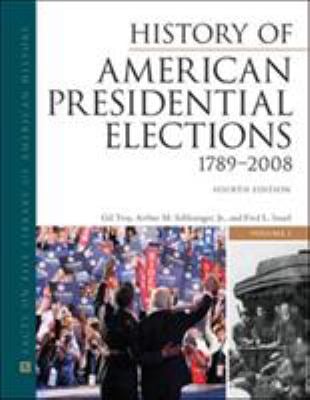 Isaac Asimov wrote a science fiction short story called “Franchise.” (Amazingly, it was published in the August 1955 issue of If: Worlds of Science Fiction). In “Franchise,” Asimov has a computer making Election decisions. It interviewed one representative voter, analyzed all the relevant information, and generated the same results that a real Election would have produced. Until that happens, we have Nate Silver to guide us through the election process. But for political junkies (like me), I highly recommend History of American Presidental Elections, 1789-2008 (I’m sure a new revised edition is being written right now). You don’t have to shell out the $219 to buy this set; your local public library should have it or should be able to acquire it for you through library inter-loan. I know of no other history of elections with this kind of scope and accessibility. In the wake of the 2012 Election, it was fun to go back and get an overview of our country’s entire Presidential Election history. GRADE: A