BORN TO RUN By Bruce Springsteen (50th Anniversary) and TONIGHT IN JUNGLELAND: THE MAKING OF BORN TO RUN By Peter Ames Carlin

TRACK LIST:

No.TitleLength
1.Thunder Road4:49
2.Tenth Avenue Freeze-Out3:11
3.Night3:00
4.Backstreets6:30
No.TitleLength
1.Born to Run4:30
2.She’s the One4:30
3.Meeting Across the River3:18
4.Jungleland9:34
Total length:39:23

Fifty years ago this week I bought a copy of Bruce Springsteen’s Born to Run album. The album had been released on August 25, 1975 and was an immediate hit. “Born to Run,” the single, garnered heavy radio play. But what I did not know before reading Peter Ames Carlin’s new book, Tonight in Jungleland: The Making of Born to Run, was that Columbia Records was about to drop Bruce Springsteen because his first two albums–Greetings from Asbury Park, N.J. and The Wild, the Innocent & the E Street Shufflewhile critical successes, disappointed the executives at Columbia with their meager sales.

Springsteen’s career was at risk while he was working on Born to Run–he knew the stakes. It’s clear from Calin’s book, that Springsteen decided to take some risks with Born to Run. He brought in new band members like drummer Max Weinberg. Springsteen also brought in rock columnist Jon Landau to co-produce Born to Run. The risks brought Springsteen and the E Street Band the fame they craved.

Peter Ames Carlin presents the recording process of Born to Run and the twists and turns in Springsteen’s tweaking of the lyrics and the arrangements. Strings were added–then subtracted. Backup singers came and went. The low tech recording equipment of 1975 also caused problems. But the story of how all these problems were overcome to produce a classic album is compelling.

Are you a fan of Born to Run? GRADE: A (for the album and the book)

TABLE OF CONTENTS:

  1. Prologue — 1
  2. Chapter 1: Watch the World Explode — 3
  3. Chapter 2: Nashville — 10
  4. Chapter 3: Lost in the Flood — 23
  5. Chapter 4: I Know Where You Live — 33
  6. Chapter 5: Carnival Weekend — 43
  7. Chapter 6: Rock ’n’ Roll Future — 52
  8. Chapter 7: Growing Young with Rock and Roll — 59
  9. Chapter 8: Walk with Me Out on the Wire — 67
  10. Chapter 9: Welcome to E Street — 75
  11. Chapter 10: The Poets Around Here Don’t Write Nothing at All — 87
  12. Chapter 11: Wings for Wheels — 95
  13. Chapter 12: The E Street Dance — 102
  14. Chapter 13: Magic in the Night — 110
  15. Chapter 14: Like a Vision — 116
  16. Chapter 15: All the Wonder It Brings — 123
  17. Chapter 16: Scooter and the Big Man — 129
  18. Chapter 17: It’s Elephants, Baby! — 138
  19. Chapter 18: And Then You Were the Psychopath — 147
  20. Chapter 19: The Heist — 154
  21. Chapter 20: Tonight in Jungleland — 165
  22. Chapter 21: Kutztown — 176
  23. Chapter 22: The Bottom Line — 187
  24. Chapter 23: Flying by the Seat of My Pants — 199
  25. Chapter 24: Backlash — 209
  26. Chapter 25: The Other Thunder Road — 218
  27. Epilogue — 229
  28. Acknowledgments — 235
  29. Bibliography — 249

WEDNESDAY’S SHORT STORIES #239: THE COLLECTOR’S BOOK OF SCIENCE FICTION Edited by David Stuart Davies

Just by chance, I stumbled upon David Suart Davies’s monumental The Collector’s Book of Science Fiction (aka, Wordsworth Book of Science Fiction) presents over a 1000 pages of classic 19th and early 20th Century SF. I own a 100 SF anthologies, but The Collector’s Book of Science Fiction contains a massive amount of material unavailable elsewhere.

Cast your eyes down the Table of Contents and prepare to be amazed at the breath of writers represented. Yes, Jules Verne, A. Conan Doyle, and Jack London are here, but Milne, Stockton, Allen show up, too.

After reading The Collector’s Book of Science Fiction, I developed a whole different sense of what was happening in early SF with little known writers like Weinbaum, Mitchell, White, and Griffith making substantial progress in the genre.

If you’re a devotee of early Science Fiction The Collector’s Book of Science Fiction is a must-read. I bought my copy of The Collector’s Book of Science Fiction for less than $10–a bargain for a book of this size and importance! GRADE: A

TABLE OF CONTENTS:

PROFESSOR T, SERIES 4 (PBS)

Professor T. is a British crime drama television series starring Ben Miller as Professor Jasper Tempest, a genius University of Cambridge criminologist with obsessive compulsive disorder.

In the opening episode, “Carpe Diem,” of this new series of Professor T, Tempest is dealing with the shocking death that concluded Series 3. The professor retreats into his lectures at Cambridge and ignores attempts by the police to involve him in more crime solving. But Dr. Helena Goldberg (Juliet Stevenson), Jasper’s therapist, helps Tempest return to his police work in a baffling case where a young woman is missing on ship. Was she murdered? Did she accidentally fall overboard? Or did she commit suicide? Only Tempest sees the true situation. GRADE: Incomplete, but treading towards a B

FILTHY RICH POLITICIANS: THE SWAMP CREATURES, LATTE LIBERALS, AND RULING CLASS ELITES CASHING IN ON AMERICA By Matt K. Lewis

Veteran political correspondant, Matt K. Lewis, has studied politicians and their use of political power to enrich themselves for decades. A recent article in The Atlantic estimated that President Trump has made over $3 billion while in office–mostly from his goofy, but lucrative, crypto business.

Filthy Rich Politicians shows how the political money games work, for both the Republicans and the Democrats. “Rich people get elected, and people, when elected, tend to get richer,” Lewis says. “Over time, it has gotten worse.”

Part of the problem is that the “guard-rails” of wealth acquisition in political office had been dismantled. Trump rid himself (and his political allies) of oversight by Inspector Generals…by firing them all.

And, it’s no surprise that Trump surrounded himself with billionaires by including them in his Cabinet. They have the opportunity to enrich themselves, too.

If you have an interest in political corruption–and what to do to fix it–Matt K. Lewis’ Filthy Rich Politicians provides a workable plan.

Do you have a “favorite” corrupt politician? GRADE: A

TABLE OF CONTENTS:

Foreword by Batya Unger-Sargon — ix

Introduction — 1

The ruling class — 11

A rich history: Pre$idents from Washington to Biden — 18

Why the rich get elected — 29

Why the elected get rich — 45

All in the family: How politicians spread the wealth — 70

The lifestyle: Living large — 91

Latte liberals: Rich and privileged with influence — 102

Ivy League populists: Rich and privileged networks — 125

You can take it with you: The revolving door — 142

Don’t eat the rich — 160

Appendix: The Richest Twenty-Five Members of Congress — 181

The Ten Richest US Presidents — 181

Acknowledgements — 193

Notes — 197

Index — 235

About the Author — 243

CONAN: SONGS OF THE SLAIN By Tim Lebbon

I’ve read a couple dozen Conan the Barbarian pastiches over the years. Last year, I enjoyed James Lovegrove’s Conan – Cult of the Obsidian Moon (you can read my review here). Titan Books has published a new pastiche by Tim Lebbon, Conan: Songs of the Slain. I really liked the illustrations by Juan Alberto Hernandez.

Tim Lebbon obviously loves Conan and by the many references to past Conan stories, he’s a serious fan as well as a talented writer. Conan: Songs of the Slain begins with the capture of Conan friend Baht Tann’s wife and two sons by the powerful warrior, Grake. Grace plans to kill Conan and ascend to greatness as a result.

But Conan faces more danger as two more enemies plan his demise. Krow Danaz, a wizard, who wants to avenge the death of his mentor, Tsotha-lanti, a sorcerer slain by Conan, links up with Grake and Mylera, a witch, whose father died saving Conan in one of the barbarian King’s wars. Mylera blames Conan for her father’s death and goes to Dark Magic for the means to kill Conan.

Sometimes less is more. Any one of these adversaries would have been challenging to the aging Conan of Conan: Songs of the Slain. Two would have the odds in their favor to kill the King. But three powerful enemies seems like overkill to me.

Much of Conan: Songs of the Slain features Conan in the wilds again, searching for the missing wife and sons of Baht Tann. Meanwhile, Conan’s enemies are preparing for a climatic showdown to bring Conan to his knees, and kill him. In the lead-up to the big battle, Conan takes a lot of punishment. No normal human could have survived the injuries Tim Lebbon inflicts on Conan.

If you’re a fan of Conan, you’ll enjoy Conan: Songs of the Slain. But, set the bar low. GRADE: C+

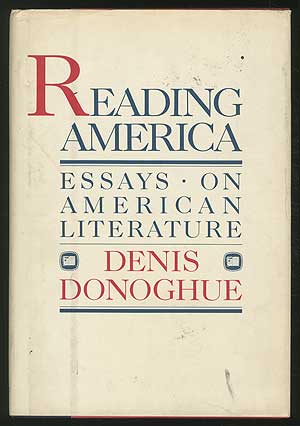
READING AMERICA By Denis Donoghue

TABLE OF CONTENTS:

Knopf published Reading America, Volume 2 of the Selected Essays of Denis Donoghue, in 1987. One wonders what the audience for a book like this would be today.

Introduction — ix

ESSAYS

America in Theory — 3

Emerson at First — 20

Thoreau — 40

Whitman — 68

Emily Dickinson — 97

Henry Adam’ss Novels — 111

Henry James and The Sense of the Past — 127

On “Gerontion” — 144

Stevens’s Gibberish — 158

Trilling, Mind, and Society — 175

BREVITIES

Conrad Aiken — 199

Marrianne Moore — 206

Wallace Stevens — 218

Ransom — 225

Allen Tate — 230

H. D. — 237

Hart Crane

I. — 242

II. — 250

Auden

I. — 254

II. 258

Kenneth Burke — 265

John Berryman — 276

Robert Lowell

I. — 282

II. — 287

Sylvia Plath — 296

John Ashbery

I. — 302

II. — 312

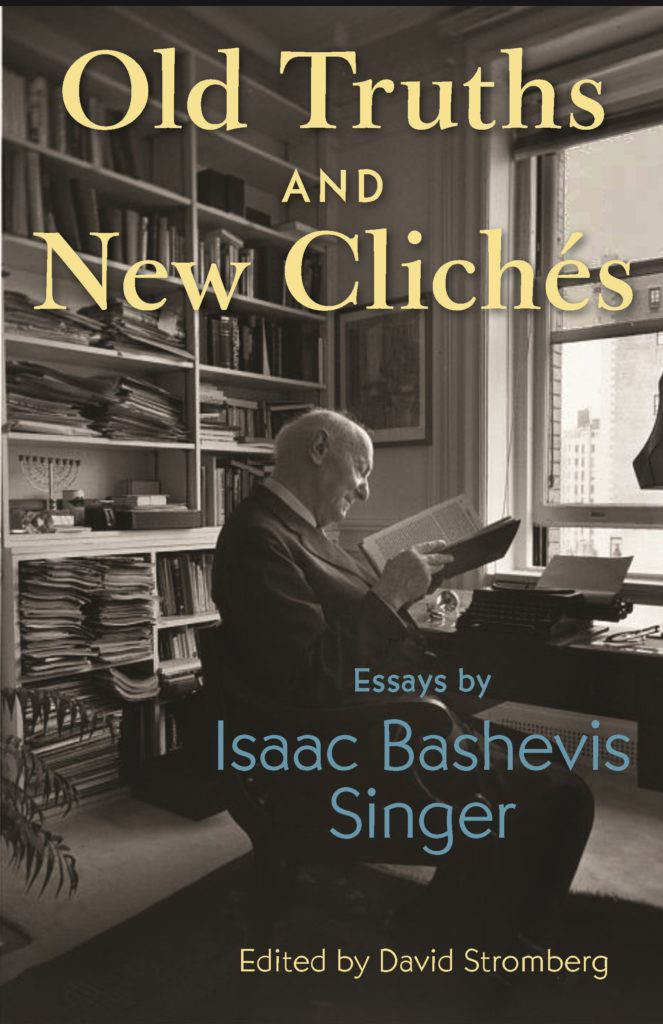
OLD TRUTHS AND NEW CLICHES: ESSAYS BY ISAAC BASHEVIS SINGER Edited by David Stromberg

Old Truths and New Clichés collects nineteen essays—most of them previously unpublished in English—by Isaac Bashevis Singer on topics that were central to his artistic vision throughout an astonishing and prolific literary career spanning more than six decades.

Expanding on themes reflected in his best-known work—including the literary arts, Yiddish and Jewish life, and mysticism and philosophy—the book illuminates in new ways the rich intellectual, aesthetic, religious, and biographical background of Singer’s singular achievement as the first Yiddish-language author to be awarded the Nobel Prize for Literature.

Like a modern Montaigne, Singer studied human nature and created a body of work that contributed to a deeper understanding of the human spirit. Much of his philosophical thought was funneled into his stories. Yet these essays, which Singer himself translated into English or oversaw the translation of, present his ideas in a new way, as universal reflections on the role of the artist in modern society. Do you read Isaac Bashevis Singer? GRADE: A

TABLE OF CONTENTS:

PREFACE (pp. ix-x) David Stromberg

Writers Don’t Write for the Drawer: AN INTRODUCTION TO THE ESSAYS OF ISAAC BASHEVIS SINGERWriters Don’t Write for the Drawer: AN INTRODUCTION TO THE ESSAYS OF ISAAC BASHEVIS SINGER (pp. 1-16) Isaac Bashevis Singer has long been acknowledged as a master storyteller. But his critical writings have been largely passed over. One underlying reason is the sheer volume of Singer’s output. Starting in 1939, when he became a regular contributor to the Yiddish daily Forverts, he produced an incredible amount of text. He published his work under at least three pseudonyms, any number of which might appear in a single issue—sometimes on a single page—in a variety of genres: stories, novels, memoirs, essays, literary sketches, satires, dialogues, travel pieces, reviews, and even a popular media digest.

THE LITERARY ARTS

The Satan of Our TimeThe Satan of Our Time (pp. 19-19) A Yiddish writer in America is an unseen entity, almost a ghost. Perhaps this is why I am so interested in ghost stories and in the supernatural. I am inclined in all my writings to search for what is hidden from the eye. Somewhere I believe every human being to be possessed, and to me real writers are those who have the ability of exorcism.My first book, Satan in Goray, was published in Warsaw, Poland, in 1935, the year I came to the U.S.A., and since then I have struggled with devils and imps in all my works.

  • Journalism and Literature (pp. 20-24) know of writers who consider it a tragedy to earn a living from journalism. They claim that it wastes their free time and that journalism is generally harmful to literary creativity. They argue that a journalist becomes accustomed to writing in a hurry and not weighing and measuring every word, and that the means and methods of journalism are altogether contrary to creativity. The experiences of this writer suggest a different approach to the question.It has been my experience that I wrote my best works in the midst of journalistic hullabaloo, often right in the editorial offices…
  • Why Literary Censorship Is Harmful (pp. 25-31) Urbane people who have a preference for what they call “pure” literature and theater have in recent years been shocked by obscene language printed in books and newspapers, and vulgar speech heard in the theater. Those with daughters have especially strong feelings. They somehow cannot imagine them reading and hearing this sort of trash. This obviously concerns what is happening in English, French, German, and other such literatures. Some feel it’s foolish to remove virtually all censorship from literature and theater, while keeping a rather strict censorship on movies, radio, and television.
  • Who Needs Literature? (pp. 32-42) There are times when I wonder what purpose fiction serves today. Why fabricate plots when life unfolds an inexhaustible wealth of events, stranger than anything literature might offer? Fantasy will never be able to match all the surprising twists that make up facts. No writer’s pen has been able to produce a work so true and free of imperfections as a case history, or the proceedings of a courtroom. Just as there is no perfect crime, so there is no perfect novel. Even Anna Karenina and Madame Bovary reveal flaws and inconsistencies that are part of all fiction.
  • Old Truths and New Clichés (pp. 43-52) Is it possible for art not to look to nature and to learn from it? Before we can answer this question, we must clarify the question itself.In a broad sense, nobody—and especially no artist—can run away from nature. Writers who think up impossible and false situations, painters who paint abstract pictures, sculptors who create figures that have no resemblance to existing objects, composers who compose symphonies that have no rhythm orharmony—they all are united with nature. People, with their fantasies, caprices, and idiosyncrasies, are all a part of nature.
    • Storytelling and Literature (pp. 53-63) I am going to speak about the importance of storytelling and literature. Actually, to say that storytelling is important to literature is like saying that food is necessary for human beings. Of course, everybody knows it. Take away the story and there is no literature. I am sorry that a number of writers have forgotten this simple fact. Sometimes people forget axioms, things that are so clear to all of us, and fall into a kind of amnesia. It is possible that maybe one day people may even forget that food is necessary for life!
    • Literature for Children and Adults (pp. 64-74) One of the biggest biological enigmas is the great gift—or the great burden—of emotions that Nature has bestowed upon people. No matter how impoverished we might be in all other areas, we are millionaires in emotions. People need not study emotions the way they study languages or sciences. What’s more, all the intelligence we have accumulated over the centuries goes to serve these emotions, and sometimes to regulate them somewhat, so that in the mad impetus of our emotions, we don’t inundate ourselves. In this area, the beggar is as rich as the king.
  • YIDDISH AND JEWISH LIFE
    • The Kabbalah and Modern Times (pp. 77-89) What can a modern person learn from the Kabbalah? My definition of such a person is someone who does not believe in any authority, who does not rely on old texts, and who is looking for the truth in a scientific manner. When such people come to the higher questions, they are skeptical. I could therefore call my lecture, “What can skeptics learn from the Kabbalah?” Has it any value for them today? Or is it only a part of the history of human faith and superstition?I consider myself a skeptic as far as dogma and revelation are concerned,..
    • The Ten Commandments and Modern Critics (pp. 90-98) What would happen if Moses were alive today and issued the Ten Commandments not on Mount Sinai with thunder and lightning, but in the form of a booklet or a brochure? How would he be received by the critics? The following are a few of the possibilities.Mr. Moses’s booklet, actually a proclamation (or leaflet), is difficult to categorize. It isn’t fiction in the usual sense of the word, nor is it a work of science. Perhaps it could best be labeled a religious tract—still, there is little of religion in it.
    • The Spirit of Judaism (pp. 99-107) Before me lie dozens of photographs of religious Jews in the Williamsburg section of New York.1 I see fur-edged rabbinical hats, long gaberdines, big beards, sidelocks, women in wigs and in bonnets that were already obsolete even in my youth in Warsaw. I know that thousands of Jews and non-Jews who see these people want to know: What does this signify? Are they all rabbis? Does it say anywhere in the Torah or Talmud that Jews must dress this way? Do they belong to some special Jewish sect? Neither the Reform, the Conservative, nor even those Jews who attend Modern Orthodox…
    • Yiddish, the Language of Exile (pp. 108-118) It is an accepted tenet of both our religious and secular literature that the exile was a calamity for the Jewish people. “And because of our sins we have been exiled from our land.”¹ Three times a day Jews pray that their eyes may see God’s return to Zion. Some of the extreme Zionists have expressed the opinion that the almost two-thousand-year period of the Diaspora was nothing more than an error and a void in our history. Others have even tried to belittle what Jews have created in exile: the Talmud, the Midrash, the Commentaries, the Zohar.
    • Yiddish Theater Lives, Despite the Past (pp. 119-128) I was already a young writer and an ardent reader of world literature when I began to attend plays in Yiddish. Some of them were written by Polish-or Russian-Jewish playwrights, and many of them were imported from the golden land of America. I could see even then that we had not produced in Yiddish a Shakespeare, a Moliere, or a Strindberg. These plays were folkish, utterly naive and sometimes even ridiculous, but I enjoyed them and often laughed, not as much at the banal subject matter, but at the clumsiness of the writers, directors, and even the actors.
    • Yiddish and Jewishness (pp. 129-144) Like grammar, nature has no exceptions. If something in nature appears to us as an exception, it means that the general law is yet unknown.The Jewish people appears to be an exception among peoples. As Balaam said about the Israelites, “The people shall dwell alone and shall not be reckoned among the nations.” In all the long history of our people, we have had our own country for only a relatively short time. We used to and continue to live in many different lands, just as we have spoken and still speak innumerable languages.
  • PERSONAL WRITINGS AND PHILOSOPHY
    • A Trip to the Circus (pp. 147-153) Looking back on my life, I can remember always being exceedingly curious about the unusual, the mysterious, the miraculous. My father constantly spoke about saints and wonder rabbis and the miracles they worked through the power of the Kabbalah and holy names. God himself was a super miracle worker. He said, “Let there be light,” and there was light. The men and women who served him, from the time of Moses to the Baal Shem Tov and Rabbi Nahman of Bratslav, were all people of magic. According to legend, those who opposed God could work magic too—Satan, Asmodeus, Lilith,…
    • Why I Write As I Do: The Philosophy and Definition of a Jewish Writer (pp. 154-167) I know in advance that anything I have to write is either known to you already or available on the shelves of your library.¹ For that reason I have decided to forget modesty and write about myself. On that subject, at any rate, I am somewhat of an authority. I hope that you will find my case history of some value.I have in my lifetime lived through a number of epochs in Jewish history. I was brought up in a home where the old Jewish faith burned brightly. Ours was a house of Torah and holy books.
    • A Personal Concept of Religion (pp. 168-175) People often ask me: Are you religious? And it isn’t easy for me to answer because the basic element of religion is divine revelation, whether God reveals himself in a burning bush or through the intervention of an angel. But can there also be a religion that does not rely upon revelation?The fact is that a number of philosophers preached this very kind of religion, but the God of philosophers never couldacquire prophets, temples, or priests. To the best of my knowledge, there is no temple where people pray to Spinoza’s Substance, 1 or Hegel’s Zeitgeist.
    • A Story about a Collection of Stories(pp. 176-178) Since I am supposed to be a “born storyteller,” as one of my lenient critics called me, the introduction to this collection will contain two little stories. One facetious and one true. The first one is that when I was born my mother asked the midwife, “Is it a boy or a girl?” And the midwife answered, “A writer.” I have told this anecdote to so many people so many times that I am beginning to believe that it is true. This “event” took place, as you may know, in 1903. The other one happened about twenty-five years later.
    • The Making of a First Book (pp. 179-193) From the day people could think, they dreamed of powers that would adjust the natural order of things to their desires and caprices. Among humanity’s greatest victories was the discovery of fire. What a miracle it was that rubbing two sticks together could light up the night, roast and cook meat, bring warmth into the cave, and frighten vicious beasts! Some imagined that human willpower in itself would work even greater miracles. Long before people discovered fire, they knew that an act of love was creative and that hatred was destructiveThe Jews who brought to the world the belief…
    • To the True Protester (pp. 194-194)
  • Singer the Editor: AN AFTERWORD ON THE EDITORIAL PROCESS (pp. 195-206) Isaac Bashevis Singer’s essays show that his artistry was grounded in a clearly articulated theoretical framework. Yet this articulation itself elides an aspect of Singer’s literary practice: his meticulous work as translator and editor. Apart from organizing and introducing Singer’s essays, collecting his work has also involved an intimate and thorough investigation of his complex creative process, which generally began in Yiddish, written by hand into small notebooks or on loose-leaf paper. These handwritten manuscripts were often sent directly to the Forverts for typesetting and printing without any intermediary stage.
  • ACKNOWLEDGMENTS (pp. 207-210)
  • NOTES (pp. 211-222)
  • BIBLIOGRAPHY (pp. 223-226)
  • INDEX (pp. 227-238)

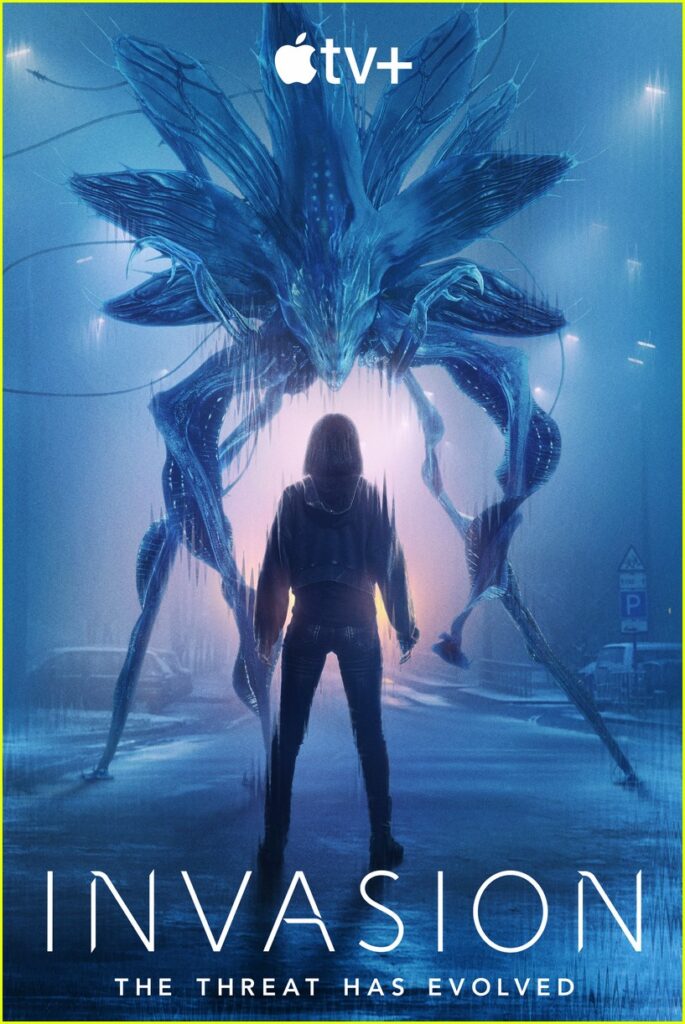
INVASION, SEASON 3

I’ve had mixed feelings about Invasion. Season One showed up in October of 2021 and I found it a slog to get through all 10 episodes. Not enough aliens, too much people freaking out over the Invasion.

Invasion, Season Two showed up in 2023 and the complaints about the first Season were “Tweaked” (I wouldn’t say “fixed) and in general these 10 episodes had more action and suspense.

Season 3 showed up yesterday and based on the first episode, this season is shifting the action in Invasion from defense to offense. The humans are taking on the alien hive mind and changing the momentum of the conflict.

If you’re a fan of alien invasion–especially one ICE can’t handle–you might want to give this 10 episode season a look. GRADE: Incomplete, but trending towards a B+


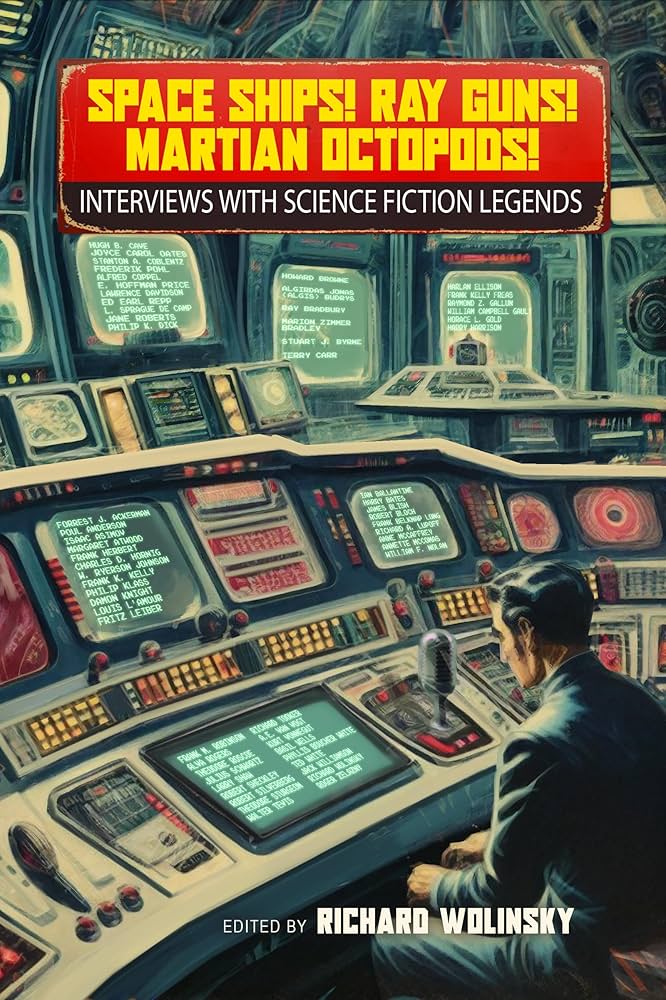
FRIDAY’S FORGOTTEN BOOKS #870: SPACE SHIPS! RAY GUNS! MARTIAN OCTOPODS!: INTERVIEWS WITH SCIENCE FICTION LEGENDS Edited by Richard Wolinsky

Richard Wolinsky co-hosted and produced Probabilities, a radio program with a focus on Science Fiction. Probabilities aired on KPFA in Berkeley, California from 1977 to 1995. Wolinsky has collected radio transcripts of more than 50 legendary SF writers interviewed during that time period and published them in Space Ships! Ray Guns! Martian Octopods!

My favorite interviews in this book are with Harlan Ellison, Philip K. Dick, Ray Bradbury, Isaac Asimov, A. E. van Vogt, Frank M. Robinson, Margaret Atwood, Frederik Pohl, Frank Herbert, and Fritz Leiber.

If you’re a fan of Science Fiction and want to hear candid interviews with some of the best writers of the genre, Space Ships! Ray Guns! Martian Octopods! should be on your Must-Read list! Highly recommended! GRADE: A

TABLE OF CONTENTS:

FORWARD by Richard A. Lupoff — xi

The Probabilities Interviews by Richard Wolinsky — xv

CHAPTER ONE

Space Ships! Ray Guns! Martian Octopods!: Science Fiction in the 1920s — 3

The Cast of the Book (In Order of Appearance) — 3

Birth of a Genre — 4

The Early Pulps — 5

Hugo Gernsback & Amazing Stories — 6

Writers of the Twenties — 11

Jack Williamson — 11

Claire Winger Harris — 12

Victor Rousseau — 12

Otis Adelbert Kline — 13

E. E. “Doc” Smith — 15

The Other Magazines: Argosy & the Bottom Feeders — 15

CHAPTER TWO

The Story of Weird Tales — 17

The Continuing Cast of the Book (In Order of Appearance) — 17

Mad Scientists & Monsters — 17

It Came from Indianapolis — 18

H.P. Lovecraft: A Twentieth-Century Poe — 23

Clark Ashton Smith: The Bard of Auburn — 31

Portraits of the Writers — 32

Robert E. Howard — 32

Seabury Quinn — 32

E. Hoffman Price — 33

Frank Belknap Long — 34

Fritz Leiber — 35

Robert Bloch — 36

CHAPTER THREE

The Years of the Depression: Triumph of the Pulps — 39

The Continuing Cast of the Book (In Order of Appearance– 39

On the Racks in the 1930s — 40

Writing for the Magazines — 41

The Future is Today — 42

Wonder Stories, Charlie Mort & The Gang — 44

Astounding: From Bates to Tremaine — 52

Amazing Stories: Santa Claus Sloane & the Astonishing Ray Palmer — 60

Doc Savage: More Like a Comic Book — 64

Meanwhile, Back at the Ranch…the Authors of the Thirties — 65

Ed Earl Repp –65

Ray Cummings — 66

Otto Binder — 66

Charles Willard Diffin — 67

Laurence Manning — 67

C. L. Moore — 68

Murray Leinster — 68

Fletcher Pratt — 68

Carl Jacobi — 69

Stanley G. Weinbaum — 69

The Hawk Curse Stories — 71

The Gentle Satire of Stanton A. Coblentz — 73

On the Water with Ed Hamilton — 73

Theodore Sturgeon Starts to Write — 74

Books of the Thirties — 75

The Pulp Merry-Go-Round — 76

Is This Any Way to Make a Living? — 79

CHAPTER FOUR

The King of Science Fiction: John W. Campbell & Astounding — 83

The Continuing Cast of the Book (In Order of Appearance) — 83

A Whole New Ball Game — 83

Unknown — Campbell’s Fantasy Magazine — 86

Campbell as Editor — 89

John W Campbell’s Personality — 95

Campbell’s Editorial Policies — 98

Campbell’s Later Years — 99

CHAPTER FIVE

World War II & Beyond: Science Fiction in the Forties — 103

The Continuing Cast of the Book (In Order of Appearance) — 103

World War II & the Science Fiction Pulps — 104

On the Home Front: The Magazines Continue — 106

Writing After the War — 107

Amazing Stories & Fantastic Adventures: Palmer & Browne Hold Down the Fort — 110

Ray Palmer & the Shaver Mystery — 112

Planet Stories: Pulpiest of the Pulps — 114

Thrilling Wonder Stories — 117

Legacy for the Future — 117

Masters of the Genre, Part One: Robert Heinlein — 120

Masters of the Genre: Part Two: Ray Bradbury — 121

Writers of the Forties — 124

Jack Williamson — 124

Robert Bloch — 124

Ed Earl Repp — 124

A. E. van Vogt — 125

Arthur J. Burks — 126

David H. Keller — 127

Henry Kuttner — 127

Leigh Brackett — 128

Theodore Sturgeon — 129

L. Ron Hubbard — 130

It’s a Bird, It’s a Plant, It’s a Comic Book — 132

CHAPTER SIX

The Fifties: The World Rushes in — 137

The Continuing Cast of the Book (In order of Appearance) — 137

Magazines, Magazines & More Magazines — 138

The Rise & Fall of the Magazines — 141

Housebound But Not Limited: Horace Gold & Galaxy — 143

The Magazine of Fantasy and Science Fiction: Anthony Boucher & J. Francis McComas — 150

Jane Roberts Get Published — 155

Amazing & Fantastic: Howard Browne Goes for Class — 156

Successors to Howard Browne: Paul W. Fairman & Cele Goldsmith — 160

Dead on Arrival: Worlds Beyond — 161

Running with the Pack: If: Worlds of Science Fiction — 163

The List Goes on: Infinity & Science Fiction Adventures — 164

Pay Palmer Goes It Alone: Other Worlds & Universe — 167

Imagination & Rogue: The Publishing Empire of William Hamlin — 169

Fantastic Universe & Satellite: Leo Margulies & His Publishing Empire — 172

Doc Lowndes: Editor Wit a Budget — 174

Bottom of the Barrel: Rocket Stories & John Raymond — 175

But Wait, There’s More: Marvel, Cosmos & the Rest — 179

The World of Small Presses — 180

The Hydra Club & the Mitford Writers’ Conference — 181

Science Fiction for Fun & Profit: Writers of the ’50s, Their Ideas, Their Books & Their Stories — 183

Wiliam F. Nolan — 183

Arthur C. Clarke — 184

Philip K. Dick — 185

Harry Harrison — 186

Algis Budrys — 186

Marion Zimmer Bradley — 187

Theodore Sturgeon — 187

Frank M. Robinson — 188

Jack Williamson — 189

“The Covenant” — 190

Jane Roberts — 190

The Rise of the Paperbacks — 191

Bantam & Ballantine — 191

Ace Books — 192

Avon Books — 193

Universal Publishing — 194

Regency Books — 194

Television — 196

Science Fiction Comes of Age: the Hugo Awards — 198

CHAPTER SEVEN

From the Science Fiction League to the Futurians: Fans for All Seasons — 201

The Continuing Cast of the Book (in Order of Appearance) — 201

The Origins of Fandom — 201

War with the Futurians — 203

John Michel — 206

The Futurians Begin Growing Up — 208

Writing About the Futurians — 212

Fandom Outside New York — 213

Let’s Join a Rock & Roll Band ‘Cause the Groups All Live Together — 216

Fandom Goes On — 219

APPENDIX I

Origin Stories: Reading & Writing That Crazy Buck Rogers Stuff — 225

APPENDIX II

List of Interviews — 239

About Richard Wolinsky — 243

About Lawrence Davidson — 244

About Richard A. Lupoff — 245

CLASSIC SOFT ROCK: SUMMER BREEZE [2-CD Set]

After enduring eight 90 degree days this Summer (Normal is five 90 degree days), the Jet Stream finally brought Western NY some pleasant 70 degree days this week. Hopefully, this is a sign of an early Fall.

With Summer winding down, I thought this compilation, Classic Soft Rock: Summer Breeze, from 2006 would be a good way of celebrating the end of Summer. Of course, the lead song is the classic Seals & Crofts “Summer Breeze.” Don’t ask me what makes Chicago’s “Does Anybody Really Know What Time It Is?” a Summer song. The same with “Sara Smile” by Hall & Oates. But I like both songs.

“Cool Change” by Little River Band fits. So does “Even the Nights are Better” by Air Supply. Other than that, this compilation seems more like a group of random songs. Do you remember these songs? Any favorites here? GRADE: B (for breeze)

TRACK LIST:

Seals & CroftsSummer Breeze3:27
Bertie HigginsKey Largo3:19
BreadMake It With You3:11
Chicago (2)Does Anybody Really Know What Time It Is?3:21
Gary WrightDream Weaver4:18
Todd RundgrenHello It’s Me3:41
Daryl Hall & John OatesSara Smile3:10
Rickie Lee JonesChuck E.’s In Love3:27
The Doobie BrothersBlack Water4:19
OrleansStill The One3:56
Linda RonstadtHurt So Bad3:17
Little River BandCool Change4:08
Ambrosia (2)Biggest Part Of Me5:26
Christopher CrossNever Be The Same4:41
America (2)You Can Do Magic3:56
BreadThe Guitar Man3:45
America (2)Tin Man3:27
Michael Murphy*–Wildfire4:49
Chicago (2)25 Or 6 To 44:52
Nicolette LarsonLotta Love3:10
The Doobie BrothersWhat A Fool Believes3:45
Robbie DupreeSteal Away3:31
Ambrosia (2)You’re The Only Woman4:21
Dr. HookSexy Eyes3:00
Exile (7)Kiss You All Over3:29
Air SupplyEven The Nights Are Better3:55
Christopher CrossArthur’s Theme (Best That You Can Do)3:54
John WaiteMissing You4:30
Joshua KadisonBeautiful In My Eyes4:10
Alannah MylesBlack Velvet4:48