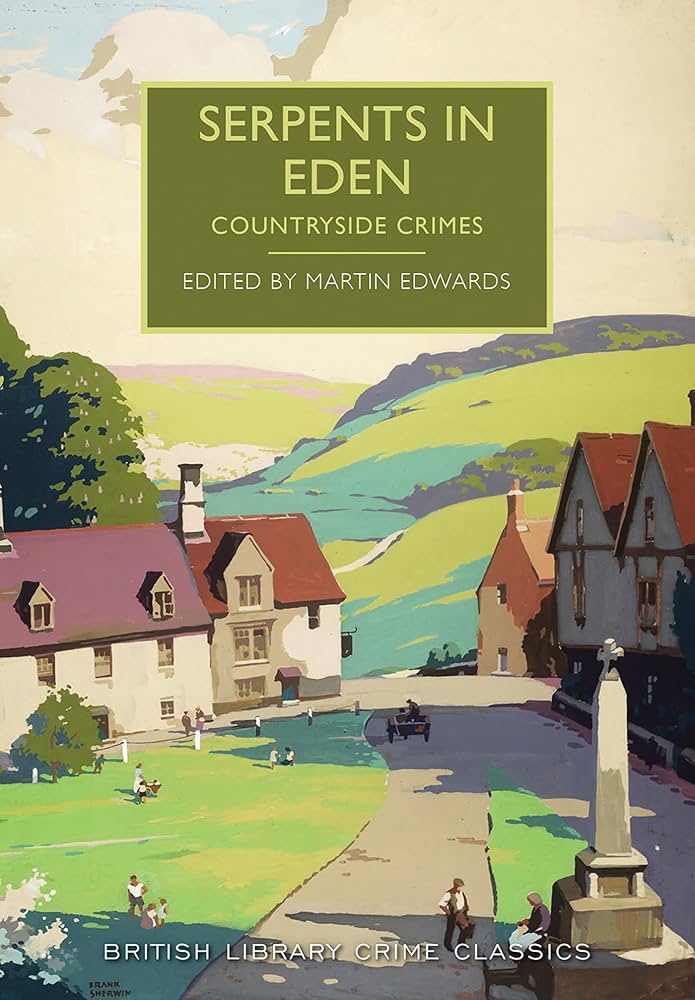
I finally got around to reading this Martin Edwards’ anthology from 2016. In his Introduction, Edwards makes the case that the Golden Age of Murder featured crime in the manor house rather than the alley’s of London. I’ve read over a dozen anthologies edited by Martin Edwards and Serpents in Eden continues his successful pattern of mixing well-known mystery writers with those not-so-well known. And, even when Edwards includes well-known writers like Arthur Conan Doyle and G. K. Chesterton, he chose a non-Sherlock Holmes story by Doyle and a non-Father Brown story by Chesterton.
My favorite story in Serpents in Eden is R. Austin Freeman’s “The Naturalist at Law,” a Dr. John Thorndyke mystery. A body is found with feet sticking out of the water. Who is the victim? Why was he murdered? Who had a motive to kill him? Thorndyke approached the case with logic and cleverness.
The most unusual story in Serpents in Eden is “Inquest” by Lenora Wodehouse. Yes, Lenora Wodehouse is the step-daughter of P. G. Wodehouse. The story was originally published under the pseudonym of “Loel Yeo.” This is the first time “Inquest” has been published under the author’s true name.
If you’re interested in classic Golden Age mystery stories, Serpents in Eden will deliver hours of entertainment for you. GRADE: B+
Table of Contents:
Introduction, vii,
The Black Doctor Arthur Conan Doyle, 1,
Murder By Proxy M. McDonnell Bodkin, 24,
The Fad of the Fisherman G.K. Chesterton, 50,
The Genuine Tabard E.C. Bentley, 73,
The Gylston Slander Herbert Jenkins, 93,
The Long Barrow H.C. Bailey, 119,
The Naturalist at Law R. Austin Freeman, 146
A Proper Mystery Margery Allingham, 181,
Direct Evidence Anthony Berkeley, 190,
Inquest Leonora Wodehouse, 213,
The Scarecrow Ethel Lina White, 234,
Clue in the Mustard Leo Bruce, 252,
Our Pageant Gladys Mitchell, 260,