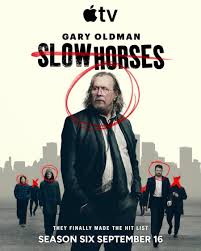
For the first time in Apple TV+’s SLOW HORSES series, two Mick Herron books are being used in Season 6 episodes. Joe Country (2019) and Slough House (2021) show the threats to the spies of Slough House both from evil mercenaries and bureaucratic enemies.
I thought SLOW HORSES, Season 5 was the best of the series. Could Season 6 be better? We’ll see. Apple TV+ releases one of the six episodes per week so it will take until the end of October to judge how good this new series is. GRADE: Incomplete but trending towards an A.
Slough House Reading Order
1.Slow Horses (2010)
2.Dead Lions (2013)
2.5.The List (2015, novella)
3.Real Tigers (2016)
4.Spook Street (2017)
5.London Rules (2018)
5.5.The Marylebone Drop (2018, novella; also known as The Drop)
6.Joe Country (2019)
6.3.The Catch (2020, novella)
6.7.The Last Dead Letter (2020, novella)
7.Slough House (2021)
8.Bad Actors (2022)
8.3.Standing by the Wall (2022, novella collection containing The List, The Marylebone Drop, The Catch, and Standing by the Wall)
Edmund Fawcett, who wrote a book on Liberalism (you can read my review here), gives equal time to Conservatism. Fawcett sees these two political movements as Yin and Yang. They need each other and they also tend to counteract the other’s worst tendencies.
“Liberals, to schematize, embraced capital modernity. Conservatives responded by opposing the liberal embrace. The first liberals welcomed capitalism and critical thought, the twin turbines of a modern change. Liberals favored freer markets, moveable labor, and the self-generative force of money. They embraced religious indifference and social and cultural diversity, as well as the constructive power of disagreement.” (p. 42).
Conservatives resist change and embrace Tradition. “Popular distrust of higher education on the right is accordingly encouraged by conservative politicians. In 2016, Trump mocked universities for taking $200,000 of parents’ money to teach their children ‘zombie studies’ and how ‘to hate our country.’ ” (p. 371) The Right is also wary of experts. It’s painful to watch the ignorance of Rand Paul and Jim Jordan when they try to argue with Dr. Fauci.
If you want to understand the dynamics of Conservatism and where it is likely to go in the years ahead, I highly recommend Conservatism: The Fight for a Tradition (2020). GRADE: A
TABLE OF CONTENTS:
Preface xi
Acknowledgments xv
Part I Conservatism’s Forerunners
1 Critics of Revolution 3
i The Hard Authority of Punishment and Soft Authority of Custom: Maistre and Burke 3
ii The Call of Faith and Beauty: Chateaubriand 18
iii Order in Nations and among Nations: Gentz 25
iv Revolution to Prevent Revolution: Madison 31
v What the Critics Left to Conservatism 36
Part II What Conservatism Is
2 Character, Outlook, and Labelling of Conservatism 41
i Conservatism as a Political Practice 41
ii The Conservative Outlook 48
iii Conservative and Liberal Outlooks Contrasted 50
iv Bonding Spaces for Conservatives with Liberals 54
v The Adaptability of Conservative Ideas 56
vi “Conservatism,” “the Right” and Other Label Troubles 58
vii Dilemmas for Conservatives 62
viii Fighting for a Tradition 65
Part III Conservatism’s First Phase (1830-80): Resisting Liberalism: The Year 1830 71
3 Parties and Politicians: A Right without Authority 72
i Improvisations of the French Right 74
ii The British Right’s Divided Heart: Peel or Disraeli 80
iii German Conservatives without Caricature 88
iv United States: Whigs and Jacksonians; Republicans and Democrats 96
4 Ideas and Thinkers: Turning Reason against Liberalism 108
i Constitutions for Unacceptable Ends: Calhoun 111
ii Reason for the Right Replaces Nostalgia: Stahl 117
iii How Conservatives Should Defend Religion: Lamennais, Ketteler, Newman, Brownson, and Hodge 124
iv Conservatism’s Need for Intellectuals: Coleridge’s Clerisy 137
v Against Liberal Individualism: Stephen, Gierke, and Bradley 141
Part IV Conservatism’s Second Phase (1880-1945): Adaptation and Compromise: The Year 1880 159
5 Parties and Politicians: Authority Recovered and Squandered 160
i The Moderate Right in France’s Third Republic 164
ii British Conservatives Adapt 175
iii The Ambivalence of German Conservatives 186
iv The American Nonexception 194
6 Ideas and Thinkers: Distrust of Democracy and of Public Reason 205
i Defending Capitalism: Mallock, Sumner, and Schumpeter 207
ii Six Ways to Imagine the People: Treitschke, he Bon, Du Camp, Adams, Mencken, and Sorel 221
iii Cultural Decline and Ethical Anomie: Junger and Other Germans, Drieu la Rochelle, the Southern Agrarians, and Eliot 242
iv Funeral Oratory for Liberal Democracy: Schmitt and Maurras 255
Part V Conservatism’s Third Phase (1945-80): Political Command and Intellectual Recovery: The Year 1945 267
7 Parties and Politicians: Recovering Nerve and Rewinning Power 269
i Normality, Pride, and Rage in France: Pinay, de Gaulle, and Poujade 271
ii Tory Wets and Dries in Britain: Macmillan to Thatcher 277
iii Remaking the German Middle Ground: Adenauer and Christian Democracy 282
iv The US Right Divided: Eisenhower-Taft, Rockefeller-Goldwater, Ford-Reagan 288
8 Ideas and Thinkers: Answering Liberal Orthodoxies 295
i Herald of the Hard Right: Powell 297
ii Our Conservative Second Nature: Gehlen 300
iii The Liberal Moderns’ Fall from Grace: Weaver, Voegelin, and MacIntyre 305
iv Winning the US Stage: Kirk, Buckley, and Kristol 315
Part VI Conservatism’s Fourth Phase (1980-The Present): Hyper-Liberalism and the Hard Right: The Year 1980 327
9 Parties and Politicians: Letting in the Hard Right 328
i The Center-Right in the 1980s and 1990s 329
ii The Rise of the Hard Right: The Le Pens, AfD, Brexit, and Trump 339
iii The Theme Music of the Hard Right: Decline, Capture, Enemies, and Victimhood 349
iv What Populism Is and Isn’t 354
10 Ideas and Thinkers: Yes or No to a Hyper-liberal Status Quo 362
i Right-Wing Liberals, Antiglohalists, and Moral-Cultural Conservatives 364
ii The Hard Right in the American Grain: Buchanan, the Paleos, and Dreher 367
iii The New Voices of the Right in Germany and France 374
iv Three Unreconciled Thinkers: Finnis, Scruton, and Sloterdijk 383
v For the Status-Quo: Pragmatism, the Via Media, Anxiety, or “Realism” 406
Coda: Choices for the Right 415
Appendix A Conservative Keywords 419
Appendix B Philosophical Sources of Conservative Thought 424
If you’re a fan of the REACHER series on AMAZON PRIME Video, you will also like NEAGLEY, a spin-off series. All eight episodes are available now.
Frances Neagley (Maria Sten) is a private investigator in Chicago and former military colleague of Jack Reacher (Alan Ritchson) in the Army’s 110th Special Investigations Unit. When Neagley learns that a close friend from her past has been killed in a suspicious subway accident, she delivers vengeance in her own manner just like Reacher would.
I’ve only watched two of the eight episodes, but I’m planning to binge this weekend! GRADE: Incomplete but trending towards a B+
Back in the 20th Century, Rex Stout created a mystery solving duo: Nero Wolfe was a corpulent genius who seldom left his brownstone and his aide, Archie Goodwin, would conduct investigations and bring back clues and evidence that Nero Wolfe would use to solve the mystery. Rex Stout wrote 33 novels and 41 novellas and short stories featuring Nero Wolfe.
Robert Jackson Bennet “borrowed” Rex Stout’s template and added a few “tweaks.” Ana Dolabra is a tiny woman genius who wears a blindfold because she can’t stand overstimulation. Her assistant, Dinios Kol, is a “modified” human who has the ability to remember EVERYTHING. Together, they work together to solve baffling crimes. The previous two Ana and Din mysteries, set on a planet ruled by the Empire and endangered by gigantic leviathans, introduced a complex world. The Tainted Cup and A Drop of Corruption (my review is here) kept me involved and faked out until the final Reveal.
The latest Ana and Din book, A Trade in Blood, explores the feud between two families (shades of Romeoand Juliette) where the beautiful daughter of the leader of one family is killed by the son of the leader of another family. But the crime is mysterious and Din discovers more suspicious deaths.
Ana is convinced the deaths lead to the powerful rulers in the Past and their secret technologies.
If you’re a Nero Wolfe fan, you’ll find these modified mysteries just as challenging as Rex Stout’s work. If you’re a fan of Science Fiction and Mystery mashups, you’ll be delighted with A Trade in Blood. GRADE: A
The Buffalo Bills pulls off a remarkable 36-31 win in Houston last Sunday, but now have a quick turn-around game with the Detroit Lions who won in overtime over the New Orleans Saints.
This Thursday night game is special because it is not only the Home Opener for the Bills, but the first game regular season game in their new stadium. Look for the Bare Naked Ladies to sing the Canadian National Anthem tonight. The Bills are favored by 4 points, but I’m expecting a close game.
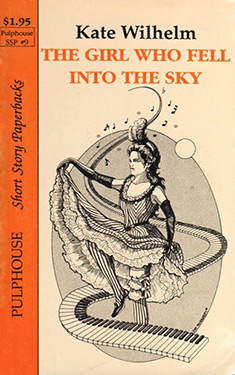
Back in 1991, I bought this Pulphouse Short Story Paperback #9. This slim, 50 page volume featured Kate Wilhelm’s The Girl Who Fell Into the Sky, The story was first published in Asimov’s Science Fiction in October 1986. It went on to win the a Nebula Award for Best Novelette in 1986.
The story is set in the magical wheatfields of Kansas. A researcher named Lorna is engaged in an oral history project. She uncovers the dark, hidden secrets of an old ruined town with a grim Past.
Pulphouse published 60 Pulphouse Short Story Paperbacks. I only own a few. I wish I’d bought more between 1991 and 1992. GRADE: B
The music in BUENA VISTA SOCIAL CLUB is entirely in Spanish with the musical styles of son, danzón, and bolero. All of the live band perform on the stage with the singers and the dancers. The musical opened on Broadway at the Gerald Schoenfeld Theatre in 2025. The touring company Diane and I saw at Shea’s Performing Arts Center over the weekend delivered an outstanding performance.
Clair Stapleton (the Bard of GOOGLE) worked 11 years for GOOGLE–from 2007 to 2019. In that time, she worked for some Good Bosses and some Bad Bosses. Stapleton does a nice job describing what GOOGLE was like during those years as the corporation changed and grew more powerful…and richer.
In 2018, Stapleton helped organize the famous GOOGLE WALKOUT–a protest over the company’s handling (or more accurately, mis-handling) of sexual harassment issues. Over 20,000 employees showed up! Suddenly, Stapleton was a national figure and as a result, her job changed radically. Basically, GOOGLE forced Stapleton out.
From a young, innocent, enthusiastic GOOGLE employee, Stapleton becomes more and more disturbed by the corporate changes over the years and the treatment of GOOGLE employees–especially women. For most of her time at GOOGLE, the corporation was a “boys club” and women were an after thought in chain of command.
I was fascinated by the inside story of GOOGLE. You would be, too. GRADE: A
The Bills have lost 6 straight games to the Houston Texans. So it’s no surprise the Bills are 1 1/2 point underdogs. The Bills have a new Head Coach, Joe Brady. They have a new Defensive Coordinator in Jim Leonhard. They traded with the Chicago Bears to acquire wide receiver D. J. Moore. General Manager Brandon Beane drafted a ton of defensive players. Will this make a difference? We’ll start to find out today.