“I think I might burn all these diaries. What if I died and people get hold of them and read them? Their endless self-obsession, anecdotes, self-exiles, rationalizations. Meanness about others.” (p. 412)
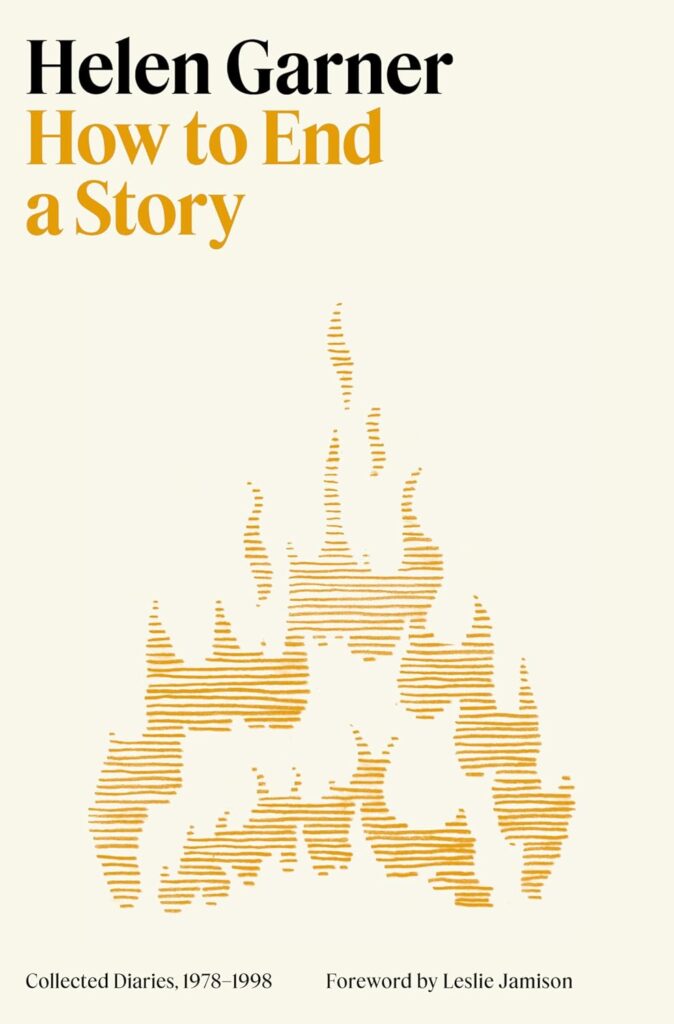
I’m usually not that attracted to reading diaries. But Helen Garner’s How to End a Story: Collected Diaries, 1978-1998 (2025) doesn’t sugar-coat Garner’s feelings and thoughts. Helen Garner is a successful Australian writer who has won the Melbourne Prize for Literature and the Windham Campbell Literature Prize for nonfiction. In 2019, Garner was honored with the Australia Council Award for Lifetime Achievement in Literature. She has written an intimate chronicle of life, love, family, and the frustrations of writing and aging.
Helen Garner’s collected diaries span 20 years, with the first volume beginning in the late 1970s just after the publication of her debut novel Monkey Grip. The second volume begins in 1987 as she embarks on an affair that she knows will be all-consuming (and possibly a huge mistake). The final volume begins in 1995, as she fights to hold on to a marriage that is disintegrating around her. Garner’s husband tells her he wants a “girl friend.” As you might suspect, this does not go well.
I found these diaries of the inner life of a woman in love and a great writer at work compelling reading. Helen Garner doesn’t cover up the messy, painful, dark side of love. She doesn’t hide the sheer force of her anger and her judgements of others. Here’s a couple of her judgements:
“Melvyn Bragg interviewed Saul Bellow on TV about The Dean’s December. Bellow grandly puts shit on sociologists, psychologists and criminologists for their failure to cure what’s wrong with society. …I am disappointed and say little. ‘I think,’ says V. ‘you weren’t very interested in what he was talking about.’ …So I say, ‘I’ll tell you what I think. I think he’s a windbag.” (p. 401)
“Read The Aspern Papers [Henry James] with joy. Its beauty, its drive, its seriousness but its lightness of touch.” (p. 452)
“Janet Malcolm has reviewed The First Stone [1995] in the New Yorker. Exhilarating, a critique by someone who wouldn’t know me from a bar of soap. …Then I felt thrilled to bits: she has read me. …(Also, she used the expression, ‘this extraordinary book’.) (p. 672)
Helen Garner is 82 years old now and writes little. But these diaries capture the energy, excitement, disappointments, heartbreak, and thrills of her active Life. It’s quite a roller-coaster ride! GRADE: A
TABLE OF CONTENTS:
Foreword by Leslie Jamison — ix
Yellow Notebook: Diaries Volume 1 1978-1987 — 1
One Day I’ll Remember This: Diaries Volume II 1987-1995 — 257
How to End a Story: Diaries Volume III 1995-1998 — 559