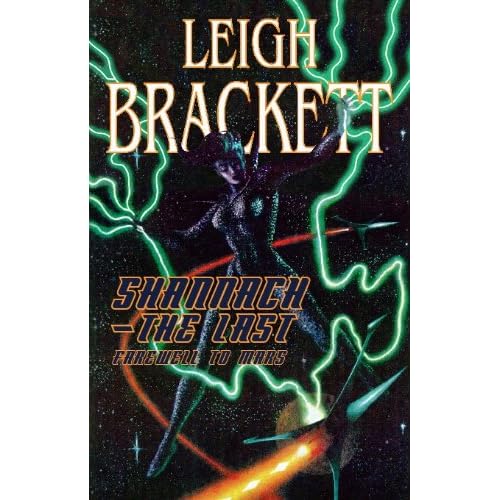
The just published Shannach–The Last Farewell to Mars collects some of Leigh Brackett’s best short fiction. As always, Haffner Press has produced an attractive package featuring a great Frank Kelly Freas cover (there’s plenty of Freas and EMSH artwork from the original magazines included, too). This 572-page tome will give you reading pleasure for hours. If you’re a Leigh Brackett fan, her previous Haffner Press collection, Lorelei of the Red Mist: Planetary Romances, is still available. Order now!
Table of Contents
“Introduction” by Anne McCaffrey
The Truants (Startling Stories Jul ’50)
The Citadel of Lost Ages (Startling Stories Dec ’50)
The Woman from Altair (Startling Stories Jul ’51)
The Shadows (Startling Stories Feb ’52)
The Last Days of Shandakor (Startling Stories Apr ’52)
Shannach—the Last (Planet Stories Nov ’52)
Mars Minus Bisha (Planet Stories Jan ’54)
Runaway (Startling Stories Spr ’54)
The Tweener (The Magazine of Fantasy and Science Fiction Feb ’55)
Last Call from Sector 9G (Planet Stories Sum ’55)
The Queer Ones (Venture Mar ’57)
All the Colors of the Rainbow (Venture Nov ’57)
The Road to Sinharat (Amazing Stories May ’63)
Purple Priestess of the Mad Moon (ss) F&SF Oct ’64)
Come Sing the Moons of Moravenn (The Other Side of Tomorrow, ed. Roger Elwood, 1973)
How Bright the Stars (Flame Tree Planet, ed. Roger Elwood, 1973)
Mommies and Daddies (Crisis, ed. Roger Elwood, 1974)
“Afterword” by Leigh Brackett
 Chris Isaak grew up listen to the songs put out by Memphis’s Sun Records run by Sam Phillips. So many great artists started at Sun Records: Elvis Presley, Johnny Cash, Roy Orbison, Carl Perkins and Jerry Lee Lewis! Now, with Beyond the Sun Isaak pays homage to that classic music with a marvelous collection of Sun Records songs, some familiar and some not. I’ve always liked Chris Isaak, but most people only know him from his early hit, “Wicked Game.” Isaak is a musical chameleon. He can sing and perform in almost any style. That may have hindered his career because Isaak isn’t associated with any particular branch of music. If you love these old songs as much as I do, you’ll be delighted at the interpretations Chris Isaak gives them. And, the sound on this CD is great! Check out the video below. GRADE: A
 I had hoped to like Margin Call more than I did. Margin Call is loosely based on the financial meltdown at Lehman Brothers. Kevin Spacey plays a character who has been part of the firm for 34-years and who acts of the conscience of the company. Stanley Tucci’s character, who works in the Risk Management office, discovers a disturbing trend in the trades the firm is making. But before he can completely prove his case, Tucci is fired. Zachary Quinto plays another analyst who takes Tucci’s findings and tweaks them until the truth becomes evident: the firm is already in jeopardy because of their trades in toxic assets. Simon Baker (The Mentalist) and Demi Moore aren’t given much to do. Jeremy Irons shows up as the CEO who will do ANYTHING to save the firm (and his stock options). There’s a subplot about a pet that I found completely gratuitous and phony. Still, this talented cast makes the most of a weak screenplay to portray the beginning of the financial crisis. GRADE: B
 I once had a film professor who exclaimed in class, “Why would any female want to read Moby Dick? There aren’t any women in the book!” Well, actually, there are. But you get the point. Once the whaling ship goes to sea, the all-male cast of characters dominates the book. Nathaniel Philbrick writes a moving tribute to Moby Dick (his favorite novel). Why Read Moby Dick? is a love letter to readers about this quirky book. I’m amazed Philbrick found someone to publish it. In these times of ebooks and neglect of the classics, Philbrick’s argument for reading Herman Melville’s odd novel is compelling. I know I wanted to drop everything and reread Moby Dick after finishing Philbrick’s insighful book. GRADE: A
 Microstyle is writing effective tweets, headlines, witty dialogue, titles, sound bites, brand names, domain names, slogans, taglines, company mantras, and bullet points. Like SHORT & SWEET. Branding consultant Christopher Johnson explores the techniques of poets, copywriters, brand namers, political speechwriters, and other professional verbal miniaturists to illustrate how to write effective, pithy messages. Microstyle goes beyond style guides like Strunk & White’s classic Elements of Style to focus on saying plenty with just a few words. Not only does Johnson deliver a heavy dose of linguistics, but he applies those principles to famous slogans and advertising campaigns to reveal how they work. I found the whole topic fascinating. GRADE: A
 Rita Dove’s just published collection is raising plenty of eyebrows: no Allen Ginsberg, no Sylvia Plath. We’re getting Rita Dove’s take on American 20th Century poetry and there are more than a few surprises. I haven’t been able to find a copy of the Table of Contents online so I’m just going to list all the poets in this volume so you get a sense of its range. I’m finding plenty of poets new to me to explore! GRADE: A