“At that point, something will crack. The nonsuburan electorate would decide that the system had failed. They would start looking around for a populist ‘strongman’ who would pay homage to their fears. He would be elected to the Oval Office and ultimately roll back the progressive achievements of the previous decades… Media-created pseudo-events, including the occasional brief and bloody war would be manufactured to distract citizens from exploitation by the ‘super rich’ and the resentment which badly educated American feel about having their manners dictated to them by College graduates. This strongman leader will be a disaster for the country and the world.” (p. 1-2)
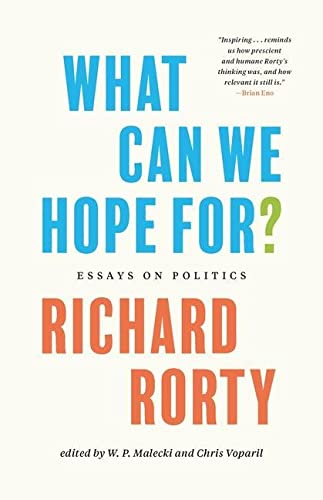
Richard Rorty, the American pragmatist, wrote these words in 1998, essentially predicting Trump. Rorty predicted plenty of upheaval for the U.S. as the political process becomes more twisted by Dark Money, PACs, and culture wars. Is fascism in our future? Rorty thought so.
In the early 2000s, globalization of supply chains was touted as a Good Thing! Now, American mothers can’t get baby formula and a good part of the elements that make our Economy run are stuck on increasingly pricy container ships.
Some of the essays in What Can We Hope For? are slightly dated, but the logic behind Rorty’s arguments remains strong. If you want to read incisive political commentary, I highly recommend What Can We Hope For? What do you think of our current political situation? GRADE: A
Table of Contents:
- Front Matter (pp. i-vi)
- Table of Contents(pp. vii-viii)
- ACKNOWLEDGMENTS (pp. ix-x)
- NOTE ON SOURCES (pp. xi-xvi)
- INTRODUCTION: THE PHILOSOPHER AND HIS COUNTRY (pp. 1-18) W. P. Malecki and Chris Voparil
- Richard Rorty (1931–2007) is best known to the wider public as the philosopher who predicted Trump. During the 2016 presidential election, eerily prescient warnings from his 1998 book, Achieving Our Country, that existing forces of American politics might set the country on a road to fascism, went viral on social media. With neither the left nor the right showing concern for the growing economic disparities in America, he contended in 1998, a large swath of voters already experiencing the negative impact of globalization would become acutely disillusioned with the political establishment.
- PART I POLITICS AND PHILOSOPHY
- 1 WHO ARE WE? MORAL UNIVERSALISM AND ECONOMIC TRIAGE (1996) (pp. 21-33)
- What sort of situation might someone ask the question “Who are we?” It seems most appropriate in the mouth of someone trying to shape her audience into a more coherent community. It is the sort of rhetorical question a party leader might ask at a party rally. In such situations, it means something like “what unifying ideal can we find to make us less like a mob and more like an army, less like people thrown together by accident and more like people who have united to accomplish a task?”“Who are we?” is quite different from the traditional…
- 2 DEMOCRACY AND PHILOSOPHY (2007)2 DEMOCRACY AND PHILOSOPHY (2007) (pp. 34-48)
- Philosophy is a ladder that Western political thinking climbed up, and then shoved aside. Starting in the seventeenth century, philosophy played an important role in clearing the way for the establishment of democratic institutions in the West. It did so by secularizing political thinking—substituting questions about how human beings could lead happier lives for questions about how God’s will might be done. Philosophers suggested that people should just put religious revelation to one side, at least for political purposes, and act as if human beings were on their own—free to shape their own laws and their own institutions.
- 3 DEWEY AND POSNER ON PRAGMATISM AND MORAL PROGRESS (2007) (pp. 49-64)
- I was greatly honored to be asked to give the Dewey Lecture, and very happy to have an occasion to revisit my old university. I entered the so-called Hutchins College in 1946, and left the University of Chicago with an MA in philosophy six years later. Those were the richest and most stimulating years of my intellectual life.When I came to Chicago, John Dewey was still alive, but his influence had waned. In those days, the best students in the University were sitting at the feet of Leo Strauss, who taught them that Plato had been magnificently right.
- 4 RETHINKING DEMOCRACY (1996) (pp. 65-70)
- My friend, the Brazilian philosopher Luiz Eduardo Soares, has nicely summarized widespread doubts about the possibility of achieving a global democratic utopia. As Soares puts it, “Agreement on the possibility and desirability of mutual understanding and the building of peace through communication has been shaken by recent dramatic developments: the revival of long-repressed hatreds and hostilities embedded in ethnic, religious and nationalist identities, the growing prestige of postmodern skepticism, and the fragility of universalistic conceptions.”¹ I agree with Soares that recent developments give reason for being less optimistic about our ability to build a global democratic utopia.
- 5 FIRST PROJECTS, THEN PRINCIPLES (1997) (pp. 71-78)
- When I first went into philosophy, I was looking for first principles. I thought that if you could get the right principles, everything else would fall into place. I was wrong. I gradually realized that it is only when things have already fallen into place that you can figure out what principles you want. Principles are useful for summing up projects, abbreviating decisions already taken and attitudes already assumed. But if you are undecided between alternative projects, you are not going to get much help from contemplating alternative principles.
- PART II AMERICAN POLITICS
- 6 DOES BEING AN AMERICAN GIVE ONE A MORAL IDENTITY? (1998) (pp. 81-89)
- When I use the term “moral identity,” I have in mind our habit of using the name of one or another group to which we belong as a reason for doing or not doing something. This is typically a group to which we are proud to belong, membership in which we would not surrender lightly. We often invoke our sense of solidarity when justifying our actions to others, and sometimes even to ourselves. For example, a devout friend of mine, who refuses to give lectures or attend conferences on Sundays, explains himself by saying, “We Calvinists simply do not do not do that.”
- 7 DEMONIZING THE ACADEMY (1995) (pp. 90-96)
- Among the many convenient targets that Republican politicians and intellectuals have at their disposal, the one at which they direct their fire with perhaps the most delight is the academy. George Will, William Bennett, and other right-wing thinkers never tire of recounting the follies of professors, and of portraying them as naive, duped, and possibly duplicitous. The right has made especially clever and effective use of the widespread suspicion of multiculturalism. A large portion of the American middle class has been made to believe that the universities are under the control of a “political correctness” police.
- 8 AMERICAN UNIVERSITIES AND THE HOPE FOR SOCIAL JUSTICE (2001) (pp. 97-118)
- American universities serve two quite different functions. On the one hand, they are cogs in an efficient mechanism for training and credentialing the American middle class. The schools of medicine, law, engineering, nursing, and the like keep the economy and the society going by supplying skilled professionals and by carrying out research projects. On the other hand, the universities, and particularly the departments of humanities and social sciences, are staging grounds for leftist political activity. They contain the largest concentration of people concerned with social justice—people who agonize over the vast disparity in life-chances between the rich nations and poor nations, and between middle-class Americans and poor Americans.
- 9 THE INTELLECTUALS AND THE POOR (2001) (pp. 119-127)
- In this essay I shall make some distinctions between types of contemporary American intellectuals. I divide them into the liberals, the radicals, libertarian conservatives, and cultural conservatives. I shall use the terms “left” and “leftist” to cover both the radicals and the liberals.American liberal intellectuals have traditionally painted a picture of America as gradually, gloriously improving both its institutions and its customs—making them more just and more beautiful as the decades have gone by. They have then added that these institutions and customs are still much more unjust and ugly than is generally thought, and they have offered suggestions for change.
- 10 CAN AMERICAN EGALITARIANISM SURVIVE A GLOBALIZED ECONOMY? (1998) (pp. 128-137)
- Most of the infrequent contacts between CEOs and philosophy professors take place on airplanes. These contacts take the form of exchanges of life-stories between seatmates, exchanges which mitigate the boredom of flight. Such exchanges provide one of the few ways in which inhabitants of the academy get a sense of what the other is doing.Professors who work in fast-breaking fields like molecular biology or neopragmatist philosophy are always flying off to conferences in places like Sao Paolo, Taipei, or Vienna. Our transoceanic flights are usually in economy class, but we nevertheless have our reward.
- 11 BACK TO CLASS POLITICS (1997) (pp. 138-145)
- If you go to Britain and attend a Labor Party rally, you will probably hear the audience sing “The Red Flag.” That song begins, “The people’s flag is deepest red. It’s shrouded oft our martyred dead. But ere their limbs grew stiff and cold, Their hearts’ blood dyed its every fold.”You may find this song maudlin and melodramatic. But it will remind you of something that many people have forgotten: that the history of the labor unions, in Britain, America, and everywhere else in the world, is a blood-drenched history of violent struggle.
- 12 MAKING THE RICH RICHER (2000) (pp. 146-148)
- A few days ago, I got a nice letter from the Social Security Administration, telling me that I was entitled to some $1,600 a month, but that unfortunately I couldn’t receive it because I was still earning a lot of money. Last week I opened the newspaper to find that the House of Representatives has voted unanimously to have the money sent to me anyway. The Senate and the president, it appears, are quite prepared to approve this change. So in the course of this year I shall get government checks for about $20,000.
- 13 LOOKING BACKWARDS FROM THE YEAR 2096 (1996) (pp. 149-158)
- Our long, hesitant, painful recovery, over the last five decades, from the breakdown of democratic institutions during the Dark Years (2014–2044) has changed our political vocabulary, as well as our sense of the relation between the moral order and the economic order. Just as twentieth-century Americans had trouble imagining how their pre–Civil War ancestors could have stomached slavery, so we at the end of the twenty-first century have trouble imagining how our great-grandparents could have legally permitted a CEO to get twenty times more than her lowest-paid employees.
- PART III GLOBAL POLITICS
- 14 THE UNPREDICTABLE AMERICAN EMPIRE (2003) (pp. 161-177)
- As Michael Ignatieff has pointed out, a country that has military bases around the world, commands military force capable of overwhelming any opponent, displays increasing arrogance in its attitude toward other nations, and sees international agreements and institutions as tools to be manipulated in its own interests, can plausibly be described as an “empire.”¹ Still, the contrast between empire and republic can be misleading. For when we think of the transition from the Roman Republic to the Roman Empire, we think of two quite different things—the imposition of the pax Romana on places far away from the imperial capital, and the increasingly authoritarian internal regime.
- 15 POST-DEMOCRACY ANTI-TERRORISM AND THE NATIONAL SECURITY STATE (2004) (pp. 178-186)
- Europe is coming to grips with the fact that al-Qaida’s opponent is the West, not just the United States. The interior ministers of the European Union nations have been holding meetings to coordinate antiterrorist measures. The outcome of these meetings is likely to determine how many of their civil liberties Europeans will have to sacrifice.We can be grateful that the 2004 attack in Madrid involved only conventional explosives. Within a year or two, suitcase-sized nuclear weapons (crafted in Pakistan or North Korea) may be commercially available.
- 16 HUMILIATION OR SOLIDARITY? THE HOPE FOR A COMMON EUROPEAN FOREIGN POLICY (pp. 187-194)
- President Bush’s national security adviser has said, according to newspaper reports, that Russia will be forgiven, Germany ignored, and France punished. Whether or not Condoleezza Rice actually used those words, they express the attitude of the Bush administration toward nations that failed to join the Iraq War coalition. Disagreement with Washington by foreign governments is being treated by the Bush White House not as honest difference of opinion but as the failure of knaves and fools to accept guidance from the wise, farsighted, and benevolent.
- 17 HALF A MILLION BLUE HELMETS? (1995) (pp. 195-200)
- Visiting Belgrade last year, I asked my hosts, the antiwar intellectuals of the Belgrade Circle, what the United States might do to help with the situation in Bosnia.¹ They replied that there is no big geopolitical problem to be resolved, but simply a lot of very well armed gangs led by very cruel warlords. Each gang is in business for itself, and has a ready supply of cheap, ultramodern weapons at its disposal. Each forms fragile and temporary alliances with other gangs, as needed. None has any higher aims than loot and rape for the private soldiers, and Swiss bank accounts for the warlords themselves.
- 18 A QUEASY AGNOSTICISM (2005) (pp. 201-207)
- Once they could no longer believe in the immortality of the soul, many Westerners substituted the project of improving human life on Earth for that of getting to Heaven. Hoping for the achievement of Enlightenment ideals took the place of yearning to see the face of God. Spiritual life came to center around movements for social change, rather than around prayer or ritual.Most of those who made that switch took for granted that the West would retain its hegemony long enough to bring liberty, equality, and fraternity to the rest of the planet. But that hegemony is over.
- AFTERWORD: INTELLECTUALS AND THE MILLENNIUM (1997) (pp. 208-214)
- The end of a chronological period—whether a century or a millennium—invites speculation about the extent to which progress has occurred during that period: Has humanity as a whole become more grown up, less childish?As soon as one tries to tell a story of the maturation of humanity as a whole, one realizes that the very idea of such a story is relatively new. In Europe, at least, it is not much older than the eighteenth century—the century that witnessed the framing of the first great European narrative of human self-fashioning (Giambattista Vico’s) as well as a growing conviction that human beings might be entirely on their own in the world, bereft of guidance from above.
- NOTES (pp. 215-222)
- INDEX (pp. 223-232)