WEDNESDAY’S SHORT STORIES #45: THE TRUTH AND OTHER STORIES by Stanislaw Lem

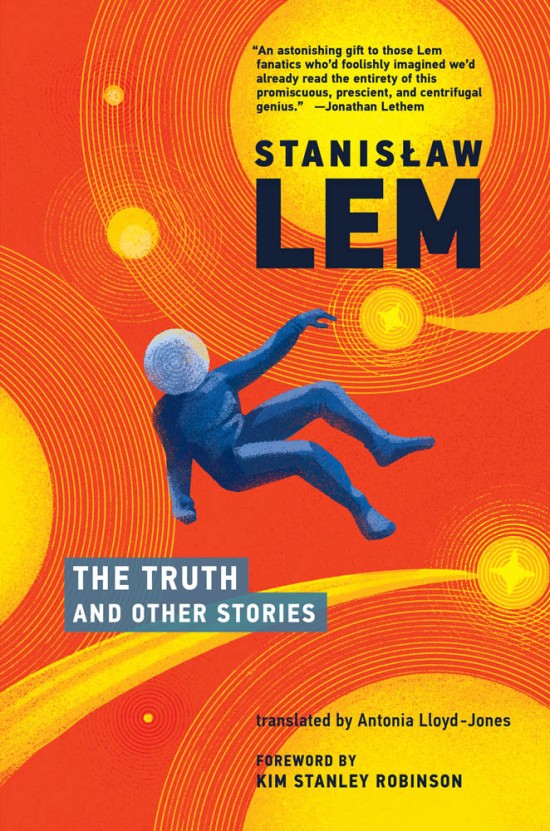
Stanisław Lem, best known in the United States for his novel (and the subsequent movie), Solaris, is the best SF writer ever according to Kim Stanley Robinson in his “Foreword” to The Truth And Other Stories (translated by Antonia Lloyd-Jones). MIT Press is reprinting much of Lem’s work–but they have a long way to go since his collected works in Polish fill 40 volumes.

It’s obvious from Kim Stanley Robinson’s “Foreword” that he’s read a lot of Lem. Over Lem’s long and prolific writing career, several themes keep reappearing. For example, in the excellent title story, “The Truth,” a trio of scientists embark on a risky experiment into the science of plasma. The Government, who is funding their research, knows nothing of this secret test and when disaster strikes–two of the three scientists die–the whole incident is hushed up. The surviving scientist tries to tell the truth about what happened, but he is dismissed as a brain-damaged eccentric.

“One Hundred and Thirty-Seven Seconds” is a story written in 1976. Lem creates a journalist who works the night shift setting up the next day’s newspaper with the aid of a four million dollar IBM mainframe computer. Over time, the journalist realizes the computer is setting up print stories before the events have been reported. This opens the door to speculation that computers operate in a different Time Zone than humans. It also suggests Artificial Intelligence before the term was commonly used. Lem shows what canny predictor he can be.

Some of the stories in The Truth And Other Stories were written in the 1950s which might explain why many of them deal with First Contact will aliens and Green-Eyed Monsters, common themes for that decade. If you’re in the mood for stories that will make you think, I recommend The Truth And Other Stories. GRADE: B+

TABLE OF CONTENTS:

FOREWORD By Kim Stanley Robinson — vii

The Hunt — 1
Rat in the Labyrinth — 23
Invasion from Aldebaran — 61
The Friend — 23
The Invasion — 123
Darkness and Mildew — 161
The Hammer — 183
Lymphater’s Formula — 221
The Journal — 269
The Truth — 272
One Hundred and Thirty-Seven Seconds — 295
An Enigma — 323


THE BAND’S VISIT

The Band’s Visit won 10 Tony Awards including Best Musical. The action begins when the Alexandra Ceremonial Police Orchestra from Egypt gets on the wrong bus in Israel and ends up in a small village of Bet Hatikva instead of the city of Petah Tikv with the Egyptian Embassy where they are scheduled to perform.

The stranded musicians discover the next bus out of town doesn’t arrive until the following morning. The band’s leader, the stiff Tewfiq (played by Sasson Gaby), reluctantly accepts the offer from the beautiful cafe owner Dina (Janet Dacal) to allow his band members to stay the night with the local residents.

The key to The Band’s Visit revolves around the unusual situation of stranded Arabs interacting with isolated Israelis where they find common ground.

I had two problems with The Band’s Visit. I found it hard to decipher some of the dialogue because of the accents the actors used. My second problem centers around the music. Yes, The Band’s Visit won the Tony for Best Musical, but I don’t care for Middle Eastern music so most of these songs didn’t move me. Your mileage may vary. GRADE: C+

Musical Numbers:

  • “Overture” – The Band
  • “Waiting” – The Residents of Bet Hatikva
  • “Welcome to Nowhere” – Dina, Itzik, Papi
  • “It Is What It Is” – Dina
  • “Beat Of Your Heart” – Avrum, Itzik, Simon, Camal
  • “Soraya” – The Band (added for Broadway, replacing “Aziza”)
  • “Omar Sharif” – Dina
  • “Haj-Butrus” – The Band
  • “Papi Hears the Ocean” – Papi
  • “Haled’s Song About Love” – Haled, Papi
  • “The Park” (Dialogue Track) – Dina, Tewfiq
  • “Something Different” – Dina, Tewfiq
  • “Itzik’s Lullaby” – Itzik and Camal (Camal added for Broadway)
  • “Something Different” (Reprise) – Dina
  • “Answer Me” – Telephone Guy and Ensemble
  • “The Concert” – The Band

AMERICANON: AN UNEXPECTED U.S. HISTORY IN THIRTEEN BESTSELLING BOOKS By Jess McHugh

Jess McHugh believes that a thread of United States history extends through a series of best selling books. McHugh starts with The Old Farmer’s Almanac–which has been around for 228 years!–and points out how loyal readers continue to support the book over centuries.

Noah Webster dreamed of uniting his country through language so he dedicated his life to writing spellers and dictionaries that would standardize American language and help indoctrinate immigrants into the American Way.

I first read Benjamin Franklin’s Autobiography in a doctoral seminar on early American Literature. Franklin, an entrepreneur, inventor, politician, and literary figure, focused his book on suggesting ways the reader could become successful. And, the massive sales and continued popularity of the book shows Franklin’s message still resonates.

The McGuffey Readers are still used by parents who homeschool their kids. Catharine Beecher published her best seller, A Treatise on Domestic Economy, in 1841. Beecher’s goal was to show American women how to run a household efficiently and effectively. Emily Post wrote Etiquette in Society, in Business, in Politics and at Home basically updated Beecher’s book and added addition advice on how women should behave. How to Win Friends and Influence People by Dale Carnage is still in print and preaching the message of getting people to like you.

I learned how to cook by using my Mom’s Betty Crocker’s Picture Cook Book. I started with French Toast and moved on to desserts. We still have an updated copy in our Kitchen Library. Everything You Always Wanted to Know About Sex* (*But Were Afraid to Ask) was a book I didn’t read (I preferred The Joy of Sex), but I did see the Woody Allen movie of the same title.

Viewing the development of our country through books that offer advice and norms of behavior produces an very different version of U. S. history. If you’re looking for an off-beat history book, Americanon is well worth a look! How many of these books are you familiar with? GRADE: A

Table of Contents:

Introduction 1

Chapter 1 The Old Farmer’s Almanac (1792-) 11

Chapter 2 Webster’s Speller and Dictionary (1783/1828) 43

Chapter 3 Benjamin Franklin’s Autobiography (1793) 84

Chapter 4 The McGuffey Readers (1836-1837) 114

Chapter 5 A Handbook to American Womanhood 145

Chapter 6 Etiquette in Society, in Business, in Politics and at Home (1922) 178

Chapter 7 How to Win Friends and Influence People (1936) 218

Chapter 8 Betty Crocker’s Picture Cook Book (1950) 252

Chapter 9 Everything You Always Wanted to Know About Sex* (*But Were Afraid to Ask) (1969) 287

Chapter 10 Surviving the Eighties 316

Epilogue 348

Acknowledgments 353

Notes 359

Selected Bibliography 393

Index 405

BUFFALO BILLS VS. JACKSONVILLE JAGUARS

The 6-2 Buffalo Bills face the struggling 1-6 Jacksonville Jaguars today in sunny Florida. The Bills are 14-point favorites. Jaguars QB Trevor Lawrence–Number One in the 2021 NFL Draft–finds himself surrounded by mediocrity and ineptness. Lawrence’s coach, Urban Meyer, has been embroiled in a lap-dancing incident. While Meyer was a very successful College coach, like many College coaches before him, he’s finding the NFL a completely different game. My guess is Urban Meyer will be looking for a new job at the end of the season. How will your favorite NFL team perform today?

ETERNALS

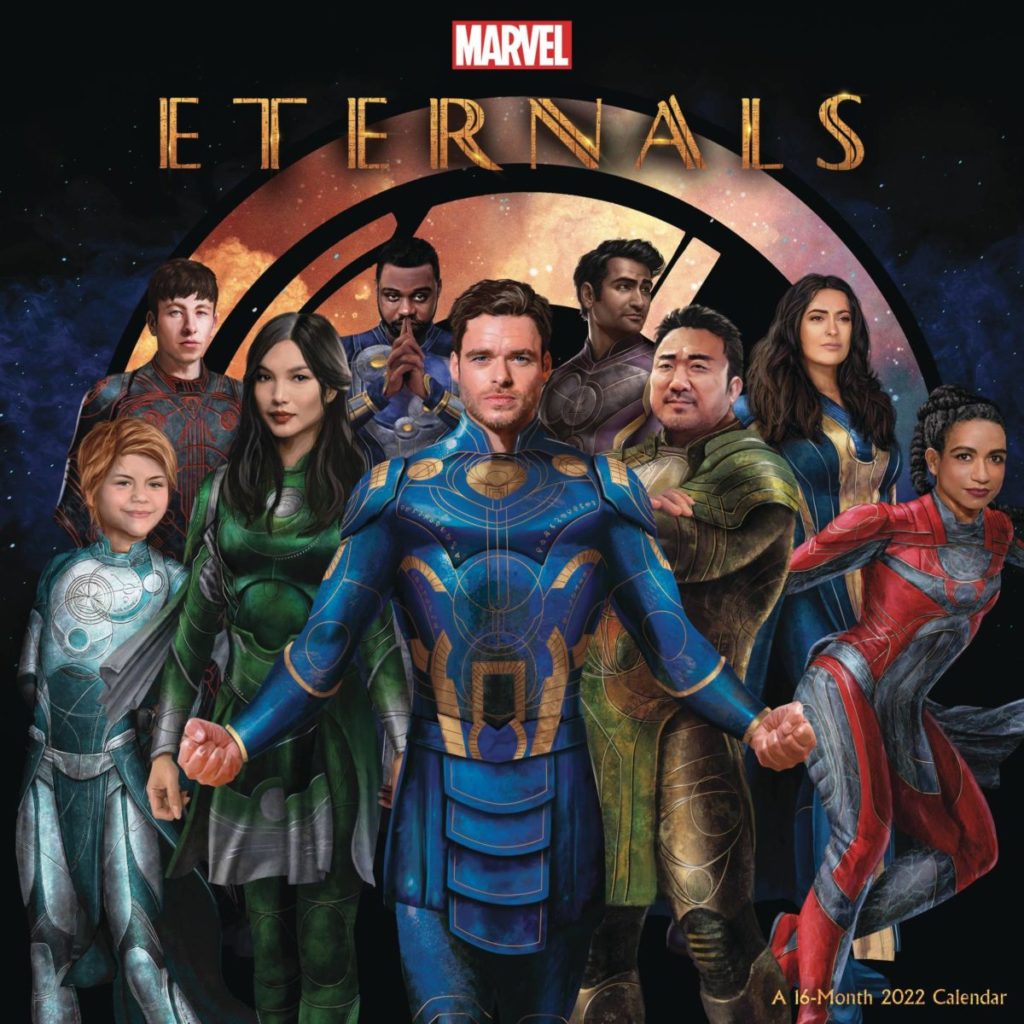
Chloe Zhao’s first movie in the Marvel Cinematic Universe, Eternals, features two historical moments: the first sex scene in a MCU movie (but if you blink, you’ll miss it) and the first MCU homosexual kiss. But, with an ensemble cast of 10 stars, the plot becomes rambling and confusing.

The 10 Eternals–leader Ajak (Salma Hayek), fighter Then (Anglina Jolie), laser eyes warrior Ikaris (Richard Madden), matter-changer Sersi (Gemma Chan), engineer Phastos (Brian Tyree Henry), mind controller Druig (Barry Koeghan), super puncher Gilgamesh (Don Lee), illusions caster Sprite (Lisa McHugh), speedster Makkari (Lauren Ridloff), and finger guns Kingo (Kumail Nanjiani)–are sent to Earth to defend it from the deadly, dinosaur-like, Deviants. After 7000 years, the Eternals feel their mission is over. Wrong!

A massive world-wide earthquake unearths a pack of Deviants from their sleepy snowy slumber. Many battles follow. But the Eternals face more than the Deviants. Their mission to protect Earth is more complicated than they thought.

Eternals represents a new phase in the MCU where the emphasis will be less on action and more on inter-personal conflict. It may take some getting used to… GRADE: B-

FRIDAY’S FORGOTTEN BOOKS #664: THE MAN WHO LOVED THE MIDNIGHT LADY/IN THE STONE HOUSE By Barry N. Malzberg

I’ve been reading Barry N. Malzberg’s short stories and novels since the 1960s. Malzberg’s fiction focuses on paranoia, the Kennedy assassination, and the fluidity of Reality. Stark House collects two of Malzberg’s short story collections, The Man Who Loved the Midnight Lady (1980) and In the Stone House (2000), which covers some of the best of Malzberg’s hundreds of published short stories.

In The Man Who Loved the Midnight Lady, at the end of each story, Malzberg comments on the genesis of the story, the publishing circumstances at the time (sometimes dire), and details surrounding subsequent reprinting of many of the stories.

In addition to excellent stories like “The Man Who Loved the Midnight Lady,” Malzberg includes three stories he wrote with Bill Pronzini. Malzberg and Pronzini also teamed up to write three excellent and underrated novels.

Also impressive is Malzberg’s thoughts on Science Fiction: “The Fifties (essay).” As Malzberg points out, dozens of SF magazines that provided a large market for Science Fiction stories at the start of the decade disappeared by the end of the decade. The market for SF morphed to paperbacks, hardcovers, and competition for sales to the remaining SF magazines in the Sixties.

THE MAN WHO LOVED THE MIDNIGHT LADY/IN THE STONE HOUSE displays Barry N. Malzberg’s unique talents and interests while delivering an adrenaline rush equivalent to a literary zipline thrill ride! GRADE: A

TABLE OF CONTENTS:

THE MAN WHO LOVED THE MIDNIGHT LADY — 7

Introduction — 8

On the air — 9
Here, for just a while — 16
In the stocks — 22
The fifties (essay) — 30
The man who married a beagle — 38
Big Ernie, the royal Russian, and the big trapdoor — 48
Ring, the brass ring, the royal Russian and I — 53
Of ladies’ night out and otherwise — 58
The annual once-a-year bash and circumstance party — 63
The appeal — 70
Yahrzeit — 77
Another burnt-out case / with Bill Pronzini — 80
I’m going through the door — 91
Cornell — 96
On account of darkness / with Bill Pronzini — 99
Impasse — 104
Varieties of technological experience — 111
Varieties of religious experience — 116
Inside out — 121
Line of succession — 126
Reaction-formation — 131
Indigestion — 135
A clone at last / with Bill Pronzini — 142
Backing up — 144
September 1958 — 148
Into the breach — 152
On ‘Revelations’ (essay) — 157
Thirty-six views of his dead majesty — 162
The trials of Sigmund — 178
The man who loved the midnight lady –182

IN THE STONE HOUSE –189

Heavy metal — 190
Turpentine — 203
Quartermain — 213
The Prince of the Steppes — 222
Andante lugubre — 230
Standards & practices — 236
Darwinian facts — 242
Allegro marcato — 253
Something from the seventies — 261
The high purpose — 266
All assassins — 282
Understanding entropy — 289
Ship full of Jews — 293
Amos — 302
Improvident excess — 309
Hitler at Nuremberg — 316
Concerto accademico — 321
The intransigents — 326
Hierartic realignment — 332
The only thing you learn — 343
Police actions — 347
Fugato — 356
Major league Triceratops — 374
In the stone house — 396

AFTERWORD: The Sprawl of Intensity, the Intensity of Sprawl — 422

Acknowledgments — 425

Bibliography — 428

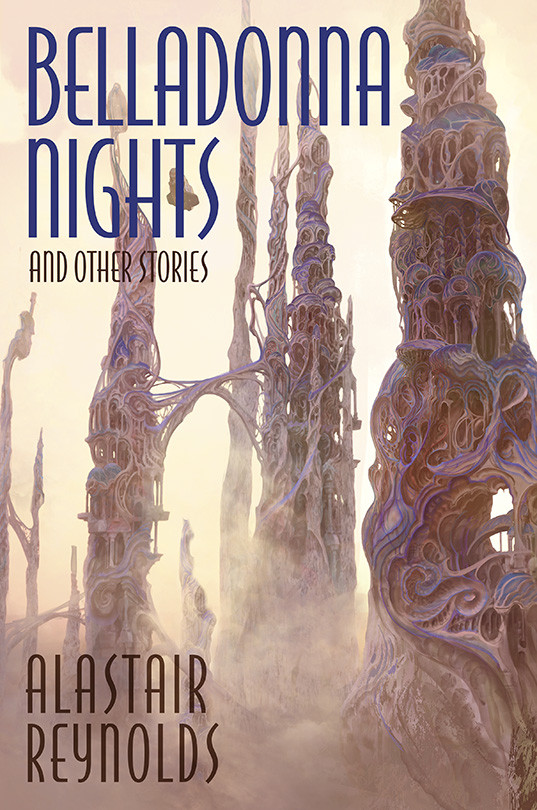
WEDNESDAY’S SHORT STORIES #44: Belladonna Nights and Other Stories By Alastair Reynolds

I’m a big fan of Alastair Reynolds and his space operas. In Belladonna Nights and Other Stories, Reynolds captures the immensity of Space with its isolated, disparate human habitats. “Plague Music” explores the aspects of a future Pandemic. I’ve read Reynolds’ SF novels about Prefect Dreyfus who is a future law enforcer. “Open and Shut” takes Prefect Dreyfus into some very unpleasant corners of the extreme libertarian-democratic Glitter Band culture, where personal freedom collides with necessary limitations, hard choices, and harder punishments. 

My favorite story in Belladonna Nights is “Night Passage,” a grim encounter with alien technology and its unanticipated effects. If you’re looking for well-told tales of the future, I highly recommend Belladonna Nights and Other Stories. They possess that elusive “sense of wonder.” GRADE: A

Table of Contents:

  • Introduction: Winter Did Come
  • Belladonna Nights
  • Different Seas
  • For the Ages
  • Visiting Hours
  • Holdfast
  • The Lobby
  • A Map of Mercury
  • Magic Bone Woman
  • Providence
  • Wrecking Party
  • Sixteen Questions for Kamala Chatterjee
  • Death’s Door
  • A Murmuration
  • Open and Shut
  • Plague Music
  • Night Passage
  • Story Notes

TREE TRIMMING

Diane wanted our trees trimmed and when we saw a crew of Kelley’s Tree Service, she decided it was “a sign.” We watched seven men with chain saws trim our evergreen tree, cut down our dead apple tree, and trim our giant oak tree. A guy in a tractor removed the cut limbs which went straight to their wood chipper.

No ladders for this crew! With the tall trees, they used a cherry picker unit that took them up 30+ feet. Rain was in the forecast, so these guys raced with rain to complete the trimming. Now, everything looks so much better! Are there any home improvements on your list?

FIVE DECEMBERS By James Kestrel

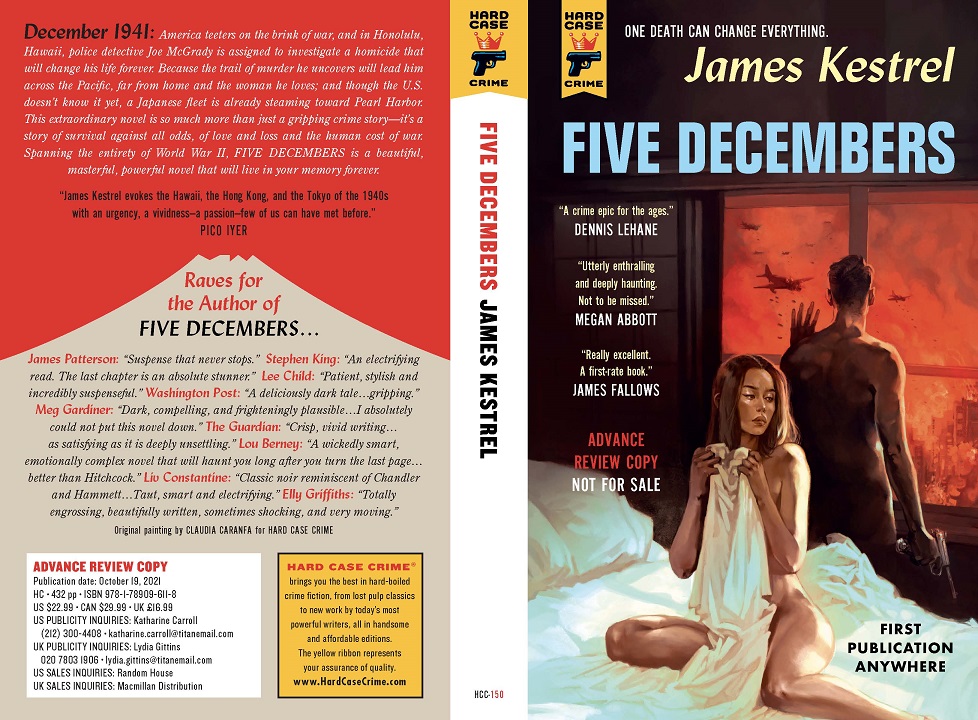
Claudia Caranfa’s cover artwork captures several of the key elements of Five Decembers by James Kestrel (aka, Jonathan Moore). You’ll notice in the background a squadron of bombers dropping death in a world on fire while a man watches with a gun in his hand. Oh, yeah, and the girl.

Five Decembers begins in 1941 with Honolulu police detective Joe McGrady discovering a vivisected body. Minutes later, McGrady engages in a shoot-out with a suspect. McGrady lives, the suspect dies. But the murder morphs into a story that resembles The Odyssey as McGrady is sent to Hong Kong to investigate a lead. As luck would have it, McGrady is framed, beaten, and jailed just as Hong Kong is invaded by the Japanese.

McGrady’s trials and tribulations continue during the war years, but he never gives up his obsession with the case that launched his incredible Asian journey. If you’re in the mood for a high octane crime novel with more twists and turns and surprises than the Le Mans Grand Prix, rev up your engine and read Five Decembers. GRADE: A