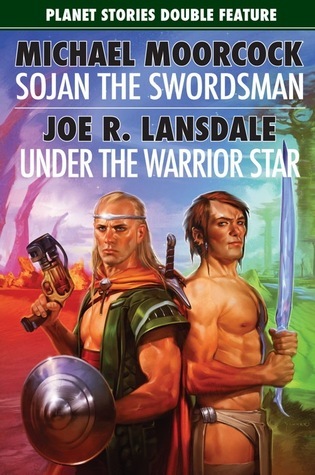
Michael Moorcock and Joe R. Lansdale are two of my favorite writers. And here they are together, in a Planet Stories Press (aka, Paizo Press) “Double Feature” that came out in 2010. Planet Stories Press published about 32 titles between 2007 and 2012, mostly reprints of Robert E. Howard, Henry Kuttner, Leigh Brackett, and C. L. Moore. So this volume is a rarity: two original stories.
Sojan the Swordsman is an amalgam of short stories Michael Moorcock wrote as a teenager starting in 1954. Most of the stories were published in Tarzan Adventures in the 1950s and this is the first U.S. publication that collects all the stories.
Both Moorcock and Lansdale admit Edgar Rice Burroughs profoundly influenced them when they read ERB as kids. Clearly, it’s doubtful that either one of these guys would have been writers without the impact of reading Burroughs in their youth.
“Borrowing” from ERB, Moorcock’s Sojan the Swordsman (aka, Sojan Shieldbearer), is an aspect of the Eternal Champion. Sojan fights with a sword and a pneumatic gun similar in function to the Needle Gun used by Jerry Cornelius. Sojan, once Sir John de Courey until he was killed in combat on Earth and resurrected on Zylor, encounters a world of wonders…and dangers. With a new name, a new identity, and no memory of his past, Sojan contends with the Devil Hunters of Norj and the Hounds of the Cergii.
Joe R. Lansdale’s Under the Warrior Star also features a character who is transported from Earth to an alien planet. A troubled loner, Braxton Booker, gets involved in a secret Government project that sends Brax to another planet called Juna. And, sure enough, there are giants to fight, deadly Mantis creatures to battle, and a beautiful girl to fall in love with.
If you’re a fan of Sword and Planet stories, Sojan the Swordsman and Under the Warrior Star are worth seeking out. GRADE: B