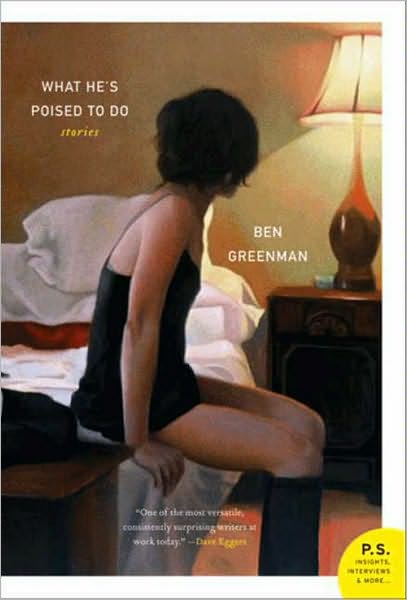
Ben Greenman, an editor at The New Yorker, combines the loneliness and intimacy of men and women in unusual configurations in this short story collection. Greenman tells a story of a woman who marries a jealous farmer who punches her when he believes she’s having an affair with an artist. But, of course, there’s more to the story. There’s also a story of a brother and sister who live in a lunar colony whose father abandons them and returns to Earth. And the businessman who sleeps with women while he’s on the road. He sends his wife postcards after each infidelity. Greenman’s stories are quirky and edgy. This edition includes an interview with Greenman where he discusses his work. Greenman adds a reading list of his favorite books, too. And, I love the cover! GRADE: B
(This completes the July 2010 portion of my Short Story Reading Challenge. I will read and review one short story collection per month in 2010. To find out more about the Short Story Reading Challenge, be sure to click: “http://theshortstorychallenge.blogspot.com/”>Short Story Reading Challenge.
 Director Christopher Nolan channeled Philip K. Dick while making Inception. Leonardo DiCaprio plays a corporate spy whose specialty is “extraction.” That is, DiCaprio’s character enters the dreams of his victim and extracts the secrets he’s been paid to find. However, now DiCaprio is hired to accomplish something much harder than extracting information: inception. That is, planting an idea in the mind of the victim. In order to accomplish this difficult feat, DiCaprio puts together a team and a dangerous strategy to plant an idea deep within the subconscious of the industrialist target. The plan involves a dream within a dream within a dream. This is Philip K. Dick territory with multiple realities that move on different time-lines. I wasn’t confused–Nolan does a masterful job juggling his multiple worlds–but I can see where some movie-goers might get lost in the complexity. Christopher Nolan is the most cerebral of Hollywood directors and it shows in this brilliant movie. GRADE: A


 Agatha Christie published The Third Girl in 1966. Many think the late Christies are inferior books. Others think Christie’s late novels were affected by Christie’s alleged Alzheimer’s. I found The Third Girl uneven, but the solution is clever (Christie stumped me). A young girl shows up at Poirot’s doorstep and says, “I may have committed a murder.” Then, she disappears. Mystery novelist Mrs. Oliver, Christie’s surrogate, shows up and gets bashed on the head. Tonight PBS Masterpiece Mystery broadcasts the TV version of The Third Girl. I’ll be watching.
 Think Xena, Warrior Princess. Or Joan of Arc. That’s the model for The Cahena, a powerful woman ruler who faces a powerful invading army. Carthage has just been sacked and now a 40,000 man army is heading to take her lands, too. Set in the Seventh Century, Cahena is mostly a historical novel told by a Saxon fighter who joins The Cahena’s forces as a strategist. His relationship with The Cahena becomes something more. The battle scenes scintillate with realism. I’ve admired Manly Wade Wellman’s versatility in writing science fiction, fantasy, mysteries, and westerns. Wellman’s Cahena is a first-rate historical novel with plenty of action and suspense. It was published by Doubleday in hardcover in 1986. I’ve never seen a paperback reprint of Cahena.
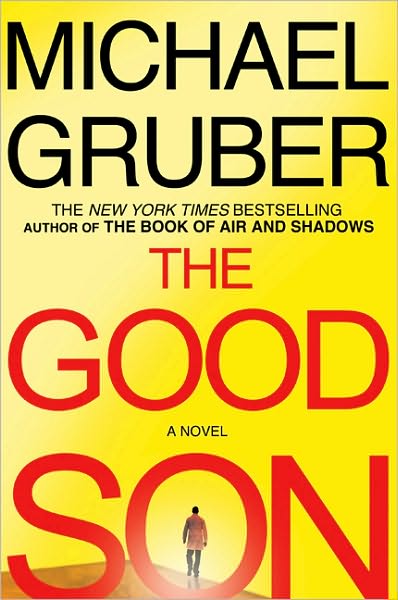 I’ve been impressed by Michael Gruber’s previous novels, Tropic of Night, Valley of Bones, and Night of the Jaguar. The Good Son begins with a peace conference in Pakistan that’s ambushed and the scholarly participants, including their billionaire sponsor, are held hostage. The son of one of the participants, Theo, just happens to be a member of an elite U.S. Army unit. Theo and his father concoct a scheme to get the U.S. military to rescue the hostages. However, the heart of this book is the survival strategies of Theo’s mother, one of the hostages. Sonia, knowing the culture and trained in Jungian analysis, turns herself into an interpreter of dreams of her guards. Her dream interpretations manipulate her captors and change the dynamic of the hostage crisis. Gruber always delivers unusual novels. I enjoyed The Good Son a lot. GRADE: B+