ELECTION DAY 2024


“Bannon was engaged in his typical combination of sycophancy and agitation, alternating praise for the president with lamentations of how Trump was under assault from the press, the FBI, the deep sate and ‘globalists.'” (p. 141)
H. R. McMaster served as Trumps National Security Advisor for 13 months. At War With Ourselves: My Tour of Duty in the Trump White House includes McMaster’s examples of Trump’s wacky decisions, Trump’s weakness for flattery, and Trump’s inability to focus on defending the United States from Putin’s threats.
In a recent episode of FIRING LINE on PBS, Margaret Hoover interviewed H. R. McMaster about his time in the White House. But, my interest was in Hoover’s questions about what a second Trump administration would look like. As you might guess, McMaster fears Trump will fill his administration with sycophants, grifters, and flakes.
If you’re concerned about what Trump will do if he wins, At War With Ourselves: My Tour of Duty in the Trump White House provides a clear blueprint of a dark future. GRADE: A
TABLE OF CONTENTS:
Note to readers — viii
“You’re fired” — 1
“You’re hired” — 17
“Love all, trust a few” — 31
DJT and LBJ — 57
Intrigue, elbows, and separate agendas — 71
A well-oiled machine — really — 83
Deep contradictions — 107
Tightrope — 123
Travels with Trump — 139
Guarding independence of judgment — 163
Winning friends and influencing foes — 179
Knives out — 193
Movement in a resistant element — 211
Contradiction and contention — 227
Asian odyssey (20K miles with Trump) — 245
Weakness is provocative — 271
Allies, authoritarians, and Afghanistan — 291
The last 385 yards — 315
Postscript — 329
Acknowledgments — 335
Notes — 339
Index— 349

The 6-2 Buffalo Bills take on the 2-5 Miami Dolphins with the concussion-prone Tua Tagovailoa risking his health. The Bills are favored by 6½ points. The Dolphins and the Jets were projected to challenge the Buffalo Bills in the AFC East according to the preseason “experts.” Not happening.
What will your favorite NFL team do today?

With our democracy under attack, I decided to reread Isaiah Berlin’s Freedom And Its Betrayal. Back in the early 1950s, Isaiah Berlin delivered a series of six lectures on the six enemies of human liberty. Berlin’s insights are just as true now as when he expressed them over 70 years ago.
Some of the “enemies” on Berlin’s list are a little surprising. You wouldn’t think that Rousseau, who championed freedom–“Man is born free but everywhere is in chains”–would undermine human liberty. But Berlin shows Rousseau’s hatred of elites leads to less freedom, not more.
Hegel presents a different problem. Hegel believed the Universe moved in directions humans could not affect. He believed History determined our fates, not individual choices. Hegel’s theories of the momentum of History, the development of ideas from one generation to another that change the economic, social, and political order in a relentless fashion, diminish human liberty because the State becomes the key instrument of Power and all patterns.
Comte Henri De Saint-Simon “was the greatest of all the prophets of the twentieth century. His writings and his life were confused and even chaotic. He was regraded in his own lifetime as an inspired lunatic.” (p. 105). Saint-Simon believed that the government of societies depended on elites who used a “double morality.” “…elites…understand the technological needs of their time; and that, since the majority of human beings are stupid…what the enlightened elite must do is to practice one morally themselves and feed their flock of human subjects with another.” (p. 107). Sound familiar?
All six of these thinkers tried to improve the human condition, but decided to sacrifice human liberty to do it. Autocratic methods, giving Government more power over citizens, limiting rights, are all strategies promoted by these historical figures who factor in our present politics. If you want to trace the origin of many of the autocratic ideas impacting us today, Freedom And Its Betrayal will lay it all out for you. GRADE: A
TABLE OF CONTENTS:

The Lincoln Lawyer, Season 3 is based on Michael Connelly’s 2013 novel, The Gods of Guilt. This 10-episode series features Manuel Garcia-Rulfo as Mickey Haller, a criminal-defense lawyer and recovering addict. As in the first two seasons, Mickey Haller has plenty of personal problems in addition to his professional problems.
I really like Becki Newton as Lorna Crane, Mickey’s second ex-wife and his legal aide. And, Neve Campbell as Maggie McPherson, Mickey’s first ex-wife and a criminal prosecutor, is a delight!
I’ve only watched the first two episodes of The Lincoln Lawyer, Season 3, but the intensity and plotting will force me to binge on it this weekend. If you like legal thrillers, I recommend The Lincoln Lawyer series, both TV streaming and novels. GRADE: INCOMPLETE, but trending towards a B+


I first read The Final War back in 1969 and In the Pocket in 1971 in their ACE Double formats. At that time, I didn’t know “K.M. O’Donnell” was a pseudonym for Barry N. Malzberg. Malzberg’s pseudonym was derived from the names of Henry Kuttner, C. L. Moore, and their joint pseudonym “Lawrence O’Donnell”.
“Final War”, which appeared in the April 1968 The Magazine of Fantasy & Science Fiction, made the Nebula final ballot and came close to winning that year’s award for Best Novelette. Given the publication date, it’s natural to assume “Final War” is a Vietnam War allegory. But, I think this story is more of a critique of War in general.
“Death to the Keeper,” “Ascension,” and “By Right of Succession” are assassination stories, a subject that comes up frequently in Malzberg’s work.
In the Pocket is a collection of a variety of Malzberg stories. I really liked “The New Rappacini”, where a man resurrects his dead wife. I found “The Falcon and the Falconeer” very odd: it’s about a Nativity play performed on an alien planet.
Malzberg has long been a critic of the SF field and this is evident in “A Question of Slant” where a Science Fiction writer turns to writing pornography because it pays better than SF. I also enjoyed two time travel stories: “July 24, 1970” and “What Time was That?”.
If you’re a Barry N. Malzberg fan, you’ll enjoy this new Stark House omnibus! If you’re looking for entertaining SF stories, they’re here in a very nice volume. GRADE: B (for both)
TABLE OF CONTENTS:
INTRODUCTION By Barry N. Malzberg — 8
The Final War and Other Fantasies
Final War — 10
Death to the Keeper –37
A Triptych — 56
How I Take Their Measure — 61
Oaten — 66
The Ascension — 73
The Major Incitement to Riot — 77
Cop-Out — 82
We’re Coming Through the Window — 90
The Market in Aliens — 93
By Right of Succession — 96
In the Pocket and Other S-F Stories
In the Pocket — 101
Gehenna — 102
Ah, Fair Uranus — 106
Notes Just Prior to the Fall — 111
As Between Generations — 116
The Falcon and the Falconeer — 127
July 24, 1970 — 130
Pacem Est — 140
The New Rappacini — 142
Bat — 147
A Question of Slant — 150
What Time Was That? — 156
A Soulsong to the Sad, Silly, Soaring Sixties — 165
Addendum — 169
The Idea — 173
Bibliography — 177


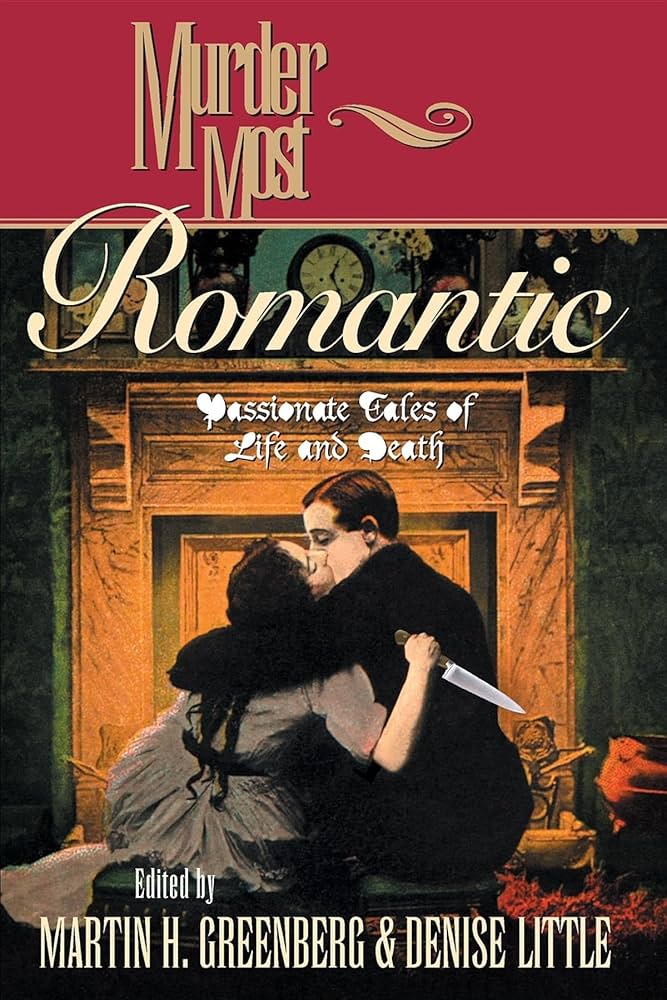
Murder Most Delectable: Savory Tales of Culinary Crimes from 2000 features several clever murders involving food. No anthology on this topic would be complete without a Nero Wolfe story and sure enough, Martin H. Greenberg includes “Poison a la Carte” by Rex Stout. A producer of Broadway plays is murdered at the annual dinner of the Ten for Aristology and Wolfe has to determine which of the dozen beautiful girls who served the food fed arsenic to one of the members.
I also enjoyed “Gored” by Bill Crider where Sheriff Dan Rhodes is confronted by a murder at a Texas BBQ. Edward D. Hoch plays with memory in a boy who doesn’t realize until years later he knows who committed a murder in “Day for a Picnic.” Also clever and funny, Barbara Collins’ “Dead and Breakfast” features a B&B where murder is on the menu.
If you’re looking for an entertaining anthology of murder mysteries and food–and every story includes a recipe!–Murder Most Delectable might just satisfy your hunger. GRADE: B
TABLE OF CONTENTS:
Introduction / John Helfers — vii
The last bottle in the world / Stanley Ellin — 1
Takeout / Joyce Christmas — 23
The case of the shaggy caps / Ruth Rendell — 39
The cassoulet / Walter Satterthwait — 67
Tea for two / M.D. Lake — 81
The second-oldest profession / Linda Grant — 91
Connoisseur / Bill Pronzini — 105
Gored / Bill Crider — 115
Day for a picnic / Edward D. Hoch — 131
Guardian angel / Caroline Benton — 143
The main event / Peter Crowther — 151
The deadly egg / Janwillem van de Wetering — 163
Dead and breakfast / Barbara Collins — 181
Recipe for a happy marriage / Nedra Tyre — 197
Death cup / Joyce Carol Oates — 215
Poison peach / Gillian Linscott — 245
Of course you know that chocolate is a vegetable / Barbara D’Amato — 265
Poison à la carte / Rex Stout — 277
Authors’ Biographies — 333
Copyrights and Permissions — 339

I’ll watch anything with Kate Beckinsale in it no matter how silly. Beckinsale plays CIA agent Avery Graves who has John Wick-type moves and is handy with a number of weapons.
Here’s how The Guardian views Canary Black:
Unaware he’s married to a spy, Beckinsale’s husband is kidnapped – cue the baddies demanding a secret file, fancy action sequences, lots of gunshots and a nice trenchcoat.
Pierre Morel, who oversaw the making of the first Taken film–the action thriller where a former CIA agent, Liam Neeson, pursues Bad Guys who kidnap his teenage daughter–is Director of this movie with the same motif.
Car chases, shootouts, fist-fights, and a great deal of mayhem result when Avery searches for her kidnapped husband David (Rupert Friend) and is required to steal a super secret computer file called “Canary Black” in order to satisfy the kidnappers.
No deep messages, no platitudes, no subtlety…just a fun action movie. GRADE: B

Charlemagne Tha God (aka, Lenard Larry McKelvey), cohost of iHeart Radio’s The Breakfast Club and cohost of the podcast The Brilliant Idiots, uses Get Honest or Die Lying to rant about the dangers of Small Talk. Charlemagne hates small talk which he defines as “a symbol of our lack of authentic communication. Both as individuals and collectively.”
Charlemagne finds most people waste much of their lives engaged in “Blah, Blah, Blah” conversations with no real meaning. And marinated in those small talk conversations are rumors, Fake News, exaggerations, recriminations, snide remarks, and outright lies.
Meaningful conversations today seem to be a rarity. Charlemagne provides dozens of examples of false claims in political conversations–both conservative and liberal. Our culture accepts lies as “normal” and inflated claims–both Good and Bad–as just the way business and commerce is conducted today.
Charlemagne concludes his book with a desperate entreaty: “Now I want to encourage you to make rejecting small talk a priority in your life,” he pleads, “because small talk is killing us as a society.” How do you feel about small talk? GRADE: B
TABLE OF CONTENTS:
Introduction: no more small talk —xi
Small talk to you nice — 1
Put some respek on the tortoise — 9
The pursuit of ignorance — 15
Father time — 23
Evolutionary revolutionary — 29
DEI (not that one) –37
The language of politics is dead — 45
Self-destruction– 51
Tree-hug the block — 57
Astronaut kids, featuring Elliott Connie — 65
Funny or die — 71
The lying game — 77
World wide nigga net — 83
Listen to the elders, bro — 91
Small minds — 101
Death of a nation, featuring Aaron McGruder — 107
Talkin’ loud and sayin’ somethin’ — 119
Same-day service — 127
Ego strength — 135
Headlines — 143
The point! — 151
I hear dead people — 159
Small town, small talk — 167
The gossip files — 175
Time 4 sum aksion — 181
Imposterism — 187
Echo — 197
True intentions — 205
The blessed don’t beef with the miserable — 209
Acknowledgments — 215