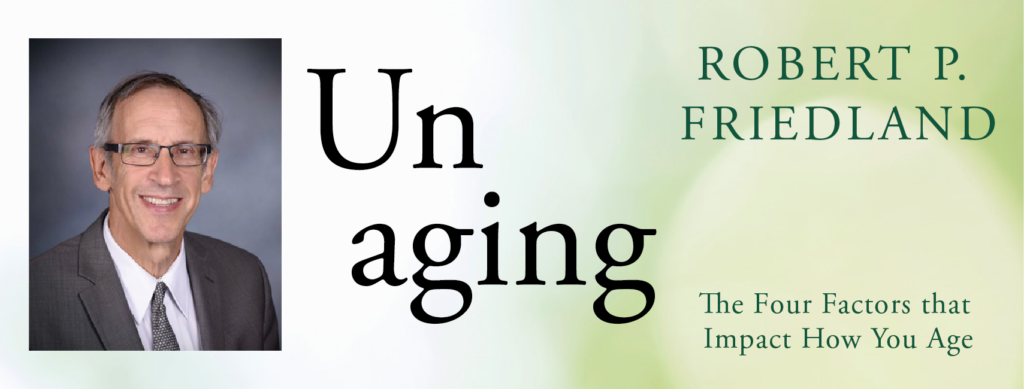
Robert P. Friedland’s Unaging: The Four Factors that Impact How You Age summarizes the latest research on aging and points out how a few life-style changes can have a big effect on our health as we get older.
“I can’t say enough about the importance of fiber in the diet. Eating fiber is critical to human health–and preventing Alzheimer’s disease and dementia– yet few American eat enough brown rice, beans nuts, berries and other sources of fiber. You body needs fiber because of the short-chain fatty acids (SCFAs) made in gut bacteria. These SCFAs are small molecules that influence energy use in the body.” (p. 139-140)
Friedland also supplies some unnerving statistics: about 30-40 percent of people have Alzheimer’s-related dementia at 90 years of age. Women have a higher risk of Alzheimer’s for reasons that are unclear. The average dementia-free 70-year-old man has about a 27% chance of developing dementia during his life-time.
Alzheimer’s and dementia research continues to explore the causes and possible treatments for this condition but research studies have shown that exercise, mental activity, and a high-fiber diet can help delay or prevent these conditions.
I found Robert P. Friedland’s book clearly written with plenty of examples to illustrate the research findings. If you want to improve your quality of Life as you grow older, Unaging provides a workable, practical roadmap for doing so. GRADE: A
TABLE OF CONTENTS:
- Contents
- List of figures and tables — x
- Preface — xi
- PART I Foundations: What Do We Need to Know about Optimal Aging? — 1
- 1 Aging is Not Inevitable, It Is an Opportunity –3
- 2 The Theory of the Multiple Reserve Factors — 25
- 3 The Brain Is Not an organ, It Is the Master — 42
- 4 Memory and Cognition — 60
- 5 The Neurodegenerative Diseases of Aging — 76
- 6 Stroke and Vascular Cognitive Impairment — 107
- 7 Other Dementias — 117
- 8 Our Microbiota and How to Do Gene Therapy in the Kitchen — 126
- 9 The Health of the Body and the Physical Reserve Factor — 148
- 10 Depression, Anxiety, and What Good Is Feeling Bad? — 161
- 11 Genetics Aren’t Everything — 170
- Part II Applications: What Can We Do about the Opportunity of Aging? — 183
- 12 Overview — 185
- 13 Physical Activity — 192
- 14 Whole Body Health — 198
- 15 Mental Activity — 200
- 16 Psychological Measures — 206
- 17 Social Factors — 216
- 18 Dealing with Stress — 219
- 19 Sleep — 222
- 20 Diet — 225
- 21 Microbial Considerations — 246
- 22 Dental Care — 249
- 23 Dealing with Doctors and Drugs — 250
- 24 Hazardous Behaviors — 269
- 25 Toxic Exposures — 274
- PART III Conclusions — 279
- 26 Considerations for Society and the Future of Aging — 281
- 27 Our Attitude and the Opportunity of Aging — 292
- Acknowledgments –298
- Glossary — 300
- References — 303
- Index — 320