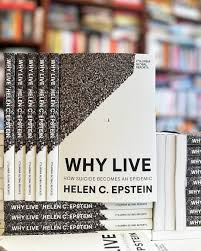
“The hypothesis of this book is that suicide epidemics appear wherever a culture based on mutual aid, respect, and belonging suddenly gives way to world of anonymous market transactions, individualism, and formal institutions, and, at the same time, a demonstrative love culture is weak.” (p.115)
Helen C. Epstein’s short but powerful book presents the latest research into suicide. It’s no secret that the Holidays trigger a spike in suicides. But in Chapter 5, “What is Haunting America’s Veterans”, I learned the vast majority of veterans who had taken their lives were abused as children. In Chapter 3, “Russia’s Traumatic Transition”, I learned that half the men in Russia are alcoholics–and that greatly increases the rate of suicides.
Many people who commit suicide suffer from depression…but only 1% of depression sufferers resort to suicide. “The age-adjusted suicide rate in the U.S. was 14.1 per 100,000 in 2023, after reaching 14.2 per 100,000 in 2022. In 2023, men died by suicide at a rate 3.8 times higher than women, and white males accounted for the majority of suicide deaths. The highest age-specific rates were for those aged 85 and older (22.7 per 100,000) and the lowest were for those aged 10–14 (2.3 per 100,000).”
Why Live documents the attempts to deal with suicide as a societal problem. Epstein suggests capitalism, transactional social interactions, and rigid working conditions that steal all creativity and purpose from a job contribute to the problem of suicide. No job, living in poverty, debts, poor health, and a sense of powerlessness makes suicide an attractive option. GRADE: A
TABLE OF CONTENTS:
INTRODUCTION — 8
CHAPTER ONE: The Inuit: The Highest Suicide Rate in the World — 27
CHAPTER TWO: Sturm und Drang in Micronesia — 42
CHAPTER THREE: Russia’s Traumatic Transition –56
CHAPTER FOUR: Deaths of Despair in America’s Heartland — 74
CHAPTER FIVE: What is Haunting American’s Veterans? — 87
CHAPTER SIX: The Arts of Endurance — 100
CONCLUSION — 115
FURTHER READING — 135
ACKNOWLEGEMENTS — 139
NOTES — 140
I’d rather bump myself off than read one of these books! I hope you don’t suffer any ill effects!
Bob, suicide is a growing problem and I suspect Artificial Intelligence will only spur the rates upward.
We are living in an age where basic human respect and dignity are dismissed by our leaders and so-called influencers. Things have always been stacked against the common man, but today empathy appears to be a dirty word and the shallow “he who dies with the most toys wins” philosophy seems to predominate. There are times when I am amazed that more people do not commit suicide, but then I remember that most folks are kind, decent, and loving and that those traits defy negative attitudes and thoughts. I weep for those we lose and I glory in those we do not. It is up to each of us to continue to shine brighter.
We’ve had several cases in Germany where teenagers killed themselves after “discussions” (chats) of their life with other influencers and/or chatbots.
Some of these cases were connnected to sexual activities, pictures sent over the internet and other strange activities.
I had to shudder after this!
Wolf, young people are vulnerable to suicidal pressures especially with the pervasive–and dangerous–social media pressures. Bullying also causes many suicides by teenagers of both sexes.
Jerry, well said! The mental health of Americans is abysmal. Alcohol and drugs contribute to depression and bi-polar disorders. The sinking Economy only accelerates the societal dysfunction.
Sounds really interesting, but I have to agree with the Cap’n: not for me.
Jeff, I try to understand societal trends…even unpleasant ones.
I wouldn’t read a book like that but I agree with Jerry’s comments.
Maggie, WHY LIVE is short and powerful.
I’ve suffered from bouts of depression but have always found it manageable by things like regular exercise and exposure to good music, film, books and art. And pets, animal companionship can do wonders. Anxiety is more tenacious. I’ve always had a deep abhorrence to suicide and have seen how it can devastate loved ones so that thought has never entered my mind.
Social media and now AI are the readily accepted villains now but I’ve always thought that the real causes are the ones Epstein cites here: transactionsl social interaction, capitalism and the dire straits of modern working conditions. I woud also add consumerism which, in indulged in more than mildly is just soul-stealing. Sounds like an interesting and timely read.
Byron, my father always told me and my siblings “Work is therapy.” I was fortunate to have had a 40 year career teaching at a College where I was pretty much left alone by the incompetent Deans. I enjoyed the classroom interaction. But my final couple of years with more online courses to teach–the source of most of my student problems–made the decision to retire when the College offered senior Professors a Buy-Out…easy.