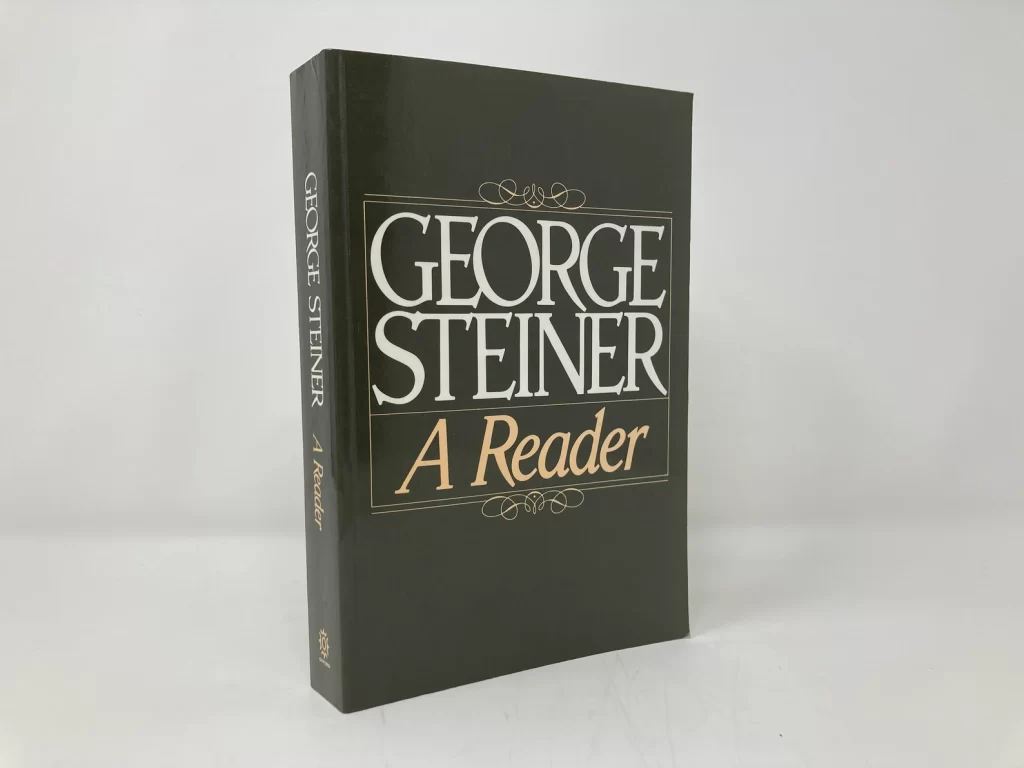
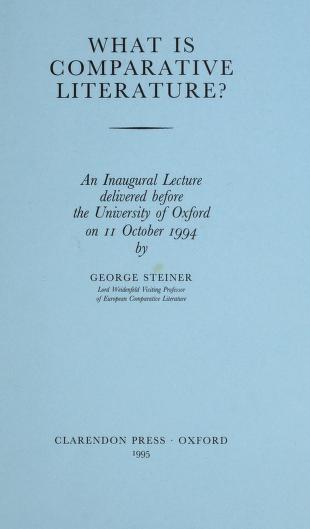
I’ve been reading George Steiner (April 23, 1929 – February 3, 2020) for decades. Steiner has been called Polymath for the range of his essays and reviews. Take WHAT IS COMPARATIVE LITERATURE? (1994) for an example. “At best, the major writer adds graffiti to the walls of the already extant house of language.” (p. 3).
Steiner dabbles in Popular Culture, too. “The episode of avenging execution in Mickey Spillane’s I, The Jury may derive its undeniable power from that ritual slaying of the priest-king…” (p. 13)
Some may argue that Steiner’s topics like Marxism, Levi-Strauss, and Freud are obsolete today. But Steiner’s criticisms are still valid: “The Marxist analysis of history has shown itself to be one-sided and often grossly in violation of evidence.” (p. 10) “Freud sought to banish the archaic shadows of irrationalism, of faith in the supernatural. His promise, like that of Marx, was a promise of light. It has not been fulfilled.” (p. 23).
“Here are three great mythologies devised to explain the history of man, the nature of man, and our future. That of Marx ends in a promise of redemption, that of Freud in a vision of homecoming to death; that of Levi-Strauss in an apocalypse brought on by human evil and human waste.” (p. 37)
Steiner’s critique of the current attitude towards Truth speaks volumes: “Truth…is in fact a complex variable dependent on political social aims. Different classes have different truths.” (p. 54) Or, as the saying goes: “Truth isn’t a solid, it’s a liquid.”
George Steiner: A Reader was published in 1984. Steiner went on to write much more in the following decades but this volume does collect the best of Steiner’s early writings. You’ll find essays where Steiner takes a Deep Dive into Literature, Politics, and Culture. If you’re looking for a brilliant writer with sharp insights into difficult subjects with eloquent writing and unique perceptions, Steiner’s work tackles literary texts and cultural issues with dazzling skill. GRADE: A (for all three books)
TABLE OF CONTENTS:
| Introduction | p. 7 |
| The Critical Act | |
| To Civilize our Gentlemen (1965; from Language and Silence) | p. 25 |
| Marxism and the Literary Critic (1958; from Language and Silence) | p. 37 |
| Georg Lukacs and His Devil’s Pact (1960; from Language and Silence) | p. 54 |
| ‘Critic’/’Reader’ (1979; from New Literary History) | p. 67 |
| Readings | |
| Nineteenth-Century America and Russia (1959; from Tolstoy or Dostoevsky) | p. 101 |
| Homer and Tolstoy (1959; from Tolstoy or Dostoevsky) | p. 109 |
| Tolstoy’s Immanence in the World (1959; from Tolstoy or Dostoevsky) | p. 118 |
| The Final Comparison (1959; from Tolstoy or Dostoevsky) | p. 132 |
| Racine (1961; from The Death of Tragedy) | p. 136 |
| Verse in Tragedy (1961; from The Death of Tragedy) | p. 154 |
| Tragedy and Myth (1961; from The Death of Tragedy) | p. 159 |
| Epilogue (1961; from The Death of Tragedy) | p. 165 |
| Obsessions | |
| A Death of Kings (1968; from Extraterritorial) | p. 171 |
| The Cleric of Treason (1980; from the New Yorker, 8 December) | p. 178 |
| Matters German | |
| The Hollow Miracle (1959; from Language and Silence) | p. 207 |
| A Kind of Survivor (1965; from Language and Silence) | p. 220 |
| Schoenberg’s ‘Moses und Aron’ (1965; from Language and Silence) | p. 234 |
| Postscript (1966; from Language and Silence) | p. 246 |
| Heidegger’s Silence (1980; from Martin Heidegger) | p. 258 |
| Lieber’s Lament (1979; from The Portage to San Cristobal of A.H.) | p. 266 |
| The Defence of A.H. (1979; from The Portage to San Cristobal of A.H.) | p. 272 |
| Language and Culture | |
| The Retreat from the Word (1961; from Language and Silence) | p. 283 |
| Night Words (1965; from Language and Silence) | p. 305 |
| Eros and Idiom (1975; from On Difficulty) | p. 314 |
| The Distribution of Discourse (1978; from On Difficulty) | p. 345 |
| Speech as Translation (1975; from After Babel) | p. 369 |
| Privacies of Speech (1975; from After Babel) | p. 385 |
| Creative Falsehood (1975; from After Babel) | p. 398 |
| Theme and Variations (1975; from After Babel) | p. 410 |
| English Tomorrow (1975; from After Babel) | p. 420 |
| Future Literacies (1971; from In Bluebeard’s Castle) | p. 423 |
| Table of Contents provided by Syndetics. All Rights Reserved. |
NOSTALGIA FOR THE ABSOLUTE (1997) TABLE OF CONTENTS:
The Secular Messiahs — 1
Voyages into the Interior — 12
The Lost Garden — 24
The Little Green Men — 38
Does the Truth Have a Future? — 50
For a minute, i thought, you were talking of Georg Lukacs and my second thought was He lived that long!
Neeru, George Steiner writes about Georg Lukacs–a underrated critic.
“Steiner dabbles in Popular Culture, too. “The episode of avenging execution in Mickey Spillane’s I, The Jury may derive its undeniable power from that ritual slaying of the priest-king…” (p. 13)” —umm, ok. I guess I should read his analysis in proper context.
” . . . that of Levi-Strauss in an apocalypse brought on by human evil and human waste.” I think we’re nearly there.
Fred, those are just some of George Steiner’s penetrating insights. Steiner leaves you with a lot to think about after you’ve read his essays.
This isn’t my cup of tea but I’m in awe of your vast range of interests
Maggie, you and Patti Abbott have said very nice things about my range of interests. I’m just a Curious George!
Fascinating as always, but I’m happy I have no urge to read this, as I have too many other things backed up already.
Jeff, George Steiner’s essays require Deep Thinking and Refection. But, the results pay off in the Long Run. I can only focus that intently a couple times per year. The effort–though rewarding–is very draining.
Never heard of him, but it sounds like he sees Marx and that other commie for the gasbags they are!
Bob, as Steiner concludes:: “The Marxist analysis of history has shown itself to be one-sided and often grossly in violation of evidence.” That pretty much says it all…
Of course, Marx (and the anarchist Proudhon, who was much of the inspiration for Bakunin) were both students of Hegel, who in his political work was a proto-fascist windbag. Alas all systems…and windbags.
Todd, I still puzzle over Hegel’s works. Is his writing fluff…or something profound that I just haven’t grasped yet?
That a Hegelian might suggest both can be true might be an answer to your perplex. But I’ve barely read him, and I should say that while authoritarians have used his work as justifying them, his adherents tend to object to this characterization, usually settling on the notion he was properly seen as a true conservative, and therefore a centrist (since conservatives are by definition Not Radicals and like slow change when any).
Todd, reading Hegel is like trying to figure out a puzzle wrapped in an enigma! Talk about dense writing!
I assume Steiner also realizes the incomplete failure of all systems of analysis (not solely Freudian or Marxist analysis!). Part of why Marx and Freud and others have failed, as they have to large degrees, is losing that thread of accepting challenge to their conclusions. But you can’t build a cult by actually admitting potential error…even when, say, Bakunin was so happy to point out Marx’s.
Good working models are the best we can hope for, in nearly every human endeavor. Pity we are collapsing into the worst non-working models in all too much of the world, now perhaps a bit more than always…with luck, we’ll be able to make some corrections before the Drumpfs of the world kill all the rest of us along with themselves.
Todd, the existing systems of analysis all fail to keep up with Change. That’s why Marx and Freud and others seem so hopelessly lame today. And the pace of Change with Artificial Intelligence will only increase.
Of course, Actual AI, as opposed to what passes for it currently, will make a difference…we’ll see how it goes, unless the AI successfully hides itself.