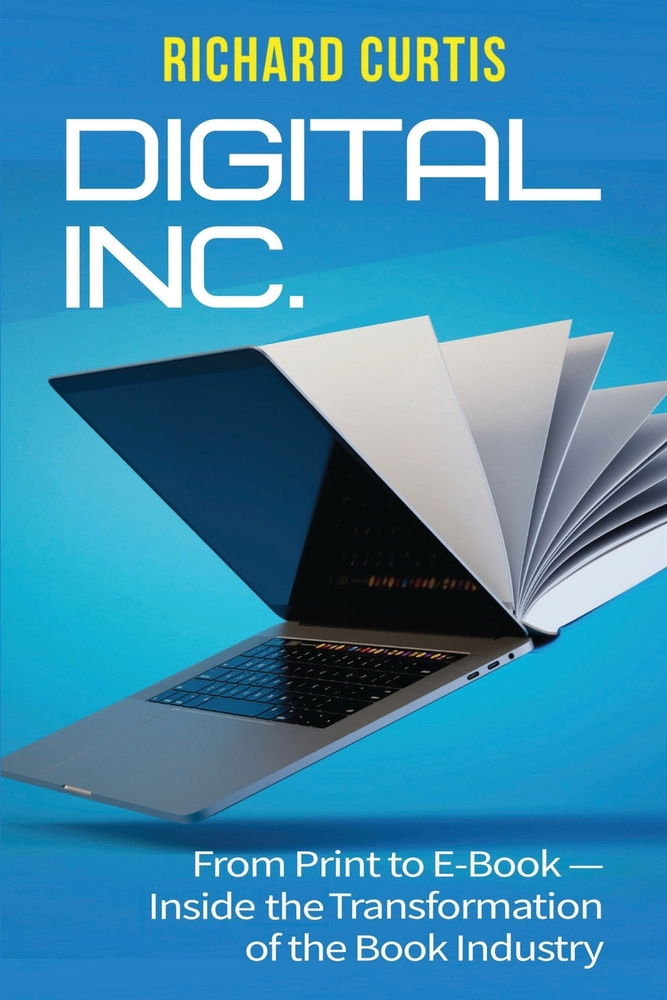
“November 19, 2007 was the birth date of the Kindle, a day I had dreamed of with messianic anticipation since that movement, some twenty-two years earlier, when I flashed on the notion of a portable e-book reader.” (p. 113)
Richard Curtis, famed literary agent, tells the story of the development of e-books (and e-book readers) from the 1980s to today. Plenty of obstacles needed to be overcome. New technologies needed to be invented. And resistance to e-books–from authors to readers–needed to be dealt with.
“Harlan Ellison was not just skeptical about ebooks but downright hostile to them… But one day in 2008, he called. ‘I’m up the creek, We’re broke, and I’m gonna lose my house.’ ” (p. 124). Curtis convinced Ellison to have his books converted to e-books with advances of $1000 per 32 titles. That $32,000 saved Ellison’s house. Sales of the e-books stabilized Ellison’s finances for years.
Curtis shares stories about many of his clients: Dan Simmons, John Norman (of GOR fame), Elizabeth Lynn, Greg Bear, and Richard S. Prather.
“According to Tidbits.com, ‘In 2009 AMAZON controlled 90% of the e-book market.’ Within three years, Forrester Research’s James McQuivery reported, AMAZON had sold 4 million Kindles in its various versions. In 2014 alone, $5 billion worth of Kindles were sold.” (p. 116)
“The digital transformation of the past fifty years has been widely chronicled, but the story of how the book industry went from print to digital has never been adequately told. As a widely admired literary agent and the founder of one of the very first e-book publishers, Richard Curtis was present at the creation. He knows the whole story as only an insider can. Digital Inc. is the first book to recount in detail the conversion of printed books to digital and the struggles of publishers to embrace a new business and creative paradigm after five hundred years of dedication to print on paper. The upheaval changed not just books but the people who write, read, and publish them. Digital Inc. blends a thoroughly researched history with an account of how Curtis and a team of hotshots built their electronic book company from scratch and turned it into a multimillion-dollar company in the vanguard of digital transformation, pioneering innovations that still shape the book business today.
The story of how the e-book morphed from an idle fantasy into an industry-shaping powerhouse is told against the backdrop of decades of tumult in publishing, from the birth of international media conglomerates and the explosion of social media to the rise of Amazon and the emergence of new business models unimaginable a generation ago. In the tradition of Hackers, Fire in the Valley, and Soul of a New Machine, Digital Inc. explores the personal, social, and creative complexities-as well as the daunting technical and economic hurdles-that the progenitors of the e-book revolution had to overcome. Curtis’s wise and witty voice brings to life the colorful characters who revolutionized publishing and continue to transform it in the rapidly-dawning age of AI. For everyone who cares about books and their continuing impact on our culture-from writers and publishing professionals to countless avid readers-Digital Inc. is an absorbing, eye-opening guide to today’s new world of books and how it came to be.” Digital Inc. tells a fascinating story and Curtis’s insights on the state of publishing today are impressive! GRADE: A
TABLE OF CONTENTS:
Introduction — 1
PRELUDE: Appointment in Gaithersburg — 3
- Analog Agent — 13
- The Dream of Portability — 23
- Content and Discontent — 33
- The Age of Miracles — 39
- Turning Point — 48
- Consolidation — 53
- “Puh…” — 69
- The Big Sleep — 85
- Shifting Sands — 93
- Slouching Towards Kindle — 99
- The Road to E-Day — 107
- Game On — 113
- What Were They Thinking? — 131
- Displaced Persons — 143
- The Dark Side — 162
- Indelible Ink — 171
- For Sale — 179
- Rescued — 184
- The End — 196
- Back From the Future — 199
ACKNOWLEGEMENTS — 208
APPENDIX A: STANDARD E-READS PUBLISHING CONTRACT — 209
APPENDIX B: SAMPLE E-READS NEWSLETTER — 220
SOURCE NOTES — 223
INDEX — 244
ABOUT THE AUTHORS — 259
Because she has trouble holding books open these days, Jackie’s reading is now 100% digital. I love books, but e-books are so much more convenient, not to mention cheaper in most cases, that I read mostly digital too. When we first started coming to Florida in the winter 20 years ago, we brought tote bags full of books to read. This year: zero books, just our Kindles and tablets. And yes, I even read on my phone sometimes.
Jeff, you and Jackie are the ideal digital readers that Richard Curtis writes about! I read an e-book occasionally and I have over 400 Kindle books on my iPad waiting to be read. I love that I can adjust the font to LARGE PRINT! Great feature!
Yep—I’ve moved from no ebooks a decade ago to almost 100% ebooks today. As Jeff points out: convenience and ease of transportation being the key factors in my adoption of ebooks. I still have shelves full of books (or “physical media” ans the Redditors put it)—and that will always be the case—but I don’t add much to their number these days.
P.S. the saddest part of that review was learning that a prolific writer like Harlan Ellison was flat broke and about to lose his house in 2008.
Deb, yes, that Harlan Ellison story was a cautionary story. Ellison was a Superstar Science Fiction writer. But in 2008, many of his books were out-of-print and the publishing business was changing. Richard Curtis saved Ellison’s house by finally convincing Ellison that e-books were his only option. And…they were.
Ellison was notoriously difficult to work with when he chose to be, and pompous upper-level execs and editors (with some overlap) at both book publishers and studios Were Not Used To Be Spoken To Thus. Also, some blockages were weighing him down by then, and more health issues. (When I interviewed him for TV GUIDE in 2007 about MASTERS OF SF, the TV series he was an editor and producer for, it was at the end of a 12hr day of other sorts of work, and I sounded pretty tired on the phone. He expressed concern, hoping to cheer me (ca. 2004) with the observation, I didn’t sound like an Old Man like him, hoped I wasn’t too tired. We soldiered on.)
But he certainly did a lot of good work. And helped get other good work into print and on screens (and eventually in print on screens).
I’m less tired now, but that interview, like MASTERS OF SF, was in 2007. “Free, with ads” Tubi will show the (uneven, but usually interesting) MASTERS series to one;https://tubitv.com/series/300000690/masters-of-science-fiction?start=true&tracking=google-feed&utm_source=google-feed
I’m not at all interested in ebooks. Having been a bookseller is one reason, but I still prefer holding a book.
I am weeding out my collection however. Sadly I waited too long to do it. There’s some I couldn’t beat to part with but really couldn’t justify keeping and since they’re books I know Larry would like, they’re in one of his bookcases.
There’s also a small shelf for his dog Blondie’s books. She “enjoys” books. She chewed the back cover and final 4 pages of a David Rosenfelt advance copy I left on the coffee table. She also enjoyed the cover of an SJ Rozan book. I had both signed to her & when Rozan was signing hers, the author next to her signed my book to Blondie and I. She has a small section of a shelf devoted to her collection. She’s also a shoe napper but she only carries them around at night and sleeps with them and doesn’t chew them.
Maggie, I’m weeding my collection, too. And I’m trying not to add to it too much. I’d say over 80% of the books I read in 2025 were Library books.
I read most of my books on my Kindle! However, I have a comfort level of $2.99 for an e-book and will pass up on I want if the price goes too high!
Bob, I’ve succumbed to .99 cent e-books a number of times. That’s why I have 400 unread e-books on my iPad!
Biggest problem I have with e-books is their potential for evanescence…either they are often set up to be available for a limited time, or if they are purchased for one reader or another, what happens when that reader goes to the electronics graveyard?
Of course, water and fire can mess over one’s paper library.
Todd, good points. I have thousands of print books but only a few hundred e-books.