“In 1953 at a Bard College Symposium dinner attended by foreign celebrities, Georges Simenon, who sat at our table, asked Ellison how many novels he had written, and when he learned that there was only one he said, ‘To be a novelist one must produce many novels. Ergo, you are not a novelist.'” (p. v)
Ralph Ellison’s Invisible Man was first published in Horizon magazine in 1947. It was published in hardcover in 1952 and Invisible Man won the U.S. National Book Award for Fiction in 1953, making Ellison the first African-American writer to win the award.
I first read Invisible Man in the mid-1980s. I had multiple paperback and hardcover copies on my shelf for years–every time I saw an inexpensive copy in a used bookstore or Library Book Sale, I bought it. In the 1990s, several of my students would ask me about Invisible Man and I’d reply with: “Would you like a copy?” And, of course, they said, “Yes!” and my shelf grew more empty. I’m down to just a couple of copies of Invisible Man today…right next to my Harlan Ellison books.
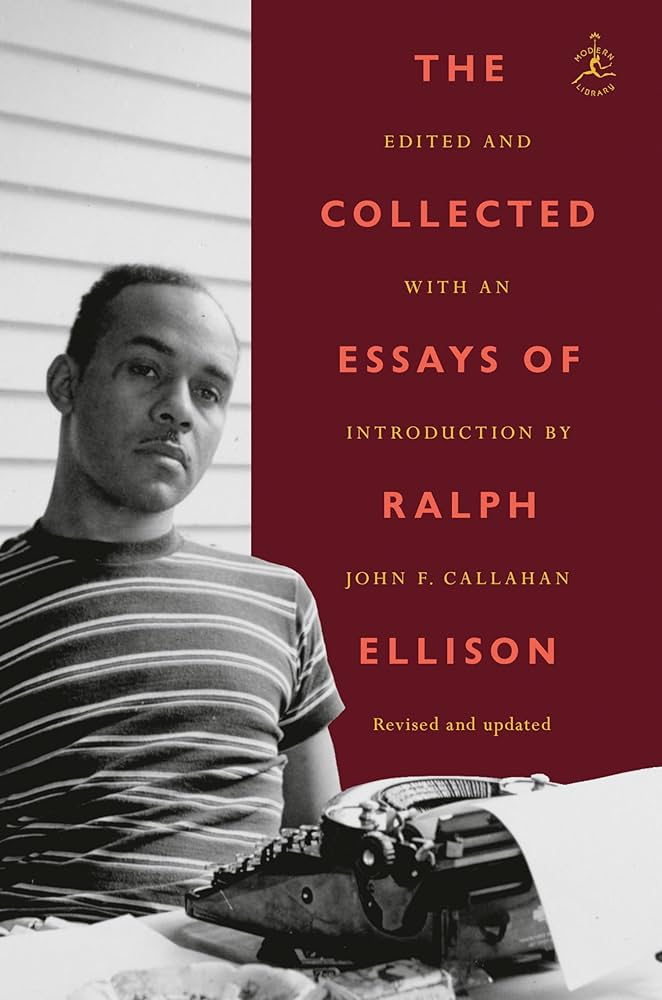
While I would quibble with Simenon’s dismissal of Ralph Ellison as novelist, there’s no doubt Ralph Ellison is a writer. In 1998, the Modern Library ranked Invisible Man 19th on its list of the 100 best English-language novels of the 20th century. Its reputation has only grown over the years. But Ellison also wrote a whole lot of other stuff, most of which appear in THE COLLECTED ESSAYS OF RALPH ELLISON (2024). This 775 page volume includes all of Ellison’s important non-fiction works.
“I practiced writing and studied Joyce, Dostoevsky, Stein, and Hemingway. Especially Hemingway; I read him to learn his sentence structure and how to organized a story.” (p. 181). In “The Art of Fiction: An Interview” (1955) in The Paris Review, Ellison discusses his writing method and the writers who most influenced him.
“Stephen Crane and the Mainstream of American Fiction” also impressed me with Ellison’s analysis of Crane’s writings and their impact on American Fiction then and now. “Remembering Richard Wright” also shows how other Black writers influenced Ellison’s writing.
Ralph Ellison also loved music–at one time considered becoming a musician–so you’ll find essays like “Homage to Duke Ellington on His Birthday,” “Flamenco,” and “Living with Music.” Jazz, Blues, and Big Bands show up in several of Ellison’s essays.
If you’re interesting in an excellent essay writer and writings on fiction, race, national identity, music, and American History, THE COLLECTED ESSAYS OF RALPH ELLISON covers it all. GRADE: A
TABLE OF CONTENTS:
Preface / by Saul Bellow — v
Editor’s note — xiii
Introduction / by John F. Callahan — xv
Postscript to the introduction (2023) / by John F. Callahan — xxvii
February — 3
A congress Jim Crow didn’t attend — 5
Flamenco — 15
“Tell it like it is, baby” — 20
And I have no other identity — 36
Shadow and Act
Introduction: 45
I. The seer and the seen — 55
II. Sound and the mainstream — 193
III. The shadow and the act — 251
Working notes for Invisible Man — 285
A special message to subscribers — 297
Testimony to the Senate Subcommittee on Harlem and Urban America — 307
Indivisible man — 334
James Armistead Lafayette — 368
Commencement address at the College of William and Mary — 372
Address to the Harvard College Alumni, class of 1949 — 378
Haverford statement — 386
Homage to William L. Dawson — 390
Alain Locke — 394
Roscoe Dunee and the American language — 401
The discipline of American humor — 410
Presentation to Bernard Malamud of the Gold Medal for Fiction — 419
Introduction to the Thirtieth-Anniversary Edition of Invisible Man — 424
Going to the Territory
The Little Man at Chehaw Station — 439
On Initiation Rites and Power: Ralph Ellison Speaks at West Point — 465
What These Children Are Like — 483
The Myth of the Flawed White Southerner — 492
If the Twain Shall Meet — 501
What America Would Be Like Without Blacks — 513
Portrait of Inman Page: A Dedication Speech — 520
Going to the Territory — 525
An Extravagance of Laughter — 543
Remembering Richard Wright — 581
Homage to Duke Ellington on His Birthday — 595
The Art of Romare Bearden — 602
Society, Morality, and the Novel — 611
“A Very Stern Discipline” — 637
The Novel as a Function of American Democracy — 661
Perspective of Literature — 670
“A completion of personality” : a talk with Ralph Ellison — 683
On being the target of discrimination — 711
Bearden — 719
Notes for class day talk at Columbia University — 724
Foreword to The Beer Can by the Highway — 727
Address at the Whiting Foundation — 731
Acknowledgements — 737
Index — 739
I think Ellison’s work is less in the Forgotten than Cited But Not Widely Read category, still, but might be falling more into the former category as the decades pile up.
Simenon could’ve just as readily been defining “hack”…
Todd, like Harlan Ellison, Ralph Ellison was constantly hounded by fans and critics who demanded, “When are you going to publish another novel?”
I am interested, as I am a big fan of INVISIBLE MAN, which I read 50+ years ago.
Jeff, Ralph Ellison was always pressured by audiences whenever he would speak to reveal when his next novel would be published. INVISIBLE MAN is iconic and Ellison’s fans wanted more.
I read INVISIBLE MAN but nothing else by him. As usual I am reminded I read better books in my twenties than any time since.
Patti, the wonderful writing of INVISIBLE MAN carries over into Ralph Ellison’s essays. Masterful writing!