Author Archives: george

FRIDAY’S FORGOTTEN BOOKS #703: IRONTOWN BLUES By John Varley

Back in the 1970s, a new Science Fiction writer appeared with wickedly innovative concepts like switching genders and bodies, and Invaders ousting humanity from the Earth. John Varley, with stories like “Overdrawn at the Memory Bank,” “Press Enter,” “The Barbie Murders,” “The Persistence of Vision,” “In the Hall of the Martian Kings,” and “Air Raid,” broke new ground in SF and for a time was my favorite Science Fiction Writer. You can find these excellent stories in The Persistence of Vision (1978) and The Barbie Murders (1980).

Then Varley went to Hollywood and stopped publishing his incredible stories. Here’s what Varley said about his major Hollywood project, Millennium:

“We had the first meeting on Millennium in 1979. I ended up writing it six times. There were four different directors, and each time a new director came in I went over the whole thing with him and rewrote it. Each new director had his own ideas, and sometimes you’d gain something from that, but each time something’s always lost in the process, so that by the time it went in front of the cameras, a lot of the vision was lost.”

When Varley returned to SF writing and publishing in the 1980s, something had changed. The dash and dazzle of Varley’s writing style from the previous decade was gone.

I dutifully read Varley’s 1980s novels, Millennium (1983) and Demon (1984)…but the magic was gone. Over the years, I tried a couple of Varley’s works: Red Thunder (2003) and Red Lightning (2006). Ho-hum.

Irontown Blues (2018) introduces Christopher Bach, a former policeman in one of the largest Lunar cities when the A.I. Lunar Central Computer had a major breakdown. Known as the Big Glitch, the problem turned out to be a larger war than anyone imagined. When order was finally restored, Chris’s life was upended. Now Chris works as a private detective, assisted by his genetically altered dog Sherlock. Varley’s Irontown revisits the hardboiled private eye world with many references to noir books and movies and style.

Chris takes the case of a woman involuntarily infected with an engineered virus. The hunt to track down the biohackers leads Chris to the infamous, dangerous district of Irontown.

All the elements for an entertaining and suspenseful SF novel show up in Irontown, but it all just doesn’t hang together. Something vital is missing. Perhaps this excerpt from LOCUS explains partly what has happened to John Varley:

…So I’m back home now. My final diagnosis, like a slap on the butt as I went out the door, was C.O.P.D. (That’s #5.) It stands for Chronic Obstructive Pulmonary Disease. My guess is that it has something to do (ya think?) with over fifty years of a pack-and-a-half per day smoking habit, only recently terminated. Used to be, it was easy to find me at SF conventions. Just look for the very tall guy whose head was obscured by the smoke that encircled his head like a wreath. That was in the early days. More recently I could usually be found outside the hotel, huddled against the rain, the cold, and the howling gale with a couple other hopeless addicts.

I was sent home with a couple bottles of oxygen and an oxygen concentrator, but it’s possible I won’t need them after a while. Lee and I were enrolled in classes at something called the Transitional Care Clinic, TCC, a really smart and nice service of the Clinic where you record all your vital signs and come in weekly for consultation. I hate trailing the coiled tubing for the O2 all around the house, but so be it. I am able to do most things I always did, and get around in the car. I still tire quickly, but I don’t pant like an overheated hound dog.

Thanks again to all who sent money after my heart attack at the beginning of the year. I can’t tell you how much those dollars have helped take a heavy load off both our minds….

GRAMMY NOMINEES 2003

It’s hard to believe these songs are almost 20 years old. It seems like almost yesterday when I first heard Pink’s “Get The Party Started” that became an anthem for celebration and having fun. Norah Jones’s “Don’t Know Why” gained an audience for her sultry style…which she has since changed. The Dixie Chicks had a hit with their version of Fleetwood Mac’s “Landside,” then faced a radio ban of their music when they criticized President Bush.

John Mayer struck gold with “Your Body Is A Wonderland,” but later got bounced by Taylor Swift. Sherry Crow’s Summer hit, “Soak Up The Sun,” got a lot of airplay on the radio. So did Nelly’s sexy “Hot In Here.”

Do you remember these songs from 2003? Any favorites here? GRADE: B+

TRACK LIST:

1Vanessa CarltonA Thousand Miles3:58
2Norah JonesDon’t Know Why3:05
3NickelbackHow You Remind Me3:43
4Dixie ChicksLandslide3:48
5EminemWithout Me4:23
6NellyHot In Herre3:49
7AshantiFoolish3:47
8Michelle BranchAll You Wanted3:36
9Avril LavigneComplicated4:04
10John MayerYour Body Is A Wonderland4:06
11Sheryl CrowSoak Up The Sun3:18
12P!NKGet The Party Started3:11
13Britney SpearsOverprotected3:19
14Craig David7 Days3:55
15StingFragile4:21
16James Taylor (2)October Road3:56
17Bowling For SoupGirl All The Bad Guys Want3:17
18Dave Matthews BandWhere Are You Going3:51
19*NSYNCGirlfriend3:59

WEDNESDAY’S SHORT STORIES #84: CHARLIE MARTZ AND OTHER STORIES By Elmore Leonard

“More than anyone, you’ll see Hemingway’s influence in Elmore’s early prose. When my father was just staring he told me he would put a blank piece of paper of the page of a Hemingway story and rewrite the scene his way. It how he learned to write.” (p. vii).

Peter Leonard, Elmore Leonard’s son, relates stories about his father’s work ethic as he struggled to become a writer: “While my father was writing the stories in this volume he worked at Campbell-Ewald, an advertising agency, writing Chevrolet ads. For almost a decade he got up at 5:00 A.M. and wrote two pages of fiction before he went to work. His rule: he couldn’t turn the water on for coffee, until he wrote a page.” (p. viii)

Elmore Leonard died in 2013 and this collection of Leonard’s unpublished stories, published in 2015, includes both crime stories and western stories–the two genres Leonard excelled in. The title story, “Charlie Martz,” features a showdown between Martz, an overworked sheriff, and a gunman from his past who wants to kill him. “Siesta in Paloverde” concerns another Martz confrontation with another unsavory character who wants to shoot Martz dead. My favorite story in Charlie Martz and Other Stories is “Evenings Away From Home” from 1959. The narrator is an ad executive assigned to work with a flamboyant photographer. The photographer attracts a beautiful airline stewardess and talks her into modeling for him on this assignment. Of course, the atmosphere is sexually charged and Leonard navigates the crisis moments with flare…and a couple of surprises.

Sure, these unpublished stories don’t have the polish Elmore Leonard gained later in his career. But even a mediocre Leonard story is better than many writers’ best stories. Are you an Elmore Leonard fan? Do you have a favorite novel or story of his? GRADE: B

TABLE OF CONTENTS:

Elmore Leonard; foreword by Peter Leonard — vii

One, horizontal — 1
Charlie Martz — 19
Siesta in Paloverde — 33
Time of terror — 47
A happy, lighthearted people — 67
Arma virumque cano — 81
Confession — 91
Evenings away from home — 109
For something to do — 125
The Italian cut — 141
The only good Syrian foot soldier is a dead one — 155
The line rider — 171
The trespassers — 183
The bull ring at Blisston — 203
Rebel on the run — 219

STAR TREK: STRANGE NEW WORLDS [Parmount+]

The death of Nichelle Nichols, who played the iconic Nyota Uhura in the original Star Trek series, comes at a time when the Star Trek franchise is looking backwards to prequel to the series Nichols starred in. Star Trek: Strange New Worlds is the 11th Star Trek series and was launched in 2022 as part of Alex Kurtzman’s expanded Star Trek Universe. A spin-off from Star Trek: Discovery, it follows Captain Christopher Pike and the crew of the starship USS Enterprise as they explore new worlds throughout the galaxy during the decade before Star Trek: The Original Series.

Anson MountEthan Peck, and Rebecca Romijn respectively star as Pike, Spock, and Number One, all characters from The Original Series.  I especially like Celia Rose Gooding as a young cadet Nyota Uhura. This 10 episode series captures much of the Sense of Wonder of the original Star Trek series. Yes, some of the episodes are better than others. But, all in all, I enjoyed this series and can’t wait for Season Two. Are you a Star Trek fan? GRADE: B+

DISASTER MON AMOUR: OUR LOVE AFFAIR WITH CATASTROPHE, SO LONG AS IT IS HAPPENING TO SOMEONE ELSE By David Thomson

It’s a bit ironic that David Thomson started writing Disaster Mon Amour just before the Covid-19 Pandemic hit the U.S. in 2020. Thomson starts his book on disaster movies with an analysis of San Andreas (2015), but as the Pandemic progresses, Thomson focuses more on The Road (2009) and Cormac McCarthy’s novel of the same name which won a Pulitzer Prize. McCarthy’s book details the bleak journey of a father and his son after a catastrophic event that destroys pretty much everything.

Thomson makes some odd detours into a discussion of Laurel and Hardy movies and his obsession with Rachel Maddow. He’s on firmer ground when he sticks with films like The Birds, The Grapes of Wrath, and Heaven’s Gate.

If you’re a fan of movies of all types, David Thomson always provides intelligent and witty commentary. Do you have a favorite disaster movie? GRADE: B

Table of Contents:

Overture for Two Staircases 1

In San Andreas 15

Vag 35

File Under “End of the World” 41

In Aberfan 67

Onlookerism 79

All the News 91

Pandemia Pandemonium 105

Missteps in the Dark 121

Across the Street 133

The Numbers 143

Our Road 155

“Fuck Off, Disaster!” 169

Necessity 181

The Table 187

Acknowledgments 199

Index 203

A PORTRAIT OF THE SCIENTIST AS A YOUNG WOMAN By Lindy Elkins-Tanton

There’s a shortage of women in the sciences and reading A Portrait of the Scientist As a Young Woman gives you some clues why that is. Lindy Elkins-Tanton is a smart, unrelenting woman. But when she was going to school, Lindy received very little encouragement to pursue her interest in science.

But everything changed in 1982 when physicist and Nobel Prize winner Hans Bethe visited Ithaca High School and Lindy heard him speak. Bethe lit a fire in Lindy and she applied to MIT (although the teacher who wrote a recommendation for her assured Lindy she would not get in).

Lindy was accepted to MIT but struggled in her early years. Many of the male students looked down on female students (and, sadly, so did some of the professors). Lindy graduated from MIT but then decided to try a business path. She got married and had a child. But the marriage didn’t work out and Lindy decided to return to MIT to get her PhD. More struggles. Her mother and father had mental problems. Her favorite brother, Tom, dies in an accident with a drunk driver.

Each step Lindy took in her career came with hurtles. Sexual harassment, conflict, doubts about her ability were just some of the problems Lindy had to overcome. Then, Lindy found out a male counterpart–with less experience and less education–was being paid much more than she was!

Reading about Lindy’s struggles both saddened me and inspired me because no matter what obstacle Lindy faced, she found a way to overcome it. I highly recommend A Portrait of the Scientist As a Young Woman. Today, Lindy is in charge of a NASA mission to send a probe to the massive asteroid Psyche. Living well is the best revenge. GRADE: A

Table of Contents:

Prologue: Creating a Mission to Space 1

1 All I Had Were Questions 5

2 In Fragments 26

3 Being Relentless 52

4 The Search for Meaning 68

5 Every Endeavor Is a Human Endeavor 92

6 Past Is Prologue 131

7 The Kinds of Things a Person Can Want 147

8 Expanding Courage 163

9 Change Begins with a Question 187

10 On Not Being a Hero 201

11 Every Day, a Brick 216

12 At the End of the Marathon, a Sprint 245

Acknowledgments 259

OUR LADY OF MYSTERIOUS AILMENTS By T. L. Huchu

Our Lady of Mysterious Ailments is the second book in the Edinburgh Nights series. You can read my review of the first book, Library of the Dead, here. These books are narrated by Ropa Moyo who has the ability to speak with ghosts. She’s a struggling teenager in Edinburgh, Scotland who supports her aging grandmother and younger sister by delivering messages to and from ghosts.

Because of the events in Library of the Dead, Ropa becomes the intern in Magic to Sir Callander, Edinburgh’s most powerful magician. But, since the internship doesn’t pay any money, Ropa takes on a case at the magical hospital Our Lady of Mysterious Ailments. Two students are in mysterious comas and Ropa is hired to find how how that happened…and how to reverse their conditions.

So, basically, Our Lady of Mysterious Ailments is a detective novel as Ropa and her friends follow the clues and use their magical powers to discover a secret society of Monks and users of Dark Magic.

Our Lady of Mysterious Ailments is perfect for Summer Reading. I suspect the target market is the Young Adult market, but I enjoyed the twisty plot and off-beat characters, too. GRADE: B

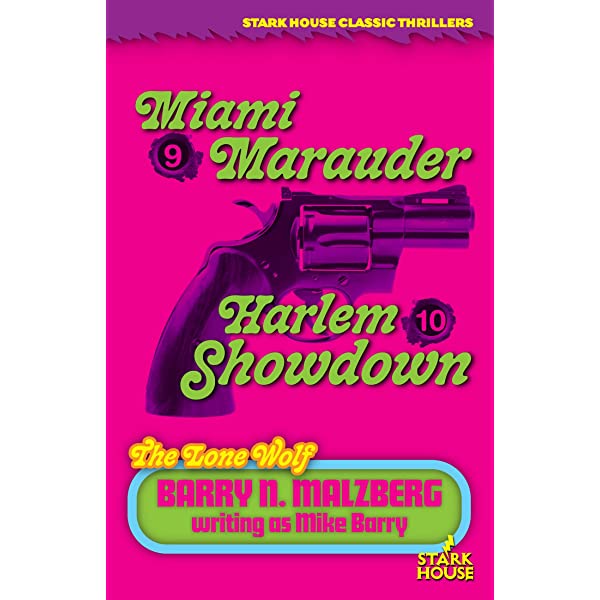
FRIDAY’S FORGOTTEN BOOKS #702: HAVANA HIT/CHICAGO SLAUGHTER By Mike Barry (aka, Barry N. Malzberg)

Burt Wulff, Barry N. Malzberg’s agent of vengeance on the drug trade, extends his violent damage in Havana Hit and Chicago Slaughter. Wulff, obsessed with avenging the death of his fiancé by targeting the operations of the drug cartels, travels from city to city as an agent of destruction.

Yes, Wulff’s attempts at exterminating the drug gangs resemble Whack-A-Mole. As Wulff’s brand of carnage captures many of the elements of the 1970s: corrupt politics, sluggish economy, and increasing number of Americans turning to drugs to deal with Nixonian Reality.

Havana Hit continues the Wulff’s violent adventures from Desert Stalker. Martin Wulff is flying out of Las Vegas on route to NYC with a valise full of heroin worth over a million dollars. Somehow this heroin was removed from the NYPD evidence room and got into the hands of organized drug traffickers. And during his last escapade in Vegas, Wulff went on a killing spree and blew up a hotel casino to get it back. No TSA and drug-sniffing dogs back in 1974!

The plane Wulff is on is hijacked and forced to land in Cuba. Taken into custody by a Cuba official named Delgado, Wulff’s valise is seized and he is sent to be executed. Delgado plans to keep the uncut heroin, sell it, and leave Cuba to live it up. But of course Wulff escapes and sets out to get the valise back again. 

With a little help from a cowardly American helicopter pilot, Wulff kills Delgado along with scores of other people and destroys the headquarters building. But the valise of heroin isn’t there. Delgado turned it over to DiStasio, who is the head of Cuban Intelligence. DiStasio has the same plan as Delgado had, take the heroin and get out of Cuba.  More mayhem results! GRADE: B

In his Afterward to Chicago Slaughter, Barry N. Malzberg writes about hitting his stride in this book, the sixth in the series (with 8 novels to go in The Lone Wolf series): “It was stern and flagrant impetus as Chicago Slaughter burned on, as Nixon flailed at the release of the tapes, as Goldwater and several grim accounting Republican Senators trudged upstairs to deliver Tchaikovsky the news.” (p. 227)

Chicago Slaughter takes The Lone Wolf series to a whole new level of corruption with Wulff dealing with the Mob and dirty cops…debasement caused by the drug trade. Malzberg creates a world slipping into double-dealing, decay, and festering immorality. And Wulff’s strategy–burn it all down–doesn’t seem so strange. Don’t miss this one! GRADE: A

SUPERFLY: 50TH ANNIVERSARY By Curtis Mayfield

In July of 1972, Curtis Mayfield’s soundtrack to the movie Superfly became a landmark in exposing the threat of drugs to the Black Community. A year after Marvin Gaye’s What’s Goin’ On, Mayfield’s songs on Superfly showed how the impact of heroin, cocaine, and the rampant abuse of other drugs resulted in significant deadly repercussions on Inner City residents.

Marc Myers of the Wall Street Journal recently wrote about this iconic album:

In December 1971, Curtis Mayfield was movin’ on up. After 10 years of writing and recording hits for the Impressions, such as “Keep on Pushing,” “People Get Ready” and “We’re a Winner,” the lead singer caught a big break. He was approached backstage after a solo concert at New York’s Philharmonic Hall by a screenwriter and film producer who invited him to write and record the soundtrack for a feature film called “Superfly.”

Jetting home to Chicago the next day, Mayfield leafed through the script about a Harlem drug dealer’s struggle to quit the business and sketched out several songs. But when Mayfield saw the film’s rushes a short time later, he recounted in Peter Burns’s 2003 biography, the movie had become a “cocaine infomercial.” Rather than quit, he wrote lyrics that exposed what the film ignored—the punishing impact of drugs on black inner-city neighborhoods and families.

When Mayfield’s “Superfly” soundtrack was released 50 years ago, in July 1972, a month before the film’s debut, the music was smarter and more sophisticated than the movie itself. The record spent four weeks at No. 1 on Billboard’s album chart, sold a half-million copies in two months and was inducted into the Grammy Hall of Fame in 1998, a year before Mayfield’s death. It also inspired soul albums to address the deterioration of black urban life. The record’s sales were remarkable given that “Superfly” played like a public-service ad. For the soundtrack, Mayfield had created a series of soft-funk hope songs designed to counter the movie’s glamorization of cocaine and the playboy lifestyle of dealers.

The album arrived at a pivotal moment in black music. It came out two years after Mayfield’s first solo album, “Curtis” (1970)—a socially conscious record that predated Marvin Gaye’s “What’s Going On” and Gil Scott-Heron’s “Pieces of a Man” (both 1971). In turn, “Superfly” set the tone for message albums by artists such as Stevie Wonder, Lou Bond and Sam Dees.

As for black film, the so-called blaxploitation genre had just emerged in Hollywood with the success of Melvin Van Peebles’s “Sweet Sweetback’s Baadasssss Song” and Gordon Parks’s “Shaft” in 1971. Both featured black leading actors and casts taking on police corruption and, in the case of “Shaft,” organized crime’s grip on black communities.

Growing up in Chicago, Mayfield had witnessed the corrosive effects of drug and alcohol addiction and thought “Superfly” required a fresh approach to lyric writing. “General statements [in songs] are all very well,” Mayfield told British journalist Roger St. Pierre in 1972, “but [if you] fit the statement into a personal context which the listener can place himself into, you have something with much more impact.” 

Shot on location and directed by Gordon Parks Jr. , son of the “Shaft” director, “Superfly” provides a fascinating pigeon’s-eye view of a crumbling New York on the cusp of recession. While the film today sags under the weight of wooden acting, clichéd dialogue and stereotypes, Mayfield’s songs and cooing falsetto remain exceptional.

The record’s orchestral drama was created by Johnny Pate, a leading Chicago jazz-soul producer and arranger who had worked with Mayfield and the Impressions since 1963 and gave their hits and albums a brassy urgency.

“Superfly” opens with organ chords, a restless conga and wailing electric guitar on “Little Child Runnin’ Wild.” Mayfield’s lyrics address the demand side of the drug epidemic: “Broken home / Father gone / Mama tired / So he’s all alone . . . Don’t care what nobody say / I got to take the pain away / It’s getting worser day by day / And all my life has been this way.” 

The supply side comes next on “Pusherman,” and features Joseph “Lucky” Scott’s funky electric bass line, which captures the dealer’s seductive personality: “Want some coke? Have some weed / You know me, I’m your friend / Your main boy, thick and thin / I’m your pusherman.”

Supply and demand collide on the third track, “Freddie’s Dead.” The hit song features a catchy bass riff with a flute on top, strings and fuzz guitar—all reminiscent of Isaac Hayes’s “Theme From Shaft”: “Everybody’s misused him / Ripped him up and abused him / Another junkie plan / Pushin’ dope for the man.”

“Eddie You Should Know Better” chastises the dealer’s partner, who doesn’t want to quit: “Must be something that’s freezin’ his mind / That has made him, through greed, so very blind / And I don’t think he’s gonna make it this time.”

Musically, “No Thing on Me (Cocaine Song)” is reminiscent of Gaye’s “Mercy Mercy Me”—a lush, upbeat recap, with the lead character finally free of dealing: “I’m so glad I’ve got my own / So glad that I can see / My life’s a natural high.”

The album ends with the track “Superfly,” which hammers home why a dealer is a predator, not a patron: “This cat of the slum / Had a mind, wasn’t dumb / But a weakness was shown / ’Cause his hustle was wrong.”

Despite its inability to eliminate the drug culture, “Superfly” is one of the finest expressions of social-realist messaging in a soul soundtrack. In the years that followed, the album became a model for dozens of blaxploitation film scores, yet none of them could top Mayfield’s sincerity, empathy or success.

Mr. Myers is the author of “Rock Concert: An Oral History as Told by the Artists, Backstage Insiders and Fans Who Were There” (Grove Press).

I was very moved the first time I heard “Freddie’s Dead” on the radio in 1972. Curtis Mayfield’s music was ground-breaking for the early Seventies. But, 50 years later, we’re still battling the destruction drug abuse inflicts on our society. And more Freddies are dead. GRADE: A

TRACK LIST:

Little Child Runnin’ Wild5:15
Pusherman4:50
Freddie’s Dead5:08
Junkie Chase (Instrumental)1:52
Give Me Your Love (Love Song)4:15
Eddie You Should Know Better2:14
No Thing On Me (Cocaine Song)4:52
Think (Instrumental)3:44
Superfly3:51

WENESDAY’S SHORT STORIES #83: MIXED BAG By Matthew Hughes

I’ve been reading Matthew Hughes’s delightful Jack Vance Dying Earth pastiches for over 20 years. Hughes created a number of characters like Luff Imbry, a master thief who can steal just about anything to generate the funds that allow him to indulge in his obsession for exquisite food. Imbry’s adventures in “Arboghasz Dal Xander Rides Again” display his cleverness and cognitive skills. It’s my favorite story in Mixed Bag (2022), Matthew Hughes’s latest Print on Demand volume available on AMAZON (there’s also an e-book).

Other Old Earth stories in Mixed Bag include “The Friends of Masquelayne the Incomparable” that features a battle of wizards. I enjoyed “Hapthorn’s Last Case” where a mystery is solved while Reality is being transformed. Erm Kaslo, Hughes’s Sam Spade of the Future, plies his investigative skills in “Thunderstone” and “The BiColor Spiral.”

Mixed Bag delivers plenty of thrills, sly humor, and detection. Perfect Summer Reading! GRADE: B+

TABLE OF CONTENTS:

Introduction — v

  1. The Friends of Masquelayne the Incomparable — 1

2. The Gift of Gabby — 33

3. Thunderstone — 49

4. Mean Mr. Mustard — 73

5. Loser — 80

6. Greeves and the Evening Star — 102

7. The Prevaricator — 133

8. Hapthorn’s Last Case — 152

9. The Bicolor Spiral — 184

10. Arboghasz Dal Xander Rides Again — 213

11. Awakening — 250