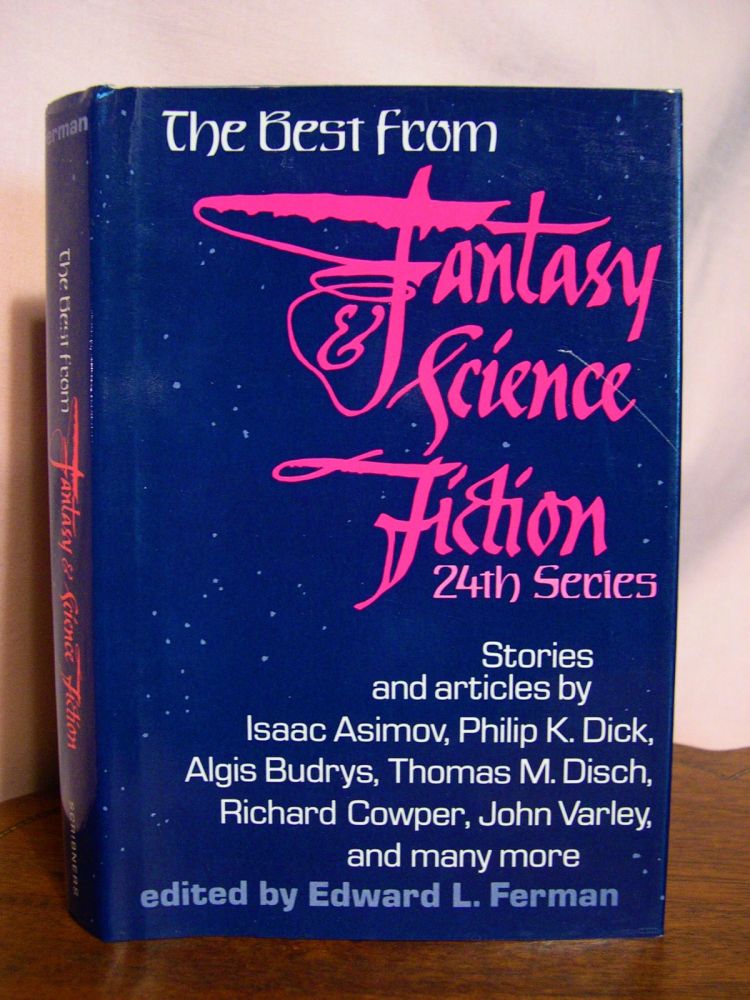
Two years ago I began the project of reading all The Best From Fantasy and Science Fiction series–all 24 volumes–in order. Well, here we are at the last volume of the original series. More anthologies were added (check out the article below) which I may or may not read some time in the future. But, I’m happy to complete this project and move on to another.
For you former DAPA-EM members out there, check out page 271 where John Nieminski–one of the DAPA-EM greats–is featured. The most famous story here is Thomas M. Disco’s “The Brave Little Toaster” went on to fame and sequels. Michael Shea’s “The Autopsy” might be one of the most gut-wrenching story I’ve read. Scary, too! I always enjoy Neal Barrett, Jr. stories and “A Day at the Fair” hits all the right notes.
There’s plenty of quality in this final volume of The Best From Fantasy and Science Fiction Series. I hope you enjoyed it as much as I did! GRADE: B+
TABLE OF CONTENTS:
The Magazine of Fantasy, renamed The Magazine of Fantasy & Science Fiction with its second issue, debuted in 1949 as the first of two magazines to challenge Astounding‘s dominance in the decade of the 1940s. Founded and edited by Anthony Boucher and J. Francis McComas, F&SF contrasting with Astounding in its attention to literary quality and, of course, the inclusion of fantasy along with science fiction.
In 1952 the editors began a series of annual anthologies, published at first by Little, Brown in hardcover (with no paperback editions), and with the third volume going to Doubleday in hardcover and Ace in paperback. (The Ace paperbacks often left out poems and other short pieces from the hardcover editions.) The third volume in 1954 limited its selections to stories from 1953 issues, and so the series became a set of best-of-the-year annuals like those of Bleiler-Dikty (who came before) and Judith Merrill (who started later), albeit limited to works from a particular magazine, and with only the occasional exception of a story or poem from a prior year. This pattern remained as editors came and went: after Boucher and McComas, there were Robert P. Mills, Avram Davidson, and then Edward L. Ferman. After the 18th volume (full of 1968 stories) the series slowed a bit, the 19th covering 1969 and 1970, the 20th covering 1971 to early 1973.
Meanwhile anniversary anthologies appeared at years 10, from Robert P. Mills; 20, from Mills and Ferman; and 25, from Ferman. The first two were not best-of-best anthologies, but ‘extras’ containing material that hadn’t been included in the annuals (with three exceptions in the 20th anniversary volume). The 25th anniversary volume gathered just six stories from the magazine’s occasional special author issues published so far, along with the accompanying tribute essays and bibliographies. This 25th anniversary anthology took the place of the 21st book in the series of annuals; there was no “Best from Fantasy and Science Fiction: 21st Series.”
Volumes 22 and 23 each covered 2+ years and then the series moved to Scribner’s for one final volume in 1982, covering late 1979 through 1981.
Meanwhile Ferman edited the first true retrospective anthology of F&SF with The Magazine of Fantasy & Science Fiction: A 30 Year Retrospective in 1980, selecting best-of-best stories from three decades. Subsequent anniversary volumes were incremental: the 40th, 45th, and 50th anniversary volumes included just stories from the 5 or 10 years since the previous volume. A final true best-of-best volume appeared in 2009 with Gordon Van Gelder’s Sixtieth Anniversary Anthology in 2009. With so much material to draw from, he published a companion Volume 2 in 2014.
Two additional volumes are included here. J. Francis McComas produced a pair of volumes in tribute to Anthony Boucher, who’d died in 1968; one for mysteries, and one for f&sf, Special Wonder, that includes stories from as late as 1967, and not all first published in F&SF. (Note in its early years F&SF often reprinted stories; the first annual includes stories by Charles Dickens and Daniel Defoe!)
Then in 1982 Annette Peltz McComas published The Eureka Years, presenting a selection of stories from F&SF but also background on the editors, interstitial correpondence between the editors and various authors, and an appendix of “Recommended Reading” columns from the magazine’s early years. As if intended to be read through as a narrative of how the magazine was run, the book has a table of contents without page numbers.
The photo shows all the annuals except the first two, in a mix of first edition Doubleday hardcovers and Ace paperback reprints, followed by first editions of the anniversary and tribute books.
Most reprinted authors in these books: Avram Davidson (18); Reginald Bretnor + pseudonym Grendel Briarton (16 total); Isaac Asimov (15); Winona McClintic (13); Poul Anderson, Alfred Bester, and Ron Goulart (12 each); Damon Knight (11); then Ray Bradbury, Zenna Henderson, and Theodore Sturgeon (9 each).
- The Best from Fantasy and Science Fiction, Anthony Boucher & J. Francis McComas, eds. (Little, Brown, 1952) [isfdb]
- The Best from Fantasy and Science Fiction, Second Series, Anthony Boucher & J. Francis McComas, eds. (Little, Brown, 1953) [isfdb]
- The Best from Fantasy and Science Fiction, Third Series, Anthony Boucher & J. Francis McComas, eds. (Doubleday, 1954) [isfdb]
- The Best from Fantasy and Science Fiction, Fourth Series, Anthony Boucher, ed. (Doubleday, 1955) [isfdb]
- The Best from Fantasy and Science Fiction: Fifth Series, Anthony Boucher, ed. (Doubleday, 1956) [isfdb]
- The Best from Fantasy and Science Fiction: Sixth Series, Anthony Boucher, ed. (Doubleday, 1957) [isfdb]
- The Best from Fantasy and Science Fiction: Seventh Series, Anthony Boucher, ed. (Doubleday, 1958) [isfdb]
- The Best from Fantasy and Science Fiction: Eighth Series, Anthony Boucher, ed. (Doubleday, 1959) [isfdb]
- The Best from Fantasy and Science Fiction: Ninth Series, Robert P. Mills, ed. (Doubleday, 1960) [isfdb]
- A Decade of Fantasy and Science Fiction, Robert P. Mills, ed. (Doubleday, 1960) [isfdb]
- The Best from Fantasy and Science Fiction: Tenth Series, Robert P. Mills, ed. (Doubleday, 1961) [isfdb]
- The Best from Fantasy and Science Fiction: Eleventh Series, Robert P. Mills, ed. (Doubleday, 1962) [isfdb]
- The Best from Fantasy and Science Fiction: Twelfth Series, Avram Davidson, ed. (Doubleday, 1963) [isfdb]
- The Best from Fantasy and Science Fiction: Thirteenth Series, Avram Davidson, ed. (Doubleday, 1964) [isfdb]
- The Best from Fantasy and Science Fiction: Fourteenth Series, Avram Davidson, ed. (Doubleday, 1965) [isfdb]
- The Best from Fantasy and Science Fiction: Fifteenth Series, Edward L. Ferman, ed. (Doubleday, 1966) [isfdb]
- The Best from Fantasy and Science Fiction: Sixteenth Series, Edward L. Ferman, ed. (Doubleday, 1967) [isfdb]
- The Best from Fantasy and Science Fiction: Seventeenth Series, Edward L. Ferman, ed. (Doubleday, 1968) [isfdb]
- The Best from Fantasy and Science Fiction: Eighteenth Series, Edward L. Ferman, ed. (Doubleday, 1969) [isfdb]
- Twenty Years of The Magazine of Fantasy and Science Fiction, Edward L. Ferman & Robert P. Mills, eds. (G.P. Putnam’s Sons, 1970) [isfdb]
- Special Wonder: The Anthony Boucher Memorial Anthology of Fantasy and Science Fiction, J. Francis McComas, ed. (Random House, 1970) [isfdb]
- The Best from Fantasy and Science Fiction: Nineteenth Series, Edward L. Ferman, ed. (Doubleday, 1971) [isfdb]
- The Best from Fantasy and Science Fiction: 20th Series, Edward L. Ferman, ed. (Doubleday, 1973) [isfdb]
- The Best from Fantasy & Science Fiction: A Special 25th Anniversary Anthology, Edward L. Ferman, ed. (Doubleday, 1974) [isfdb]
- The Best from Fantasy and Science Fiction: 22nd Series, Edward L. Ferman, ed. (Doubleday, 1977) [isfdb]
- The Magazine of Fantasy & Science Fiction: A 30 Year Retrospective, Edward L. Ferman, ed. (Doubleday, 1980) [isfdb]
- The Best from Fantasy and Science Fiction: 23rd Series, Edward L. Ferman, ed. (Doubleday, 1980) [isfdb]
- The Best from Fantasy and Science Fiction, 24th Series, Edward L. Ferman, ed. (Scribner’s, 1982) [isfdb]
- The Eureka Years: Boucher and McComas’s The Magazine of Fantasy and Science Fiction 1949-54, Annette Peltz McComas, ed. (Bantam, 1982) [isfdb]
- The Best from Fantasy & Science Fiction: A 40th Anniversary Anthology, Edward L. Ferman, ed. (St. Martin’s, 1989) [isfdb]
- The Best from Fantasy & Science Fiction: A 45th Anniversary Anthology, Edward L. Ferman & Kristine Kathryn Rusch, eds. (St. Martin’s, 1994) [isfdb]
- The Best from Fantasy & Science Fiction: The Fiftieth Anniversary Anthology, Edward L. Ferman & Gordon Van Gelder, eds. (Tor, 1999) [isfdb]
- The Very Best of Fantasy & Science Fiction: Sixtieth Anniversary Anthology, Gordon Van Gelder, ed. (Tachyon Publications, 2009) [isfdb]
- The Very Best of Fantasy and Science Fiction, Volume 2, Gordon Van Gelder, ed. (Tachyon Publications, 2014) [isfdb]
Combined Contents by Author and Title
Vance AandahlAn Adventure in the Yolla Bolly Middle Eel Wilderness (F&SF Aug 1969) — The Best from Fantasy and Science Fiction: Nineteenth SeriesBeyond the Game (F&SF May 1968) — The Best from Fantasy and Science Fiction: Eighteenth SeriesIt’s a Great Big Wonderful Universe (F&SF Nov 1960) — The Best from Fantasy and Science Fiction: Tenth SeriesWhen Lilacs Last in the Dooryard Bloomed (F&SF May 1962) — The Best from Fantasy and Science Fiction: Twelfth SeriesRobert AbernathyHeirs Apparent (F&SF Jun 1954) — The Best from Fantasy and Science Fiction, Fourth SeriesLouis J. A. AdamsDark Conception (F&SF Nov 1964) — The Best from Fantasy and Science Fiction: Fourteenth SeriesBrian W. AldissA Kind of Artistry (F&SF Oct 1962) — The Best from Fantasy and Science Fiction: Twelfth Series
— The Very Best of Fantasy and Science Fiction, Volume 2Poor Little Warrior! (F&SF Apr 1958) — The Best from Fantasy and Science Fiction: Eighth Series
— The Magazine of Fantasy & Science Fiction: A 30 Year RetrospectiveRandy’s Syndrome (F&SF Apr 1967) — The Best from Fantasy and Science Fiction: Seventeenth SeriesSpace Burial (F&SF Jul 1959) — The Best from Fantasy and Science Fiction: Ninth SeriesRay AldridgeSteel Dogs (F&SF Sep 1989) — The Best from Fantasy & Science Fiction: A 45th Anniversary AnthologyKaren AndersonIn Memoriam: Henry Kuttner (F&SF May 1958) — The Best from Fantasy and Science Fiction: Eighth SeriesLandscape with Sphinxes (F&SF Nov 1962) — The Best from Fantasy and Science Fiction: Twelfth SeriesOrigin of the Species (F&SF Jun 1958) — The Best from Fantasy and Science Fiction: Eighth SeriesTreaty in Tartessos (F&SF May 1963) — The Best from Fantasy and Science Fiction: Thirteenth SeriesPoul AndersonBackwardness (F&SF Mar 1958) — The Best from Fantasy and Science Fiction: Eighth SeriesThe Barbarian (F&SF May 1956) — The Best from Fantasy and Science Fiction: Sixth SeriesThe Immortal Game (F&SF Feb 1954) — The Best from Fantasy and Science Fiction, Fourth SeriesJourneys End (F&SF Feb 1957) — The Best from Fantasy and Science Fiction: Seventh Series
— Special Wonder: The Anthony Boucher Memorial Anthology of Fantasy and Science FictionThe Man Who Came Early (F&SF Jun 1956) — The Best from Fantasy and Science Fiction: Sixth SeriesThe Martyr (F&SF Mar 1960) — The Best from Fantasy and Science Fiction: Tenth SeriesThe Problem of Pain (F&SF Feb 1973) — The Best from Fantasy and Science Fiction: 20th SeriesThe Queen of Air and Darkness (F&SF Apr 1971) — The Best from Fantasy & Science Fiction: A Special 25th Anniversary AnthologyThe Sky People (F&SF Mar 1959) — A Decade of Fantasy and Science FictionTime Lag (F&SF Jan 1961) — The Best from Fantasy and Science Fiction: Eleventh SeriesWhen Half-Gods Go (F&SF May 1953) — The Eureka Years: Boucher and McComas’s The Magazine of Fantasy and Science Fiction 1949-54John AnthonyThe Hypnoglyph (F&SF Jul 1953) — A Decade of Fantasy and Science FictionRobert ArthurPostpaid to Paradise (Argosy Jun 15 1940) — The Best from Fantasy and Science FictionIsaac AsimovThe Brazen Locked Room (F&SF Nov 1956) — Special Wonder: The Anthony Boucher Memorial Anthology of Fantasy and Science FictionDreaming Is a Private Thing (F&SF Dec 1955) — The Magazine of Fantasy & Science Fiction: A 30 Year RetrospectiveDreamworld (F&SF Nov 1955) — The Best from Fantasy and Science Fiction: Fifth SeriesEyes Do More Than See (F&SF Apr 1965) — The Best from Fantasy and Science Fiction: Fifteenth SeriesFeminine Intuition (F&SF Oct 1969) — Twenty Years of The Magazine of Fantasy and Science FictionFlies (F&SF Jun 1953) — The Eureka Years: Boucher and McComas’s The Magazine of Fantasy and Science Fiction 1949-54The Foundation of Science Fiction Success (F&SF Oct 1954) — The Best from Fantasy and Science Fiction, Fourth Series
— The Eureka Years: Boucher and McComas’s The Magazine of Fantasy and Science Fiction 1949-54The Key (F&SF Oct 1966) — The Best from Fantasy and Science Fiction: Sixteenth Series
— The Best from Fantasy & Science Fiction: A Special 25th Anniversary AnthologyA Loint of Paw (F&SF Aug 1957) — The Best from Fantasy and Science Fiction: Seventh SeriesThe Machine That Won the War (F&SF Oct 1961) — The Best from Fantasy and Science Fiction: Eleventh SeriesThe Singing Bell (F&SF Jan 1955) — The Best from Fantasy and Science Fiction: Fifth SeriesUnto the Fourth Generation (F&SF Apr 1959) — A Decade of Fantasy and Science FictionThe Up-to-Date Sorcerer (F&SF Jul 1958) — The Best from Fantasy and Science Fiction: Eighth SeriesE. D. B.The Escapist (F&SF Feb 1953) — The Best from Fantasy and Science Fiction, Third SeriesSolar Systems… (F&SF Feb 1953) — The Best from Fantasy and Science Fiction, Third SeriesPaolo BacigalupiThe People of Sand and Slag (F&SF Feb 2004) — The Very Best of Fantasy and Science Fiction, Volume 2Dale BaileyQuinn’s Way (F&SF Feb 1997) — The Best from Fantasy & Science Fiction: The Fiftieth Anniversary AnthologyTouched (F&SF Oct/Nov 1993) — The Best from Fantasy & Science Fiction: A 45th Anniversary AnthologyJ. G. BallardThe Cloud-Sculptors of Coral D (F&SF Dec 1967) — The Best from Fantasy and Science Fiction: Eighteenth SeriesThe Garden of Time (F&SF Feb 1962) — The Best from Fantasy and Science Fiction: Twelfth SeriesThe Illuminated Man (F&SF May 1964) — The Best from Fantasy and Science Fiction: Fourteenth SeriesNow Wakes the Sea (F&SF May 1963) — The Best from Fantasy and Science Fiction: Thirteenth SeriesRaymond E. BanksRabbits to the Moon (F&SF Jul 1959) — A Decade of Fantasy and Science FictionThe Short Ones (F&SF Mar 1955) — The Best from Fantasy and Science Fiction: Fifth SeriesNeal Barrett, Jr.“A Day at the Fair” (F&SF Mar 1981) — The Best from Fantasy and Science Fiction, 24th SeriesJoan Patricia BaschMatog (F&SF Aug 1966) — The Best from Fantasy and Science Fiction: Sixteenth SeriesPeter S. BeagleTwo Hearts (F&SF Oct/Nov 2005) — The Very Best of Fantasy & Science Fiction: Sixtieth Anniversary AnthologyCharles BeaumontFree Dirt (F&SF May 1955) — Twenty Years of The Magazine of Fantasy and Science FictionThe Last Word (by Chad Oliver & CB) (F&SF Apr 1955) — The Best from Fantasy and Science Fiction: Fifth SeriesThe Vanishing American (F&SF Aug 1955) — The Best from Fantasy and Science Fiction: Fifth SeriesNorman BelkinA Vampire’s Saga (F&SF May 1959) — The Best from Fantasy and Science Fiction: Ninth SeriesKem BennettA Different Purpose (F&SF Nov 1958) — The Best from Fantasy and Science Fiction: Ninth SeriesThe Soothsayer (Magpie Aug 1951) — The Best from Fantasy and Science Fiction, Second SeriesBruce BergesFrom Competition 25: Short Poems about SF Animals: The Fleffel (F&SF Nov 1980) — The Best from Fantasy and Science Fiction, 24th SeriesJohn BerryThe One Who Returns (F&SF Mar 1961) — The Best from Fantasy and Science Fiction: Eleventh SeriesAlfred Bester5,271,009 (F&SF Mar 1954) — Twenty Years of The Magazine of Fantasy and Science FictionThe Animal Fair (F&SF Oct 1972) — The Best from Fantasy and Science Fiction: 20th SeriesFondly Fahrenheit (F&SF Aug 1954) — The Best from Fantasy and Science Fiction, Fourth Series
— The Magazine of Fantasy & Science Fiction: A 30 Year RetrospectiveHobson’s Choice (F&SF Aug 1952) — The Best from Fantasy and Science Fiction, Second SeriesThe Men Who Murdered Mohammed (F&SF Oct 1958) — The Best from Fantasy and Science Fiction: Eighth SeriesOf Time and Third Avenue (F&SF Oct 1951) — The Eureka Years: Boucher and McComas’s The Magazine of Fantasy and Science Fiction 1949-54
— The Very Best of Fantasy & Science Fiction: Sixtieth Anniversary AnthologyThe Pi Man (Star Light, Star Bright, 1959) — The Best from Fantasy and Science Fiction: Ninth SeriesStar Light, Star Bright (F&SF Jul 1953) — The Best from Fantasy and Science Fiction, Third SeriesThey Don’t Make Life Like They Used To (F&SF Oct 1963) — The Best from Fantasy and Science Fiction: Thirteenth SeriesWill You Wait? (F&SF Mar 1959) — A Decade of Fantasy and Science FictionLloyd Biggle, Jr.And Madly Teach (F&SF May 1966) — The Best from Fantasy and Science Fiction: Sixteenth SeriesIn His Own Image (F&SF Jan 1968) — The Best from Fantasy and Science Fiction: Eighteenth SeriesTerry Bissonmacs (F&SF Oct/Nov 1999) — The Very Best of Fantasy & Science Fiction: Sixtieth Anniversary AnthologyNext (F&SF May 1992) — The Best from Fantasy & Science Fiction: A 45th Anniversary AnthologyPartial People (Bears Discover Fire, 1993) — The Best from Fantasy & Science Fiction: The Fiftieth Anniversary AnthologyJames BlishIn Memoriam: Fletcher Pratt (F&SF Jan 1957) — The Best from Fantasy and Science Fiction: Seventh SeriesA Matter of Energy (F&SF May 1955) — The Best from Fantasy and Science Fiction: Fifth SeriesMidsummer Century (F&SF Apr 1972) — The Best from Fantasy & Science Fiction: A Special 25th Anniversary AnthologyWho’s in Charge Here? (F&SF May 1962) — The Best from Fantasy and Science Fiction: Twelfth SeriesRobert BlochA Case of the Stubborns (F&SF Oct 1976) — The Best from Fantasy and Science Fiction: 22nd SeriesNina (F&SF Jun 1977) — The Best from Fantasy and Science Fiction: 23rd SeriesThat Hell-Bound Train (F&SF Sep 1958) — Twenty Years of The Magazine of Fantasy and Science FictionMichael BlumleinPaul and Me (F&SF Oct/Nov 1997) — The Best from Fantasy & Science Fiction: The Fiftieth Anniversary AnthologyAnthony BoucherGandolphus (F&SF Dec 1956) — A Decade of Fantasy and Science FictionThe Model of a Science Fiction Editor — The Eureka Years: Boucher and McComas’s The Magazine of Fantasy and Science Fiction 1949-54Nellthu (F&SF Aug 1955) — The Best from Fantasy and Science Fiction: Fifth SeriesThe Other Inauguration (F&SF Mar 1953) — The Eureka Years: Boucher and McComas’s The Magazine of Fantasy and Science Fiction 1949-54The Quest for Saint Aquin (New Tales of Space and Time, 1951) — The Magazine of Fantasy & Science Fiction: A 30 Year RetrospectiveSnulbug (Unknown Dec 1941) — The Best from Fantasy and Science Fiction, Third SeriesElizabeth BowenThe Cheery Soul (The Listener Dec 24 1942) — The Best from Fantasy and Science Fiction, Second SeriesRichard BowesOn Death and the Deuce (F&SF May 1992) — The Best from Fantasy & Science Fiction: A 45th Anniversary AnthologyRay BradburyAll Summer in a Day (F&SF Mar 1954) — The Best from Fantasy and Science Fiction, Fourth Series
— The Very Best of Fantasy & Science Fiction: Sixtieth Anniversary AnthologyAnother Fine Mess (F&SF Apr 1995) — The Best from Fantasy & Science Fiction: The Fiftieth Anniversary AnthologyThe Exiles (Maclean’s Sep 15 1949) — The Eureka Years: Boucher and McComas’s The Magazine of Fantasy and Science Fiction 1949-54A Final Sceptre, a Lasting Crown (F&SF Oct 1969) — Twenty Years of The Magazine of Fantasy and Science FictionThe Fire Balloons (Imagination Apr 1951) — Special Wonder: The Anthony Boucher Memorial Anthology of Fantasy and Science FictionIcarus Montgolfier Wright (F&SF May 1956) — The Best from Fantasy and Science Fiction: Sixth SeriesOut of Dickinson by Poe or The Only Begotten Son of Edgar & Emily (F&SF Oct 1976) — The Best from Fantasy and Science Fiction: 22nd SeriesTo the Chicago Abyss (F&SF May 1963) — The Best from Fantasy & Science Fiction: A Special 25th Anniversary AnthologyAlan BrennertMa Qui (F&SF Feb 1991) — The Best from Fantasy & Science Fiction: A 45th Anniversary AnthologyReginald BretnorCat (F&SF Apr 1953) — The Eureka Years: Boucher and McComas’s The Magazine of Fantasy and Science Fiction 1949-54The Gnurrs Come from the Voodvork Out (F&SF Win/Spr 1950) — Special Wonder: The Anthony Boucher Memorial Anthology of Fantasy and Science Fiction
— The Magazine of Fantasy & Science Fiction: A 30 Year RetrospectiveGratitude Guaranteed (by RB & Kris Neville) (F&SF Aug 1953) — Twenty Years of The Magazine of Fantasy and Science FictionMaybe Just a Little One (Harper’s Aug 1947) — The Best from Fantasy and Science Fiction, Third SeriesOld Uncle Tom Cobleigh and All (F&SF Oct 1973) — The Best from Fantasy and Science Fiction: 22nd SeriesGrendel BriartonThrough Time and Space with Ferdinand Feghoot (The Great Science Fiction Series, 1980) — Special Wonder: The Anthony Boucher Memorial Anthology of Fantasy and Science Fiction
— The Magazine of Fantasy & Science Fiction: A 30 Year RetrospectiveThrough Time and Space with Ferdinand Feghoot: VII (F&SF Mar 1958) — The Best from Fantasy and Science Fiction: Eighth SeriesThrough Time and Space with Ferdinand Feghoot: VIII (F&SF Aug 1958) — The Best from Fantasy and Science Fiction: Eighth SeriesThrough Time and Space with Ferdinand Feghoot: X (F&SF Jan 1959) — The Best from Fantasy and Science Fiction: Ninth SeriesThrough Time and Space with Ferdinand Feghoot: XI (F&SF Feb 1959) — The Best from Fantasy and Science Fiction: Ninth SeriesThrough Time and Space with Ferdinand Feghoot: XII (F&SF Mar 1959) — The Best from Fantasy and Science Fiction: Ninth SeriesThrough Time and Space with Ferdinand Feghoot: XIII (F&SF Apr 1959) — The Best from Fantasy and Science Fiction: Ninth SeriesThrough Time and Space with Ferdinand Feghoot: XIV (F&SF May 1959) — The Best from Fantasy and Science Fiction: Ninth SeriesThrough Time and Space with Ferdinand Feghoot: XV (F&SF Jun 1959) — The Best from Fantasy and Science Fiction: Ninth SeriesAnthony BrodeThe Better Bet (F&SF Feb 1958) — The Best from Fantasy and Science Fiction: Eighth SeriesCall Me Mister (F&SF Feb 1959) — The Best from Fantasy and Science Fiction: Ninth SeriesFlying Chaucer (F&SF Mar 1956) — The Best from Fantasy and Science Fiction: Sixth SeriesThe Watchers (F&SF Apr 1958) — The Best from Fantasy and Science Fiction: Eighth SeriesYes, But… (F&SF Sep 1957) — The Best from Fantasy and Science Fiction: Seventh SeriesFredric BrownExpedition (F&SF Feb 1957) — The Best from Fantasy and Science Fiction: Seventh SeriesPuppet Show (Playboy Nov 1962) — Special Wonder: The Anthony Boucher Memorial Anthology of Fantasy and Science FictionToo Far (F&SF Sep 1955) — The Best from Fantasy and Science Fiction: Fifth SeriesJohn BrunnerPuzzle for Spacemen (New Worlds Dec 1955) — Special Wonder: The Anthony Boucher Memorial Anthology of Fantasy and Science FictionEdward BryantStone (F&SF Feb 1978) — The Best from Fantasy and Science Fiction: 23rd SeriesDoris Pitkin BuckAunt Agatha (F&SF Oct 1952) — Special Wonder: The Anthony Boucher Memorial Anthology of Fantasy and Science FictionClassical Query Composed While Shampooing (F&SF Jul 1959) — The Best from Fantasy and Science Fiction: Ninth SeriesEpithalamium (F&SF Jan 1958) — The Best from Fantasy and Science Fiction: Eighth SeriesFrom Two Universes (F&SF Dec 1964) — The Best from Fantasy and Science Fiction: Fifteenth SeriesLyric for Atom Splitters (F&SF May 1957) — The Best from Fantasy and Science Fiction: Seventh SeriesMickey Finn (F&SF Mar 1966) — The Best from Fantasy and Science Fiction: Sixteenth SeriesSportsman’s Difficulity (F&SF Mar 1959) — The Best from Fantasy and Science Fiction: Ninth SeriesKen BulmerThe Adjusted (F&SF Jun 1966) — The Best from Fantasy and Science Fiction: Sixteenth SeriesDavid R. BunchThat High-Up Blue Day That Saw the Black Sky-train Come Spinning (F&SF Mar 1968) — The Best from Fantasy and Science Fiction: Eighteenth SeriesBill ButlerLetter to a Tyrant King (F&SF Aug 1966) — The Best from Fantasy and Science Fiction: Sixteenth SeriesPat CadiganFrom Competition 25: Short Poems about SF Animals: Conkew (F&SF Nov 1980) — The Best from Fantasy and Science Fiction, 24th SeriesHolley CantineDouble, Double, Toil and Trouble (F&SF Jan 1960) — The Best from Fantasy and Science Fiction: Tenth SeriesT. P. CaravanThe Court of Tartary (F&SF Dec 1963) — The Best from Fantasy and Science Fiction: Fourteenth SeriesTerry CarrHop-Friend (F&SF Nov 1962) — The Best from Fantasy and Science Fiction: Twelfth SeriesTouchstone (F&SF May 1964) — The Best from Fantasy and Science Fiction: Fourteenth SeriesCleve CartmillHuge Beast (F&SF Sum 1950) — The Best from Fantasy and Science FictionA. Bertram ChandlerThe Cage (F&SF Jun 1957) — The Best from Fantasy and Science Fiction: Seventh SeriesTed ChiangThe Merchant and the Alchemist’s Gate (Subterranean) — The Very Best of Fantasy & Science Fiction: Sixtieth Anniversary AnthologyJohn ChristopherA Few Kindred Spirits (F&SF Nov 1965) — The Best from Fantasy and Science Fiction: Sixteenth SeriesJohn CiardiLove Letter from Mars (F&SF Jan 1965) — The Best from Fantasy and Science Fiction: Fifteenth Series
— The Magazine of Fantasy & Science Fiction: A 30 Year RetrospectiveArthur C. ClarkeAll That Glitters (The (London) Evening Standard May 26 1956) — The Best from Fantasy and Science Fiction: Seventh SeriesGreen Fingers (The (London) Evening Standard May 25 1956) — The Best from Fantasy and Science Fiction: Seventh SeriesA Question of Residence (The (London) Evening Standard May 29 1956) — The Best from Fantasy and Science Fiction: Seventh SeriesRobin Hood, F.R.S. (The (London) Evening Standard May 24 1956) — The Best from Fantasy and Science Fiction: Seventh SeriesThe Starting Line (The (London) Evening Standard May 23 1956) — The Best from Fantasy and Science Fiction: Seventh SeriesThis Earth of Majesty (F&SF Jul 1955) — The Best from Fantasy and Science Fiction: Fifth SeriesWatch This Space (The (London) Evening Standard May 28 1956) — The Best from Fantasy and Science Fiction: Seventh SeriesBrian CleeveThe Devil and Democracy (Argosy (UK) Oct 1966) — The Best from Fantasy and Science Fiction: Seventeenth SeriesMildred ClingermanBirds Can’t Count (F&SF Feb 1955) — The Best from Fantasy and Science Fiction: Fifth SeriesFirst Lesson (Colliers Jun 22 1956) — A Decade of Fantasy and Science FictionThe Last Prophet (F&SF Aug 1955) — The Best from Fantasy and Science Fiction: Fifth SeriesMinister Without Portfolio (F&SF Feb 1952) — The Eureka Years: Boucher and McComas’s The Magazine of Fantasy and Science Fiction 1949-54Mr. Sakrison’s Halt (F&SF Jan 1956) — The Best from Fantasy and Science Fiction: Sixth SeriesStair Trick (F&SF Aug 1952) — The Best from Fantasy and Science Fiction, Second SeriesThe Wild Wood (F&SF Jan 1957) — The Best from Fantasy and Science Fiction: Seventh Series
— Special Wonder: The Anthony Boucher Memorial Anthology of Fantasy and Science FictionCarlyn CoffinSurvival (F&SF Jun 1955) — The Best from Fantasy and Science Fiction: Fifth SeriesJohn CollierMan Overboard (Argosy (UK) Jan 1960) — The Best from Fantasy and Science Fiction: Tenth SeriesMeeting of Relations (The Yale Review Dec 1941) — A Decade of Fantasy and Science FictionGeorge CollynOut of Time, Out of Place (F&SF Sep 1967) — The Best from Fantasy and Science Fiction: Seventeenth SeriesMichael ConnerGuide Dog (F&SF) — The Best from Fantasy & Science Fiction: A 45th Anniversary AnthologyVictor ContoskiVon Goom’s Gambit (Chess Review Apr 1966) — The Best from Fantasy and Science Fiction: Seventeenth SeriesRichard CowperThe Hertford Manuscript (F&SF Oct 1976) — The Best from Fantasy and Science Fiction: 22nd SeriesOut There Where the Big Ships Go (F&SF Aug 1979) — The Best from Fantasy and Science Fiction, 24th SeriesArthur Jean CoxThe Sea Change (F&SF Mar 1967) — The Best from Fantasy and Science Fiction: Seventeenth SeriesJohn CrowleyGone (F&SF Sep 1996) — The Best from Fantasy & Science Fiction: The Fiftieth Anniversary AnthologyAvram DavidsonAprés Nous (F&SF Mar 1960) — The Best from Fantasy and Science Fiction: Tenth SeriesBumberboom (F&SF Dec 1966) — The Best from Fantasy and Science Fiction: Seventeenth SeriesThe Certificate (F&SF Mar 1959) — A Decade of Fantasy and Science FictionDagon (F&SF Oct 1959) — The Best from Fantasy and Science Fiction: Ninth SeriesThe Golem (F&SF Mar 1955) — The Best from Fantasy and Science Fiction: Fifth SeriesThe Grantha Sighting (F&SF Apr 1958) — The Best from Fantasy and Science Fiction: Eighth SeriesThe House the Blakeneys Built (F&SF Jan 1965) — The Best from Fantasy and Science Fiction: Fifteenth SeriesKing’s Evil (F&SF Oct 1956) — The Best from Fantasy and Science Fiction: Sixth Series
— Special Wonder: The Anthony Boucher Memorial Anthology of Fantasy and Science FictionMr. Stilwell’s Stage (F&SF Sep 1957) — The Best from Fantasy and Science Fiction: Seventh SeriesMy Boy Friend’s Name Is Jello (F&SF Jul 1954) — The Best from Fantasy and Science Fiction, Fourth SeriesSacheverell (F&SF Mar 1964) — The Best from Fantasy and Science Fiction: Fourteenth SeriesSelectra Six-ten (F&SF Oct 1970) — The Best from Fantasy and Science Fiction: Nineteenth Series
— The Magazine of Fantasy & Science Fiction: A 30 Year RetrospectiveThe Singular Events Which Occurred in the Hovel on the Alley Off Eye Street (F&SF Feb 1962) — The Best from Fantasy and Science Fiction: Twelfth SeriesThe Sources of the Nile (F&SF Jan 1961) — The Best from Fantasy and Science Fiction: Eleventh SeriesWhat Strange Stars and Skies (F&SF Dec 1963) — The Best from Fantasy and Science Fiction: Thirteenth SeriesWhile You’re Up (F&SF Oct 1988) — The Best from Fantasy & Science Fiction: A 40th Anniversary AnthologyL. Sprague de CampThe Black Ball (by LSdC & Fletcher Pratt) (F&SF Oct 1952) — The Best from Fantasy and Science Fiction, Second SeriesElephas Frumenti (by LSdC & Fletcher Pratt) (F&SF Win/Spr 1950) — The Best from Fantasy and Science Fiction
— The Eureka Years: Boucher and McComas’s The Magazine of Fantasy and Science Fiction 1949-54The Gift of God (by LSdC & Fletcher Pratt) (F&SF Win/Spr 1950) — The Best from Fantasy and Science FictionLament by a Maker (F&SF Jan 1955) — The Best from Fantasy and Science Fiction: Fifth SeriesThe Untimely Toper (by LSdC & Fletcher Pratt) (F&SF Jul 1953) — The Best from Fantasy and Science Fiction, Third SeriesPat De GrawMemo to Secretary (F&SF Jun 1966) — The Best from Fantasy and Science Fiction: Sixteenth SeriesCharles de LintThe Bone Woman (F&SF Aug 1993) — The Very Best of Fantasy and Science Fiction, Volume 2Daniel DefoeThe Friendly Demon — The Best from Fantasy and Science FictionMiriam Allen deFordThe Apotheosis of Ki (F&SF Dec 1956) — Special Wonder: The Anthony Boucher Memorial Anthology of Fantasy and Science FictionSamuel R. DelanyCorona (F&SF Oct 1967) — The Best from Fantasy and Science Fiction: Seventeenth SeriesPrismatica (F&SF Oct 1977) — The Best from Fantasy and Science Fiction: 23rd SeriesRichard DemingThe Shape of Things That Came (F&SF Oct 1951) — Special Wonder: The Anthony Boucher Memorial Anthology of Fantasy and Science FictionBradley DentonWe Love Lydia Love (F&SF Oct/Nov 1994) — The Best from Fantasy & Science Fiction: The Fiftieth Anniversary AnthologyMike M. DesimoneFrom Competition 25: Short Poems about SF Animals: The Wud (F&SF Nov 1980) — The Best from Fantasy and Science Fiction, 24th SeriesMarc DesmondFrom Competition 22: Anecdotes in the Style of a SF Writer In the style of Barry Malzberg (F&SF Sep 1979) — The Best from Fantasy and Science Fiction, 24th SeriesG. Gordon DeweyThe Tooth (F&SF Aug 1952) — The Best from Fantasy and Science Fiction, Second SeriesPhilip K. DickThe Alien Mind (The Yuba City High Times Feb 20 1981) — The Best from Fantasy and Science Fiction, 24th SeriesThe Electric Ant (F&SF Oct 1969) — The Very Best of Fantasy & Science Fiction: Sixtieth Anniversary AnthologyThe Little Movement (F&SF Nov 1952) — The Eureka Years: Boucher and McComas’s The Magazine of Fantasy and Science Fiction 1949-54We Can Remember It for You Wholesale (F&SF Apr 1966) — The Best from Fantasy and Science Fiction: Sixteenth Series
— Twenty Years of The Magazine of Fantasy and Science Fiction
— The Magazine of Fantasy & Science Fiction: A 30 Year RetrospectiveCharles DickensThe Rat that Could Speak (All the Year Round Sep 8 1860) — The Best from Fantasy and Science FictionJoseph DickinsonThree for the Stars (F&SF Apr 1962) — The Best from Fantasy and Science Fiction: Twelfth SeriesGordon R. DicksonThe Haunted Village (F&SF Aug 1961) — The Best from Fantasy and Science Fiction: Eleventh SeriesListen (F&SF Aug 1952) — The Eureka Years: Boucher and McComas’s The Magazine of Fantasy and Science Fiction 1949-54The Three (Startling Stories May 1953) — Special Wonder: The Anthony Boucher Memorial Anthology of Fantasy and Science FictionThomas M. DischThe Brave Little Toaster (F&SF Aug 1980) — The Best from Fantasy and Science Fiction, 24th SeriesThe Man Who Had No Idea (F&SF Oct 1978) — The Best from Fantasy and Science Fiction: 23rd SeriesNada (F&SF Aug 1964) — The Best from Fantasy and Science Fiction: Fourteenth SeriesProblems of Creativeness (F&SF Apr 1967) — The Best from Fantasy and Science Fiction: Seventeenth Series
— The Magazine of Fantasy & Science Fiction: A 30 Year RetrospectiveUnderstanding Human Behavior (F&SF Feb 1982) — The Best from Fantasy & Science Fiction: A 40th Anniversary AnthologyBuzz DixonFrom Competition 22: Anecdotes in the Style of a SF Writer In the style of Robert Heinlein (F&SF Sep 1979) — The Best from Fantasy and Science Fiction, 24th SeriesMarcos DonnellyThe Resurrection of Alonso Quijana (F&SF Mar 1992) — The Best from Fantasy & Science Fiction: A 45th Anniversary AnthologySonya DormanDance Music for a Gone Planet (F&SF Oct 1968) — The Magazine of Fantasy & Science Fiction: A 30 Year RetrospectiveLunatic Assignment (F&SF Jan 1968) — The Best from Fantasy and Science Fiction: Eighteenth SeriesLeah Bodine DrakeThe Woods Grow Darker (F&SF Nov 1955) — The Best from Fantasy and Science Fiction: Sixth SeriesAllen DrurySomething (F&SF Oct 1960) — The Best from Fantasy and Science Fiction: Tenth SeriesStan DryerZorphwar! (F&SF Aug 1977) — The Best from Fantasy and Science Fiction: 23rd SeriesLord DunsanyMisadventure (Lilliput Mar-Apr (#190) 1953) — The Best from Fantasy and Science Fiction, Fourth SeriesS. N. DyerSins of the Mothers (F&SF May 1997) — The Best from Fantasy & Science Fiction: The Fiftieth Anniversary AnthologyG. C. EdmondsonRescue (F&SF Jun 1957) — The Best from Fantasy and Science Fiction: Seventh SeriesGeorge Alec EffingerThe Aliens Who Knew, I Mean, Everything (F&SF Oct 1984) — The Best from Fantasy & Science Fiction: A 40th Anniversary Anthology
— The Very Best of Fantasy and Science Fiction, Volume 2Phyllis EisensteinBorn to Exile (F&SF Aug 1971) — The Best from Fantasy and Science Fiction: 20th SeriesBruce ElliottFearsome Fable (F&SF Feb 1951) — The Best from Fantasy and Science FictionGeorge Paul ElliottInvasion of the Planet of Love (F&SF Jan 1959) — The Best from Fantasy and Science Fiction: Ninth SeriesHarlan EllisonThe Deathbird (F&SF Mar 1973) — The Best from Fantasy and Science Fiction: 20th Series
— The Very Best of Fantasy & Science Fiction: Sixtieth Anniversary AnthologyEidolons (F&SF Jul 1988) — The Best from Fantasy & Science Fiction: A 40th Anniversary AnthologyJeffty Is Five (F&SF Jul 1977) — The Magazine of Fantasy & Science Fiction: A 30 Year Retrospective
— The Very Best of Fantasy and Science Fiction, Volume 2Pretty Maggie Moneyeyes (Knight May 1967) — Special Wonder: The Anthony Boucher Memorial Anthology of Fantasy and Science FictionSensible City (F&SF Oct/Nov 1994) — The Best from Fantasy & Science Fiction: The Fiftieth Anniversary AnthologySusan (F&SF Dec 1993) — The Best from Fantasy & Science Fiction: A 45th Anniversary AnthologyGuy EndoreMen of Iron — A Decade of Fantasy and Science FictionPhilip José FarmerAttitudes (F&SF Oct 1953) — The Best from Fantasy and Science Fiction, Third SeriesPrometheus (F&SF Mar 1961) — Special Wonder: The Anthony Boucher Memorial Anthology of Fantasy and Science FictionHoward FastThe Martian Shop (F&SF Nov 1959) — A Decade of Fantasy and Science FictionBird FergusonInterview (F&SF Dec 1955) — The Best from Fantasy and Science Fiction: Sixth SeriesCharles G. FinneyThe Captivity (F&SF Oct 1961) — The Best from Fantasy and Science Fiction: Eleventh SeriesJack FinneyThe Third Level (Colliers Oct 7 1950) — The Best from Fantasy and Science Fiction, Second Series
— The Very Best of Fantasy and Science Fiction, Volume 2Charles FontenayThe Silk and the Song (F&SF Jul 1956) — The Best from Fantasy and Science Fiction: Sixth SeriesJeffrey FordCreation (F&SF May 2002) — The Very Best of Fantasy & Science Fiction: Sixtieth Anniversary AnthologyKaren Joy FowlerThe Dark (F&SF Jun 1991) — The Best from Fantasy & Science Fiction: A 45th Anniversary Anthology
— The Very Best of Fantasy & Science Fiction: Sixtieth Anniversary AnthologyFace Value (F&SF Nov 1986) — The Best from Fantasy & Science Fiction: A 40th Anniversary AnthologyAlbert Compton FriborgCareless Love (F&SF Jul 1954) — The Best from Fantasy and Science Fiction, Fourth SeriesBruce Jay FriedmanYes, We Have No Ritchard (F&SF Nov 1960) — Twenty Years of The Magazine of Fantasy and Science FictionEsther M. FriesnerA Birthday (F&SF Aug 1995) — The Best from Fantasy & Science Fiction: The Fiftieth Anniversary AnthologyH. B. FyfeRansom (F&SF Feb 1952) — The Best from Fantasy and Science Fiction, Second Series
— Special Wonder: The Anthony Boucher Memorial Anthology of Fantasy and Science FictionNeil GaimanOther People (F&SF Oct/Nov 2001) — The Very Best of Fantasy & Science Fiction: Sixtieth Anniversary AnthologyDaniel F. GalouyeSanctuary (F&SF Feb 1954) — The Best from Fantasy and Science Fiction, Fourth SeriesR. Garcia y RobertsonCast on a Distant Shore (F&SF Apr 1989) — The Best from Fantasy & Science Fiction: A 45th Anniversary AnthologyMartin GardnerNo-Sided Professor (Esquire Jan 1947) — The Best from Fantasy and Science FictionRandall GarrettBlaze of Glory (F&SF Dec 1955) — The Best from Fantasy and Science Fiction: Sixth SeriesThe Muddle of the Woad (Analog Jun 1965) — Special Wonder: The Anthony Boucher Memorial Anthology of Fantasy and Science FictionSasha GilienTwo’s a Crowd (F&SF Jul 1962) — The Best from Fantasy and Science Fiction: Twelfth SeriesCarolyn Ives GilmanThe Honeycrafters (F&SF Oct/Nov 1991) — The Best from Fantasy & Science Fiction: A 45th Anniversary AnthologyParke GodwinThe Fire When It Comes (F&SF May 1981) — The Best from Fantasy and Science Fiction, 24th SeriesRon GoulartConfessions (F&SF Aug 1970) — The Best from Fantasy and Science Fiction: Nineteenth SeriesExperiment in Autobiography (F&SF Jul 1966) — The Best from Fantasy and Science Fiction: Sixteenth SeriesFill in the Blank (F&SF May 1967) — The Best from Fantasy and Science Fiction: Seventeenth SeriesInto the Shop (F&SF Apr 1964) — The Best from Fantasy and Science Fiction: Fourteenth SeriesLetters to the Editor (Pelican Oct 1950) — The Best from Fantasy and Science Fiction, Second Series
— The Eureka Years: Boucher and McComas’s The Magazine of Fantasy and Science Fiction 1949-54McNamara’s Fish (F&SF Jul 1963) — The Best from Fantasy and Science Fiction: Thirteenth SeriesMuscadine (F&SF Apr 1968) — The Best from Fantasy and Science Fiction: Eighteenth SeriesA New Lo! (F&SF Jan 1958) — The Best from Fantasy and Science Fiction: Eighth SeriesPlease Stand By (F&SF Jan 1962) — The Best from Fantasy and Science Fiction: Twelfth SeriesRake (F&SF Jun 1965) — The Best from Fantasy and Science Fiction: Fifteenth SeriesRalph Wollstonecraft Hedge: A Memoir (F&SF May 1959) — The Best from Fantasy and Science Fiction: Ninth SeriesRobert GravesThe Shout (The Woburn Books #16 1929) — The Best from Fantasy and Science Fiction, Second SeriesRobert M. Green, Jr.Apology to Inky (F&SF Jan 1966) — The Best from Fantasy and Science Fiction: Sixteenth SeriesGraham GreeneProof Positive (Harper’s Oct 1947) — A Decade of Fantasy and Science FictionWilliam Lindsay GreshamThe Star Gypsies (F&SF Jul 1953) — The Best from Fantasy and Science Fiction, Third SeriesRussell GriffinThe Most Illuminatingly Doleful and Instructively Affecting Demise of Flo, Late of Upper Blooton (F&SF Jul 1980) — The Best from Fantasy and Science Fiction, 24th SeriesAnn Warren GriffithCaptive Audience (F&SF Aug 1953) — The Best from Fantasy and Science Fiction, Third SeriesLen GuttridgeAunt Millicent at the Races (F&SF Apr 1965) — The Best from Fantasy and Science Fiction: Fifteenth SeriesJoe HaldemanGraves (F&SF Oct/Nov 1992) — The Best from Fantasy & Science Fiction: A 45th Anniversary AnthologyElizabeth HandEcho (F&SF Oct/Nov 2005) — The Very Best of Fantasy and Science Fiction, Volume 2Last Summer at Mars Hill (F&SF Aug 1994) — The Best from Fantasy & Science Fiction: The Fiftieth Anniversary AnthologyCharles L. HarnessChild by Chronos (F&SF Jun 1953) — The Best from Fantasy and Science Fiction, Third SeriesHarry HarrisonCaptain Honario Harpplayer, R.N. (F&SF Mar 1963) — The Best from Fantasy and Science Fiction: Thirteenth SeriesI Have My Vigil (F&SF Feb 1968) — The Best from Fantasy and Science Fiction: Eighteenth SeriesM. John HarrisonSuicide Coast (F&SF Jul 1999) — The Very Best of Fantasy and Science Fiction, Volume 2H. F. HeardThe Collector (F&SF Aug 1951) — The Best from Fantasy and Science FictionRobert A. Heinlein‘All You Zombies—’ (F&SF Mar 1959) — The Best from Fantasy and Science Fiction: Ninth Series
— The Magazine of Fantasy & Science Fiction: A 30 Year Retrospective
— The Very Best of Fantasy and Science Fiction, Volume 2Zenna HendersonThe Anything Box (F&SF Oct 1956) — The Very Best of Fantasy and Science Fiction, Volume 2Ararat (F&SF Oct 1952) — The Magazine of Fantasy & Science Fiction: A 30 Year RetrospectiveCaptivity (F&SF Jun 1958) — The Best from Fantasy and Science Fiction: Eighth SeriesCome On, Wagon! (F&SF Dec 1951) — The Best from Fantasy and Science Fiction, Second Series
— The Eureka Years: Boucher and McComas’s The Magazine of Fantasy and Science Fiction 1949-54Deluge (F&SF Oct 1963) — The Best from Fantasy and Science Fiction: Thirteenth SeriesJordan (F&SF Mar 1959) — A Decade of Fantasy and Science FictionNo Different Flesh (F&SF May 1965) — The Best from Fantasy and Science Fiction: Fifteenth SeriesPottage (F&SF Sep 1955) — The Best from Fantasy and Science Fiction: Fifth SeriesCharles HennebergThe Blind Pilot (F&SF Jan 1960) — The Best from Fantasy and Science Fiction: Tenth SeriesRoderic C. HodginsThe History of Doctor Frost (F&SF Apr 1965) — The Best from Fantasy and Science Fiction: Fifteenth SeriesP. M. HubbardBotany Bay (F&SF Feb 1955) — The Best from Fantasy and Science Fiction: Fifth SeriesFree Flight (F&SF Apr 1956) — The Best from Fantasy and Science Fiction: Sixth SeriesThe Golden Brick (F&SF Jan 1963) — The Best from Fantasy and Science Fiction: Thirteenth SeriesManuscript Found in a Vacuum (Punch Dec 1952) — The Best from Fantasy and Science Fiction, Third SeriesLiz HuffordThis Offer Expires (F&SF Sep 1976) — The Best from Fantasy and Science Fiction: 22nd SeriesMargaret IrwinThe Earlier Service (Madame Fears the Dark, 1935) — The Best from Fantasy and Science Fiction, Second SeriesShirley JacksonBulletin (F&SF Mar 1954) — The Best from Fantasy and Science Fiction, Fourth SeriesThe Omen (F&SF Mar 1958) — The Best from Fantasy and Science Fiction: Eighth SeriesOne Ordinary Day, with Peanuts (F&SF Jan 1955) — The Best from Fantasy and Science Fiction: Fifth Series
— The Magazine of Fantasy & Science Fiction: A 30 Year Retrospective
— The Very Best of Fantasy & Science Fiction: Sixtieth Anniversary AnthologyHarvey JacobsDress Rehearsal (F&SF Jul 1974) — The Best from Fantasy and Science Fiction: 22nd SeriesThe Egg of the Glak (F&SF Mar 1968) — The Best from Fantasy and Science Fiction: Eighteenth SeriesNorman R. JaffrayCowboy Lament (F&SF Jan 1954) — The Best from Fantasy and Science Fiction, Fourth SeriesGary JenningsA Murkle for Jesse (F&SF Jul 1965) — The Best from Fantasy and Science Fiction: Fifteenth SeriesSooner or Later or Never Never (F&SF May 1972) — The Best from Fantasy and Science Fiction: 20th SeriesEdward JesbyOgre! (F&SF Sep 1968) — The Best from Fantasy and Science Fiction: Eighteenth SeriesS. S. JohnsonThe House by the Crab Apple Tree (F&SF Feb 1964) — The Best from Fantasy and Science Fiction: Fourteenth SeriesGerald JonasImaginary Numbers in a Real Garden (F&SF Apr 1965) — The Best from Fantasy and Science Fiction: Sixteenth Series
— The Magazine of Fantasy & Science Fiction: A 30 Year RetrospectiveAlice Eleanor JonesCreated He Them (F&SF Jun 1955) — The Best from Fantasy and Science Fiction: Fifth SeriesBeverly KellerBirdlime (F&SF Mar 1971) — The Best from Fantasy and Science Fiction: 20th SeriesJames Patrick KellyRat (F&SF Jun 1986) — The Very Best of Fantasy and Science Fiction, Volume 2Walter H. KerrTreat (F&SF Nov 1964) — The Best from Fantasy and Science Fiction: Fifteenth SeriesJohn KesselBuffalo (F&SF Jan 1991) — The Very Best of Fantasy & Science Fiction: Sixtieth Anniversary AnthologyJudgment Call (F&SF Oct 1987) — The Best from Fantasy & Science Fiction: A 40th Anniversary AnthologyDaniel KeyesCrazy Maro (F&SF Apr 1960) — The Best from Fantasy and Science Fiction: Tenth SeriesFlowers for Algernon (F&SF Apr 1959) — The Best from Fantasy and Science Fiction: Ninth Series
— The Magazine of Fantasy & Science Fiction: A 30 Year Retrospective
— The Very Best of Fantasy & Science Fiction: Sixtieth Anniversary AnthologyLee KilloughA House Divided (F&SF Jun 1978) — The Best from Fantasy and Science Fiction: 23rd SeriesStephen KingThe Gunslinger (F&SF Oct 1978) — The Very Best of Fantasy & Science Fiction: Sixtieth Anniversary AnthologyThe New York Times at Special Bargain Rates — The Very Best of Fantasy and Science Fiction, Volume 2Russell KirkBalgrummo’s Hell (F&SF Jul 1967) — The Best from Fantasy and Science Fiction: Seventeenth SeriesDamon KnightThe Country of the Kind (F&SF Feb 1956) — The Very Best of Fantasy and Science Fiction, Volume 2Eripmav (F&SF Jun 1958) — The Best from Fantasy and Science Fiction: Eighth SeriesThe God Machine (F&SF Jul 1985) — The Best from Fantasy & Science Fiction: A 40th Anniversary AnthologyI See You (F&SF Nov 1976) — The Best from Fantasy and Science Fiction: 23rd Series
— The Very Best of Fantasy & Science Fiction: Sixtieth Anniversary AnthologyNot with a Bang (F&SF Win/Spr 1950) — The Magazine of Fantasy & Science Fiction: A 30 Year Retrospective
— The Eureka Years: Boucher and McComas’s The Magazine of Fantasy and Science Fiction 1949-54What Rough Beast? (F&SF Feb 1959) — The Best from Fantasy and Science Fiction: Ninth SeriesYou’re Another (F&SF Jun 1955) — The Best from Fantasy and Science Fiction: Fifth Series
— Special Wonder: The Anthony Boucher Memorial Anthology of Fantasy and Science FictionC. M. KornbluthThe Cosmic Charge Account (F&SF Jan 1956) — The Best from Fantasy and Science Fiction: Sixth Series
— The Very Best of Fantasy and Science Fiction, Volume 2I Never Ast No Favors (F&SF Apr 1954) — The Best from Fantasy and Science Fiction, Fourth SeriesMS. Found in a Chinese Fortune Cookie (F&SF Jul 1957) — The Best from Fantasy and Science Fiction: Seventh SeriesMute Inglorious Tam (by Frederik Pohl & CMK) (F&SF Oct 1974) — The Best from Fantasy and Science Fiction: 22nd SeriesThe Silly Season (F&SF Fll 1950) — Twenty Years of The Magazine of Fantasy and Science FictionTheory of Rocketry (F&SF Jul 1958) — The Best from Fantasy and Science Fiction: Eighth SeriesNancy KressOut of All Them Bright Stars (F&SF Mar 1985) — The Best from Fantasy & Science Fiction: A 40th Anniversary AnthologyOliver La FargeJohn the Revelator (F&SF Feb 1951) — The Best from Fantasy and Science FictionSpud and Cochise (A Pause in the Desert, 1935) — A Decade of Fantasy and Science FictionR. A. LaffertyHog-Belly Honey (F&SF Sep 1965) — The Best from Fantasy and Science Fiction: Fifteenth SeriesNarrow Valley (F&SF Sep 1966) — The Very Best of Fantasy and Science Fiction, Volume 2Allen Kim LangThaw and Serve (F&SF Jan 1964) — The Best from Fantasy and Science Fiction: Fourteenth SeriesUrsula K. Le GuinBuffalo Gals, Won’t You Come Out Tonight (Buffalo Gals and Other Animal Presences, 1987) — The Best from Fantasy & Science Fiction: A 40th Anniversary AnthologySolitude (F&SF Dec 1994) — The Best from Fantasy & Science Fiction: The Fiftieth Anniversary Anthology
— The Very Best of Fantasy & Science Fiction: Sixtieth Anniversary AnthologyTanith LeeAll the Birds of Hell (F&SF Oct/Nov 1998) — The Best from Fantasy & Science Fiction: The Fiftieth Anniversary AnthologyWilliam M. LeeSea Home (F&SF Jun 1968) — The Best from Fantasy and Science Fiction: Eighteenth SeriesFritz Leiber237 Talking Statues, Etc. (F&SF Sep 1963) — Twenty Years of The Magazine of Fantasy and Science FictionThe Big Trek (F&SF Oct 1957) — The Best from Fantasy and Science Fiction: Seventh SeriesThe Cat Hotel (F&SF Oct 1983) — The Best from Fantasy & Science Fiction: A 40th Anniversary AnthologyA Deskful of Girls (F&SF Apr 1958) — The Best from Fantasy and Science Fiction: Eighth SeriesFour Ghosts in Hamlet (F&SF Jan 1965) — The Best from Fantasy and Science Fiction: Fifteenth SeriesThe Inner Circles (F&SF Oct 1967) — The Best from Fantasy and Science Fiction: Seventeenth SeriesShip of Shadows (F&SF Jul 1969) — The Best from Fantasy & Science Fiction: A Special 25th Anniversary AnthologyBob LemanWindow (F&SF May 1980) — The Best from Fantasy and Science Fiction, 24th SeriesC. S. LewisAn Expostulation (F&SF Jun 1959) — The Best from Fantasy and Science Fiction: Ninth SeriesMinistering Angels (Saturday Review of Literature May 28 1955) — The Best from Fantasy and Science Fiction: Eighth SeriesThe Shoddy Lands (F&SF Feb 1956) — The Best from Fantasy and Science Fiction: Sixth SeriesThomas LigottiThe Last Feast of Harlequin (F&SF Apr 1990) — The Best from Fantasy & Science Fiction: A 45th Anniversary AnthologyKen LiuThe Paper Menagerie (F&SF Mar/Apr 2011) — The Very Best of Fantasy and Science Fiction, Volume 2Philip MacDonaldHub (F&SF Aug 1951) — The Best from Fantasy and Science FictionPrivate—Keep Out! (F&SF Fll 1949) — Twenty Years of The Magazine of Fantasy and Science FictionKatherine MacLeanInterbalance (F&SF Oct 1960) — The Best from Fantasy and Science Fiction: Tenth SeriesPhyllis MacLennanThus Love Betrays Us (F&SF Sep 1972) — The Best from Fantasy and Science Fiction: 20th SeriesRachel MadduxFinal Clearence (F&SF Feb 1956) — The Best from Fantasy and Science Fiction: Sixth SeriesPaul MajorFrom Competition 22: Anecdotes in the Style of a SF Writer In the style of Jack Vance (F&SF Sep 1979) — The Best from Fantasy and Science Fiction, 24th SeriesMose MalletteThe Seven Wonders of the Universe (F&SF Aug 1966) — The Best from Fantasy and Science Fiction: Sixteenth SeriesBarry N. MalzbergFinal War (F&SF Apr 1968) — The Best from Fantasy and Science Fiction: Eighteenth SeriesNotes Just Prior to the Fall (F&SF Oct 1970) — The Best from Fantasy and Science Fiction: Nineteenth SeriesFélix Martí-IbáñezNiña Sol (F&SF May 1963) — The Best from Fantasy and Science Fiction: Thirteenth SeriesJohn MasefieldThe Sealman (The Manchester Guardian Apr 12 1907) — A Decade of Fantasy and Science FictionRichard MathesonBorn of Man and Woman (F&SF Sum 1950) — The Magazine of Fantasy & Science Fiction: A 30 Year RetrospectiveDress of White Silk (F&SF Oct 1951) — The Best from Fantasy and Science Fiction
— The Eureka Years: Boucher and McComas’s The Magazine of Fantasy and Science Fiction 1949-54The Holiday Man (F&SF Jul 1957) — Twenty Years of The Magazine of Fantasy and Science FictionPattern for Survival (F&SF May 1955) — The Best from Fantasy and Science Fiction: Fifth SeriesThe Test (F&SF Nov 1954) — The Best from Fantasy and Science Fiction, Fourth SeriesBruce McAllisterBenji’s Pencil (F&SF Mar 1969) — The Best from Fantasy and Science Fiction: Nineteenth SeriesPrime-Time Teaser (F&SF Dec 1968) — Twenty Years of The Magazine of Fantasy and Science FictionWinona Mcclintic1980 Overtures (F&SF Apr 1955) — The Best from Fantasy and Science Fiction: Fifth SeriesThe Anti-Climax (F&SF Jan 1956) — The Best from Fantasy and Science Fiction: Sixth SeriesThe Antiquary (F&SF Jul 1953) — The Best from Fantasy and Science Fiction, Third SeriesBright Destruction (F&SF Jun 1956) — The Best from Fantasy and Science Fiction: Sixth SeriesThe Doctrine of Original Design (F&SF Mar 1955) — The Best from Fantasy and Science Fiction: Fifth SeriesHis Master’s Voice (F&SF Jun 1953) — The Best from Fantasy and Science Fiction, Third SeriesI Want My Name in the Title (F&SF Jul 1956) — The Best from Fantasy and Science Fiction: Sixth SeriesIn the Days of Our Fathers (F&SF Fll 1949) — The Best from Fantasy and Science FictionTo Give Them Beauty for Ashes (F&SF Sep 1959) — The Best from Fantasy and Science Fiction: Ninth SeriesTwo Voices (F&SF Jun 1953) — The Best from Fantasy and Science Fiction, Third SeriesThe Unquiet Grave (F&SF Aug 1953) — The Best from Fantasy and Science Fiction, Third SeriesValise Macabre (F&SF Nov 1957) — The Best from Fantasy and Science Fiction: Eighth SeriesYe Phantasie Writer and His Catte (F&SF Mar 1958) — The Best from Fantasy and Science Fiction: Eighth SeriesJ. Francis McComasBrave New Word (F&SF Sep 1954) — The Best from Fantasy and Science Fiction, Fourth Series
— The Eureka Years: Boucher and McComas’s The Magazine of Fantasy and Science Fiction 1949-54Shock Treatment (9 Tales of Space and Time, 1954) — A Decade of Fantasy and Science FictionMaureen F. McHughThe Lincoln Train (F&SF Apr 1995) — The Best from Fantasy & Science Fiction: The Fiftieth Anniversary Anthology
— The Very Best of Fantasy and Science Fiction, Volume 2Richard McKennaCasey Agonistes (F&SF Sep 1958) — The Best from Fantasy and Science Fiction: Ninth SeriesHunter, Come Home (F&SF Mar 1963) — The Best from Fantasy and Science Fiction: Thirteenth SeriesMine Own Ways (F&SF Feb 1960) — The Best from Fantasy and Science Fiction: Tenth SeriesRichard MiddletonShepherd’s Boy (The Ghost Ship, 1912) — The Best from Fantasy and Science Fiction, Third SeriesWalter M. Miller, Jr.A Canticle for Leibowitz (F&SF Apr 1955) — The Best from Fantasy and Science Fiction: Fifth Series
— The Magazine of Fantasy & Science Fiction: A 30 Year RetrospectiveRobert P. MillsThe Last Shall Be First (F&SF Aug 1958) — A Decade of Fantasy and Science FictionJudith MoffettSurviving (F&SF Jun 1986) — The Best from Fantasy & Science Fiction: A 40th Anniversary AnthologyHal R. MooreSea Bright (F&SF Sep 1965) — The Best from Fantasy and Science Fiction: Fifteenth SeriesRaylyn MooreA Different Drummer (F&SF Feb 1971) — The Best from Fantasy and Science Fiction: 20th SeriesWard MooreAdjustment (F&SF May 1957) — The Best from Fantasy and Science Fiction: Seventh SeriesThe Fellow Who Married the Maxill Girl (F&SF Feb 1960) — The Best from Fantasy and Science Fiction: Tenth SeriesLot (F&SF May 1953) — The Best from Fantasy and Science Fiction, Third SeriesLot’s Daughter (F&SF Oct 1954) — A Decade of Fantasy and Science FictionNo Man Pursueth (F&SF Apr 1956) — The Best from Fantasy and Science Fiction: Sixth SeriesTony MorphettLitterbug (F&SF Jul 1969) — The Best from Fantasy and Science Fiction: Nineteenth SeriesJohn MorressyA Rarebit of Magic (F&SF Jan 1983) — The Best from Fantasy & Science Fiction: A 40th Anniversary AnthologyJames MorrowAbe Lincoln in McDonald’s (F&SF May 1989) — The Best from Fantasy & Science Fiction: A 45th Anniversary AnthologyHerman W. MudgettThe Glass of the Future (F&SF Jan 1955) — The Best from Fantasy and Science Fiction: Fifth SeriesLimerick (F&SF Aug 1951) — The Eureka Years: Boucher and McComas’s The Magazine of Fantasy and Science Fiction 1949-54The Naming of Names (F&SF Oct 1953) — The Best from Fantasy and Science Fiction, Third Series
— The Eureka Years: Boucher and McComas’s The Magazine of Fantasy and Science Fiction 1949-54Report on the Sexual Behavior of the Extra-Sensory Perceptor (F&SF Aug 1954) — The Best from Fantasy and Science Fiction, Fourth SeriesSilent, Upon Two Peaks… (F&SF Jul 1955) — The Best from Fantasy and Science Fiction: Fifth SeriesRobert MurrayThe Replacement (F&SF Feb 1960) — The Best from Fantasy and Science Fiction: Tenth SeriesOgden NashA Tale of the Thirteenth Floor (F&SF Jul 1955) — A Decade of Fantasy and Science FictionRobert NathanEncounter in the Past (F&SF Jul 1967) — The Best from Fantasy and Science Fiction: Seventeenth SeriesH. Nearing, Jr.The Hyperspherical Basketball (F&SF Dec 1951) — The Best from Fantasy and Science Fiction, Second SeriesThe Maladjusted Classroom (F&SF Jun 1953) — The Best from Fantasy and Science Fiction, Third SeriesThe Mathematical Voodoo (F&SF Apr 1951) — The Best from Fantasy and Science FictionAlan NelsonNarapoia (What’s Doing Apr 1948) — The Best from Fantasy and Science FictionRay NelsonEight O’Clock in the Morning (F&SF Nov 1963) — The Best from Fantasy and Science Fiction: Thirteenth SeriesKris NevilleGratitude Guaranteed (by Reginald Bretnor & KN) (F&SF Aug 1953) — Twenty Years of The Magazine of Fantasy and Science FictionOld Man Henderson (F&SF Jun 1951) — The Best from Fantasy and Science Fiction
— Special Wonder: The Anthony Boucher Memorial Anthology of Fantasy and Science FictionLarry NivenBecalmed in Hell (F&SF Jul 1965) — Twenty Years of The Magazine of Fantasy and Science FictionGet a Horse! (F&SF Oct 1969) — The Best from Fantasy and Science Fiction: Nineteenth SeriesWilliam F. NolanHe Kilt It with a Stick (F&SF Feb 1968) — Special Wonder: The Anthony Boucher Memorial Anthology of Fantasy and Science FictionEric NordenThe Curse of the Mhondoro Nkabele (Starsongs and Unicorns, 1978) — The Best from Fantasy and Science Fiction, 24th SeriesAndre NortonMousetrap (F&SF Jun 1954) — The Eureka Years: Boucher and McComas’s The Magazine of Fantasy and Science Fiction 1949-54Alan E. NourseThe Canvas Bag (F&SF Apr 1955) — Special Wonder: The Anthony Boucher Memorial Anthology of Fantasy and Science FictionThe Compleat Consumators (F&SF Apr 1964) — The Best from Fantasy and Science Fiction: Fourteenth SeriesJohn NovotnyA Trick or Two (F&SF Jul 1957) — A Decade of Fantasy and Science FictionChad OliverBetween the Thunder and the Sun (F&SF May 1957) — The Best from Fantasy and Science Fiction: Seventh SeriesThe Boy Next Door (F&SF Jun 1951) — The Eureka Years: Boucher and McComas’s The Magazine of Fantasy and Science Fiction 1949-54The Last Word (by CO & Charles Beaumont) (F&SF Apr 1955) — The Best from Fantasy and Science Fiction: Fifth SeriesPilgrimage (F&SF Feb 1958) — Special Wonder: The Anthony Boucher Memorial Anthology of Fantasy and Science FictionEdgar PangbornThe Golden Horn (F&SF Feb 1962) — The Best from Fantasy and Science Fiction: Twelfth SeriesLongtooth (F&SF Jan 1970) — The Best from Fantasy and Science Fiction: Nineteenth SeriesMary PangbornFrom Competition 25: Short Poems about SF Animals (F&SF Nov 1980) — The Best from Fantasy and Science Fiction, 24th SeriesRachel C. PayesFrom Competition 25: Short Poems about SF Animals: The Sipple (F&SF Nov 1980) — The Best from Fantasy and Science Fiction, 24th SeriesSusan C. PetreySpidersong (F&SF Sep 1980) — The Best from Fantasy and Science Fiction, 24th SeriesDorothy Cowles PinkneyFull Circle (F&SF Dec 1956) — The Best from Fantasy and Science Fiction: Seventh SeriesFrederik PohlThe Census Takers (F&SF Feb 1956) — The Best from Fantasy and Science Fiction: Sixth SeriesMute Inglorious Tam (by FP & C. M. Kornbluth) (F&SF Oct 1974) — The Best from Fantasy and Science Fiction: 22nd SeriesShaffery Among the Immortals (F&SF Jul 1972) — The Best from Fantasy and Science Fiction: 20th SeriesRachel PollackThe Fool, the Stick, and the Princess (F&SF Oct/Nov 1998) — The Best from Fantasy & Science Fiction: The Fiftieth Anniversary AnthologyArthur Porges$1.98 (F&SF May 1954) — The Best from Fantasy and Science Fiction, Fourth SeriesThe Devil and Simon Flagg (F&SF Aug 1954) — The Eureka Years: Boucher and McComas’s The Magazine of Fantasy and Science Fiction 1949-54Fletcher PrattThe Black Ball (by L. Sprague de Camp & FP) (F&SF Oct 1952) — The Best from Fantasy and Science Fiction, Second SeriesElephas Frumenti (by L. Sprague de Camp & FP) (F&SF Win/Spr 1950) — The Best from Fantasy and Science Fiction
— The Eureka Years: Boucher and McComas’s The Magazine of Fantasy and Science Fiction 1949-54The Gift of God (by L. Sprague de Camp & FP) (F&SF Win/Spr 1950) — The Best from Fantasy and Science FictionThe Untimely Toper (by L. Sprague de Camp & FP) (F&SF Jul 1953) — The Best from Fantasy and Science Fiction, Third SeriesJames RansomFred One (F&SF Apr 1964) — The Best from Fantasy and Science Fiction: Fourteenth SeriesW. B. ReadyDevlin (F&SF Apr 1953) — The Best from Fantasy and Science Fiction, Third SeriesTom ReamyThe Detweiler Boy (F&SF Apr 1977) — The Best from Fantasy and Science Fiction: 23rd SeriesSan Diego Lightfoot Sue (F&SF Aug 1975) — The Best from Fantasy and Science Fiction: 22nd SeriesDavid ReddSundown (F&SF Dec 1967) — The Best from Fantasy and Science Fiction: Eighteenth SeriesKit ReedThe Attack of the Giant Baby (F&SF Jan 1976) — The Very Best of Fantasy and Science Fiction, Volume 2Automatic Tiger (F&SF Mar 1964) — The Best from Fantasy and Science Fiction: Fourteenth SeriesThe Wait (F&SF Apr 1958) — The Best from Fantasy and Science Fiction: Eighth SeriesRobert ReedCoffins (F&SF Dec 1992) — The Best from Fantasy & Science Fiction: A 45th Anniversary AnthologyFirst Tuesday (F&SF Feb 1996) — The Best from Fantasy & Science Fiction: The Fiftieth Anniversary AnthologyWinemaster (F&SF Jul 1999) — The Very Best of Fantasy and Science Fiction, Volume 2Rosser ReevesE=mc² (F&SF Sep 1961) — The Best from Fantasy and Science Fiction: Eleventh SeriesEffigy (F&SF Sep 1961) — The Best from Fantasy and Science Fiction: Eleventh SeriesInfinity (F&SF Dec 1960) — The Best from Fantasy and Science Fiction: Tenth SeriesMike ResnickKirinyaga (F&SF Nov 1988) — The Best from Fantasy & Science Fiction: A 45th Anniversary AnthologyMack ReynoldsGun for Hire (Analog Dec 1960) — Special Wonder: The Anthony Boucher Memorial Anthology of Fantasy and Science FictionJane RiceThe Rainbow Gold (F&SF Dec 1959) — The Best from Fantasy and Science Fiction: Tenth SeriesThe Willow Tree (F&SF Feb 1959) — The Best from Fantasy and Science Fiction: Ninth SeriesM. RickertJourney into the Kingdom (F&SF May 2006) — The Very Best of Fantasy & Science Fiction: Sixtieth Anniversary AnthologyRalph RobinBudding Explorer (F&SF Sep 1952) — The Best from Fantasy and Science Fiction, Second SeriesMadeleine E. RobinsWillie (F&SF Dec 1992) — The Best from Fantasy & Science Fiction: A 45th Anniversary AnthologyKim Stanley RobinsonBlack Air (F&SF Mar 1983) — The Best from Fantasy & Science Fiction: A 40th Anniversary AnthologySebastian RobinsonFrom Competition 25: Short Poems about SF Animals (F&SF Nov 1980) — The Best from Fantasy and Science Fiction, 24th SeriesBruce Holland RogersLifeboat on a Burning Sea (F&SF Oct/Nov 1995) — The Best from Fantasy & Science Fiction: The Fiftieth Anniversary AnthologyJoel Townsley RogersNo Matter Where You Go (F&SF Feb 1959) — The Best from Fantasy and Science Fiction: Ninth SeriesKay RogersExperiment (F&SF Feb 1953) — The Best from Fantasy and Science Fiction, Third SeriesRobert H. Rohrer, Jr.Keep Them Happy (F&SF Apr 1965) — The Best from Fantasy and Science Fiction: Fifteenth SeriesCharles RunyonDream Patrol (F&SF Feb 1970) — The Best from Fantasy and Science Fiction: Nineteenth SeriesSweet Helen (F&SF Sep 1969) — Twenty Years of The Magazine of Fantasy and Science FictionJoanna RussMy Boat (F&SF Jan 1976) — The Best from Fantasy and Science Fiction: 22nd SeriesMy Dear Emily (F&SF Jul 1962) — The Best from Fantasy and Science Fiction: Twelfth SeriesGeoff RymanHave Not Have (F&SF Apr 2001) — The Very Best of Fantasy and Science Fiction, Volume 2Winston P. SandersPact (F&SF Aug 1959) — The Best from Fantasy and Science Fiction: Ninth SeriesHilbert SchenckMe (F&SF Aug 1959) — The Best from Fantasy and Science Fiction: Ninth Series
— The Magazine of Fantasy & Science Fiction: A 30 Year RetrospectiveHoward SchoenfeldBuilt Up Logically (Retort Win 1949) — The Best from Fantasy and Science Fiction
— Special Wonder: The Anthony Boucher Memorial Anthology of Fantasy and Science FictionJody ScottGo for Baroque (F&SF Jun 1961) — The Best from Fantasy and Science Fiction: Eleventh SeriesIdris SeabrightThe Causes (F&SF Jun 1952) — A Decade of Fantasy and Science FictionThe Hole in the Moon (F&SF Feb 1952) — The Best from Fantasy and Science Fiction, Second SeriesThe Listening Child (F&SF Dec 1950) — The Best from Fantasy and Science FictionNew Ritual (F&SF Jan 1953) — The Best from Fantasy and Science Fiction, Third SeriesThe Wines of Earth (F&SF Sep 1957) — The Best from Fantasy and Science Fiction: Seventh SeriesJack SharkeyTrade-In (F&SF Jun 1964) — The Best from Fantasy and Science Fiction: Fourteenth SeriesMichael SheaThe Autopsy (F&SF Dec 1980) — The Best from Fantasy and Science Fiction, 24th SeriesUncle Tuggs (F&SF May 1986) — The Best from Fantasy & Science Fiction: A 40th Anniversary AnthologyRobert SheckleyThe Accountant (F&SF Jul 1954) — The Best from Fantasy and Science Fiction, Fourth SeriesThe People Trap (F&SF Jun 1968) — The Best from Fantasy and Science Fiction: Eighteenth SeriesThe Prize of Peril (F&SF May 1958) — The Very Best of Fantasy and Science Fiction, Volume 2Starting from Scratch (F&SF Nov 1970) — The Best from Fantasy and Science Fiction: Nineteenth SeriesLucius ShepardSalvador (F&SF Apr 1984) — The Best from Fantasy & Science Fiction: A 40th Anniversary Anthology
— The Very Best of Fantasy and Science Fiction, Volume 2John ShepleyGorilla Suit (F&SF May 1958) — The Best from Fantasy and Science Fiction: Eighth SeriesThree for Carnival (F&SF May 1966) — The Best from Fantasy and Science Fiction: Sixteenth SeriesWilma ShoreA Bulletin from the Trustees (F&SF Aug 1964) — The Best from Fantasy and Science Fiction: Fourteenth SeriesIs It the End of the World? (F&SF Mar 1972) — The Best from Fantasy and Science Fiction: 20th SeriesRobert SilverbergSundance (F&SF Jun 1969) — The Best from Fantasy and Science Fiction: Nineteenth Series
— The Magazine of Fantasy & Science Fiction: A 30 Year Retrospective
— The Very Best of Fantasy and Science Fiction, Volume 2Warm Man (F&SF May 1957) — Special Wonder: The Anthony Boucher Memorial Anthology of Fantasy and Science FictionClifford D. SimakShotgun Cure (F&SF Jan 1961) — The Best from Fantasy and Science Fiction: Eleventh SeriesCordwainer SmithAlpha Ralpha Boulevard (F&SF Jun 1961) — The Best from Fantasy and Science Fiction: Eleventh SeriesEvelyn E. SmithCalliope and Gherkin and the Yankee Doodle Thing (F&SF Mar 1969) — The Best from Fantasy and Science Fiction: Nineteenth SeriesThe Last of the Spode (F&SF Jun 1953) — The Eureka Years: Boucher and McComas’s The Magazine of Fantasy and Science Fiction 1949-54Softly While You’re Sleeping (F&SF Apr 1961) — The Best from Fantasy and Science Fiction: Eleventh SeriesRon SmithA Horror Story Shorter by One Letter Than the Shortest Horror Story Ever Written (F&SF Jul 1957) — The Best from Fantasy and Science Fiction: Seventh SeriesI Don’t Mind (F&SF Oct 1956) — The Best from Fantasy and Science Fiction: Sixth SeriesNorman SpinradThe Age of Invention (F&SF Jul 1966) — The Best from Fantasy and Science Fiction: Sixteenth SeriesNancy SpringerThe Boy Who Plaited Manes (F&SF Oct 1986) — The Best from Fantasy & Science Fiction: A 40th Anniversary AnthologySherwood SpringerEpitaph in Avalon (F&SF Jul 1954) — The Best from Fantasy and Science Fiction, Fourth SeriesEpitaph Near Moonport (F&SF Jan 1954) — The Best from Fantasy and Science Fiction, Fourth Series
— The Eureka Years: Boucher and McComas’s The Magazine of Fantasy and Science Fiction 1949-54Eric St. ClairOlsen and the Gull (F&SF Sep 1964) — The Best from Fantasy and Science Fiction: Fourteenth SeriesMargaret St. ClairBrightness Falls from the Air (F&SF Apr 1951) — Special Wonder: The Anthony Boucher Memorial Anthology of Fantasy and Science FictionWill StantonAs Long as You’re Here (F&SF Jul 1963) — Twenty Years of The Magazine of Fantasy and Science FictionBarney (F&SF Feb 1951) — The Best from Fantasy and Science FictionDodger Fan (F&SF Jun 1957) — The Best from Fantasy and Science Fiction: Seventh SeriesThe Gumdrop King (F&SF Aug 1962) — The Best from Fantasy and Science Fiction: Twelfth SeriesThe Last Present (F&SF Aug 1956) — The Best from Fantasy and Science Fiction: Sixth SeriesJames StephensThe Threepenny-Piece (Here Are Ladies, 1913) — The Best from Fantasy and Science FictionMonica SterbaCyprian’s Room (F&SF May 1967) — The Best from Fantasy and Science Fiction: Seventeenth SeriesBruce SterlingManeki Neko (F&SF May 1998) — The Best from Fantasy & Science Fiction: The Fiftieth Anniversary Anthology
— The Very Best of Fantasy and Science Fiction, Volume 2Robert StewartFrom Competition 22: Anecdotes in the Style of a SF Writer In the style of Philip K. Dick (F&SF Sep 1979) — The Best from Fantasy and Science Fiction, 24th SeriesJan StrutherUgly Sister (The London Mercury Dec 1935) — The Best from Fantasy and Science Fiction, Second SeriesTheodore SturgeonAnd Now the News… (F&SF Dec 1956) — The Best from Fantasy and Science Fiction: Sixth Series
— The Magazine of Fantasy & Science Fiction: A 30 Year RetrospectiveFear Is a Business (F&SF Aug 1956) — A Decade of Fantasy and Science FictionThe Hurkle Is a Happy Beast (F&SF Fll 1949) — The Eureka Years: Boucher and McComas’s The Magazine of Fantasy and Science Fiction 1949-54The Man Who Learned Loving (Adam May 1969) — The Best from Fantasy and Science Fiction: Nineteenth SeriesThe Man Who Lost the Sea (F&SF Oct 1959) — The Best from Fantasy and Science Fiction: Ninth SeriesA Touch of Strange (F&SF Jan 1958) — Twenty Years of The Magazine of Fantasy and Science Fiction
— The Very Best of Fantasy & Science Fiction: Sixtieth Anniversary AnthologyWhen You Care, When You Love (F&SF Sep 1962) — The Best from Fantasy & Science Fiction: A Special 25th Anniversary AnthologyLee SuttonSoul Mate (F&SF Jun 1959) — The Best from Fantasy and Science Fiction: Ninth SeriesMichael SwanwickMother Grasshopper (A Geography of Unknown Lands, 1997) — The Very Best of Fantasy & Science Fiction: Sixtieth Anniversary AnthologyStephen TallThe Bear with the Knot on His Tail (F&SF May 1971) — The Best from Fantasy and Science Fiction: 20th SeriesWilliam TennEastward Ho! (F&SF Oct 1958) — The Best from Fantasy and Science Fiction: Ninth Series
— The Very Best of Fantasy & Science Fiction: Sixtieth Anniversary AnthologyWalter S. TevisFar from Home (F&SF Dec 1958) — The Best from Fantasy and Science Fiction: Ninth SeriesGilbert ThomasLuana (F&SF Sep 1966) — The Best from Fantasy and Science Fiction: Sixteenth SeriesTheodore ThomasTest (F&SF Apr 1962) — The Best from Fantasy and Science Fiction: Twelfth SeriesRobert J. TilleySomething Else (F&SF Oct 1965) — The Best from Fantasy and Science Fiction: Fifteenth Series
— Twenty Years of The Magazine of Fantasy and Science FictionJames Tiptree, Jr.In Midst of Life (F&SF Nov 1987) — The Best from Fantasy & Science Fiction: A 40th Anniversary AnthologyThe Women Men Don’t See (F&SF Dec 1973) — The Best from Fantasy and Science Fiction: 22nd Series
— The Magazine of Fantasy & Science Fiction: A 30 Year Retrospective
— The Very Best of Fantasy & Science Fiction: Sixtieth Anniversary AnthologyLeonard TushnetGifts from the Universe (F&SF May 1968) — The Best from Fantasy and Science Fiction: Eighteenth SeriesLisa TuttleWives (F&SF Dec 1979) — The Best from Fantasy and Science Fiction, 24th SeriesSteven UtleyUpstart (F&SF Feb 1977) — The Best from Fantasy and Science Fiction: 23rd SeriesJack VanceGreen Magic (F&SF Jun 1963) — The Best from Fantasy and Science Fiction: Thirteenth Series
— Special Wonder: The Anthony Boucher Memorial Anthology of Fantasy and Science Fiction
— The Very Best of Fantasy and Science Fiction, Volume 2John VarleyIn the Bowl (F&SF Dec 1975) — The Best from Fantasy and Science Fiction: 22nd SeriesIn the Hall of the Martian Kings (F&SF Feb 1977) — The Best from Fantasy and Science Fiction: 23rd SeriesThe Pusher (F&SF Oct 1981) — The Best from Fantasy and Science Fiction, 24th SeriesJules VerneGil Braltar — The Best from Fantasy and Science Fiction: Eighth SeriesKurt Vonnegut, Jr.Harrison Bergeron (F&SF Oct 1961) — The Best from Fantasy and Science Fiction: Eleventh Series
— The Very Best of Fantasy & Science Fiction: Sixtieth Anniversary AnthologyRay VukcevichThe Finger (F&SF Apr 1995) — The Best from Fantasy & Science Fiction: The Fiftieth Anniversary AnthologyMom’s Little Friends (F&SF Apr 1992) — The Best from Fantasy & Science Fiction: A 45th Anniversary AnthologyHorace WalpoleSaturnia Celia (The Letters of Horace Walpole, 1903) — A Decade of Fantasy and Science FictionIan WatsonSlow Birds (F&SF Jun 1983) — The Best from Fantasy & Science Fiction: A 40th Anniversary AnthologyRon WebbThe Girl with the Hundred Proof Eyes (F&SF Jul 1964) — The Best from Fantasy and Science Fiction: Fourteenth SeriesEdward WellenSanity Clause (F&SF Jan 1975) — The Best from Fantasy and Science Fiction: 22nd SeriesManly Wade WellmanThe Desrick on Yandro (F&SF Jun 1952) — The Best from Fantasy and Science Fiction, Second SeriesThe Ghastly Priest Doth Reign (F&SF Mar 1975) — The Best from Fantasy and Science Fiction: 22nd SeriesThe Little Black Train (F&SF Aug 1954) — The Best from Fantasy and Science Fiction, Fourth SeriesO Ugly Bird! (F&SF Dec 1951) — The Eureka Years: Boucher and McComas’s The Magazine of Fantasy and Science Fiction 1949-54Vandy, Vandy (F&SF Mar 1953) — The Best from Fantasy and Science Fiction, Third SeriesWalk Like a Mountain (F&SF Jun 1955) — A Decade of Fantasy and Science FictionJohn Anthony WestGeorge (F&SF Jun 1961) — The Best from Fantasy and Science Fiction: Eleventh SeriesGladys’s Gregory (F&SF Feb 1963) — Twenty Years of The Magazine of Fantasy and Science FictionDon WhitePeggy and Peter Go to the Moon (F&SF Feb 1963) — The Best from Fantasy and Science Fiction: Thirteenth SeriesWalt WhitmanWhen I Heard the Learn’d Astronomer — The Best from Fantasy and Science Fiction: Eleventh SeriesWayne WightmanCage 37 (F&SF Apr 1987) — The Best from Fantasy & Science Fiction: A 40th Anniversary AnthologyNiall WildeA Divvil with the Women (Science-Fantasy #16 1955) — The Best from Fantasy and Science Fiction: Tenth SeriesKate WilhelmForget Luck (F&SF Apr 1996) — The Best from Fantasy & Science Fiction: The Fiftieth Anniversary AnthologyThe Man Without a Planet (F&SF Jul 1962) — The Best from Fantasy and Science Fiction: Twelfth SeriesJay WilliamsThe Asa Rule (F&SF Jun 1956) — The Best from Fantasy and Science Fiction: Sixth SeriesSomebody to Play With (F&SF May 1961) — The Best from Fantasy and Science Fiction: Eleventh SeriesCarter WilsonThe Brief, Swinging Career of Dan and Judy Smythe (F&SF Apr 1970) — The Best from Fantasy and Science Fiction: Nineteenth SeriesGahan WilsonM-1 (F&SF Feb 1970) — Twenty Years of The Magazine of Fantasy and Science FictionRichard WilsonDeny the Slake (Infinity Science Fiction Apr 1957) — Special Wonder: The Anthony Boucher Memorial Anthology of Fantasy and Science FictionThe Eight Billion (F&SF Jul 1965) — The Best from Fantasy and Science Fiction: Fifteenth SeriesRobert Charles WilsonState of the Art (F&SF Jan 1986) — The Best from Fantasy & Science Fiction: A 40th Anniversary AnthologyRobin Scott WilsonGone Fishin’ (F&SF Oct 1970) — The Best from Fantasy and Science Fiction: Nineteenth SeriesLeonard WolfMore Facts About Robots (F&SF Jan 1954) — The Best from Fantasy and Science Fiction, Fourth SeriesSome Facts About Robots (F&SF Jul 1954) — The Best from Fantasy and Science Fiction, Fourth SeriesSome Facts About Robots I (F&SF Nov 1953) — The Best from Fantasy and Science Fiction, Third SeriesGene WolfeThe Friendship Light (F&SF Oct 1989) — The Best from Fantasy & Science Fiction: A 45th Anniversary Anthology
— The Very Best of Fantasy and Science Fiction, Volume 2No Planets Strike (F&SF Jan 1997) — The Best from Fantasy & Science Fiction: The Fiftieth Anniversary AnthologyWill WorthingtonWho Dreams of Ivy (F&SF Nov 1960) — The Best from Fantasy and Science Fiction: Tenth SeriesJohn WyndhamJizzle (F&SF Feb 1952) — The Best from Fantasy and Science Fiction, Second SeriesJane YolenBrother Hart (F&SF Nov 1978) — The Best from Fantasy and Science Fiction: 23rd SeriesThe Hundredth Dove (F&SF Apr 1977) — The Very Best of Fantasy and Science Fiction, Volume 2Robert F. YoungGoddess in Granite (F&SF Sep 1957) — The Best from Fantasy and Science Fiction: Seventh SeriesNikita Eisenhower Jones (F&SF Aug 1960) — The Best from Fantasy and Science Fiction: Tenth SeriesProject Hi-Rise (F&SF Nov 1978) — The Best from Fantasy and Science Fiction: 23rd SeriesTo Fell a Tree (F&SF Jul 1959) — A Decade of Fantasy and Science FictionRoger ZelaznyThe Doors of His Face, the Lamps of His Mouth (F&SF Mar 1965) — The Best from Fantasy and Science Fiction: Fifteenth SeriesA Rose for Ecclesiastes (F&SF Nov 1963) — The Best from Fantasy and Science Fiction: Fourteenth SeriesThis Moment of the Storm (F&SF Jun 1966) — The Best from Fantasy and Science Fiction: Sixteenth Series
— The Very Best of Fantasy & Science Fiction: Sixtieth Anniversary Anthology
Copyright 2012 – 2021 by Mark R. Kelly and the Locus Science Fiction Foundation. All rights reserved.This page last updated Thursday 3 Sep 2020 at 10:22 PT