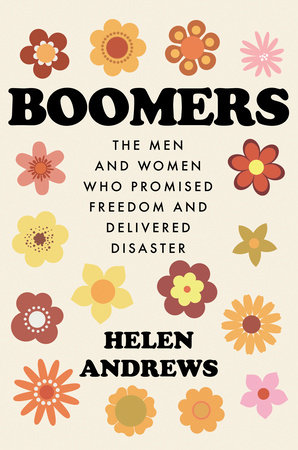

Helen Andrews lays out her approach in Boomers in her Preface where she writes: “…I found I had no interest at all in writing about buffoons and psychopaths, however colorful some of them were. Instead, I was drawn to the boomers who had all the elements of greatness but whose effect on the world was tragically and often ironically contrary to their intentions.” Andrews quotes David Crosby’s assessment of his generation: “We were right about the war. We were right about the environment. We were right about civil rights and women’s issues. But we were wrong about drugs.” (p.195)
When Andrews tackles Steve Jobs, she goes for the jugular. Not only did Jobs unleash cell phones on an unsuspecting populace–she doesn’t go as far as blaming Jobs for Tinder and Tik Tok–but Andrews suggests Jobs may have sown the seeds to civilization’s impending collapse.
Andrew Sorkin gets blamed for fooling an entire generation about the way politics and Washington works with his fictitious TV show The West Wing. I was surprised that Andrews didn’t blame social media on Sorkin because he wrote the screenplay to The Social Network, a movie about the founding of Facebook.
Jeffrey Sachs gets nailed because his economics doesn’t work. Andrews thinks “the Indian Jones of economics” is goofy and wrong.
Camille Paglia, “the next Susan Sontag,” falls short with her career as an academic superstar. Andrews chronicles the years Paglia labored in obscurity, teaching workers at the Philadelphia College of Performing Arts Night School until she hit the Big Time with Sexual Personae in 1990. Suddenly, Paglia was a hot commodity on the media circuit. “Paglia was able to parlay this initial burst of celebrity in a more lasting fame as a public intellectual.” (p. 105) Andrews uses this case study as one of the reasons our vaulted colleges and universities allow dissertations on The Sopranos.
I did not know that Reverend Al Sharpton worked as James Brown’s tour manager. “Traveling on the road with Brown taught Sharpton as much about business as it did about showmanship.” (p. 128). Despite the debacle of the Tawana Brawley hoax of 1987–where Brawley falsely claimed she had been gang raped by law enforcement officials–Sharpton managed to escape most of the blow-back of that escapade. And Sharpton settled most of the income tax problems he generated with his many “charitable” projects. Basically, Andrews dismisses Sharpton as a phony.
I confess I did not know much about Sonya Sotomayor. Andrews lists many of Sotomayor’s faults which basically reveals her as a diva. According to Andrews, Chief Justice John Roberts has criticized Sotomayor for attacking the majority of the Justices in personal terms. Using her heritage as a lever of power, Sotomayor destabilizes the Supreme Court according to Andrews. Personally, I’m not seeing it.
Boomers shows as much about Helen Andrews’s thought process and beliefs as it does the people Andrews accuses of “delivering disaster.” One has to wonder why Trump isn’t on this list… GRADE: C
Table of Contents
Preface ix
1 The Boomers 1
2 Steve Jobs 19
3 Aaron Sorkin 43
4 Jeffrey Sachs 69
5 Camille Paglia 97
6 Al Sharpton 125
7 Sonia Sotomayor 165
8 The Millennials 191
Acknowledgments 199
Notes 201
Index 231