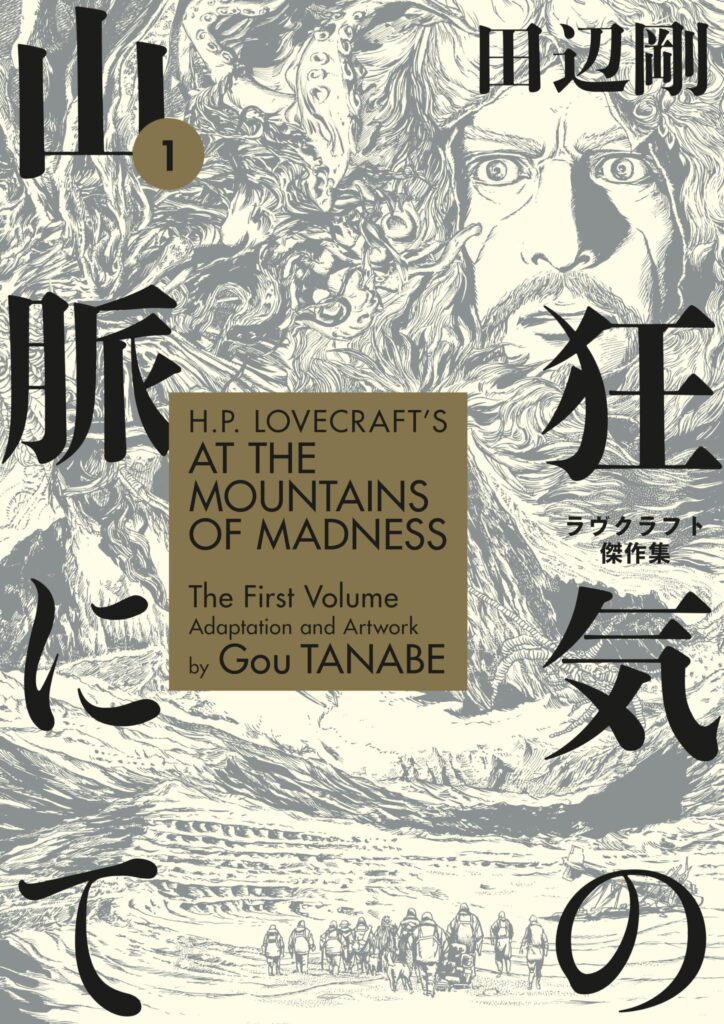
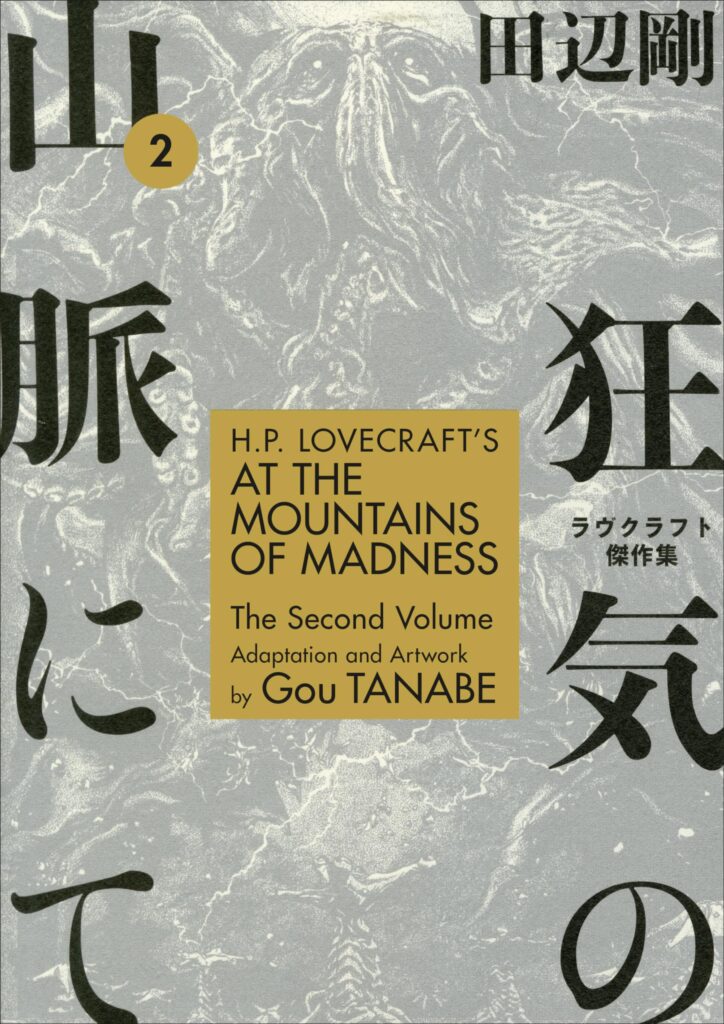
I’m a huge H. P. Lovecraft fan and At The Mountains of Madness may be his best known work. Gou Tanabe’s brilliant graphic novel blends incredible artwork with Lovecraft’s disturbing visions.
The book opens with this warning: Gou Tanabe’s manga adaptation of H. P. Lovecraft was drawn in the traditional Japanese comics style, whose page and panel order reads the opposite of the Western order, right-to-left. Please turn the book around and begin reading.
The English translation brings Lovecraft back to life. At the Mountains of Madness was written in February/March 1931 and published in 1936. It was rejected that year by Weird Tales editor Farnsworth Wright on the grounds of its length. Then it was originally serialized in the February, March, and April 1936 issues of Astounding Stories.
Lovecraft’s novel records the events of a disastrous expedition to Antarctica in September 1930, and what is found there by a group of explorers led by the narrator, Dr. William Dyer of Miskatonic University. Throughout the story, Dyer details a series of previously untold events in the hope of deterring another group of explorers who wish to return to the continent. These events include the discovery of an ancient civilization older than the human race. And you know what that means in Lovecraft Land…
If you’re an H.P. Lovecraft fan, this incredible graphic novel version of At the Mountains of Madness is a must-read. It doesn’t get much better than this! GRADE: A
I’ve never read Lovecraft but I have read a couple of his imitators! I didn’t like them! This graphic novel looks pretty keen, though!
Bob, check your local public library for Gou Tanabe’s books! They’re better than pretty keen!
I don’t think I have ever read Lovecraft.
Patti, Lovecraft’s stories are full of dread. If you’d like a book of Lovecraft stories, let me know and I’ll put it in the mail to you.
My opinion: AT THE MOUNTAINS OF MADNESS was the beest thing Lovecraft wrote, hands down.
There was an earlier graphic novel (in 2010) by I. N. J. Culbard which was named Graphic novel of the Month by the OBSERVER.
Guillermo del Toro has famously tried to get the story filmed for the last fifteen years. Technical and financial problems put a halt to the live-action project. Reportedly, del Toro began revising the script in 2021 with an aim for an animated, stop-motion version. One can only hope.
Jerry, you join many fans of Lovecraft who believe AT THE MOUNTAINS OF MADNESS was his best work. It certainly is haunting! This manga version by Gou Tanabe is first-rate!
I agree on MOUNTAINS.
Jeff, this manga version of AT THE MOUNTAINS OF MADNESS by Gou Tanabe is really great!
Contrarian that I am, I run lukewarm on MOUNTAINS OF MADNESS. I like his other shift from Gothic to SF, “Shadow out of Time,” more.
Fred, I’m going to track down other manga adaptations by Gou Tanabe of Lovecraft’s work.
George, I suspect more people still have run across such short stories as “The Outsider” or some of the more “key” Cthulhu stories than “Mountains”. I’ve never been HPL’s biggest fan, but it’s hard to not love the work of many of his acolytes, Robert Bloch and Fritz Leiber alone would be enough, and such admirers as Jorge Luis Borges. Then there are August Derleth’s attempted pastiches, and worse.
Though I do have a “MOM” anecdote. I was standing in line to get copies of Harlan Ellison’s DREAM CORRIDOR’s early issues signed for me and my aunt, who was a big Ellison fan (and I brought along one of my copies of the issue of TOMORROW SPECULATIVE FICTION that had Ellison’s and my stories in it), and behind me in the bookstore line were two younger men, not too much younger, but kinda hipster fans, and they began riffing on how cool it would’ve been if H. P. Lovecraft had published something in ASTOUNDING, what a trip!, and I then let them know about “At the Mountains” in ASF, if before JWC was editor…
Todd, Bloch and Leiber wrote Mythos stories far superior to many of Lovecraft’s.
indeed they did, and more importantly, they took some of his approach and did even betting things with it in their ways, along with writing their fiction in better prose. They were better and far less monomaniacal writers.