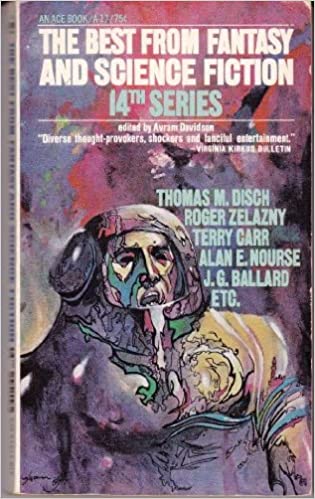
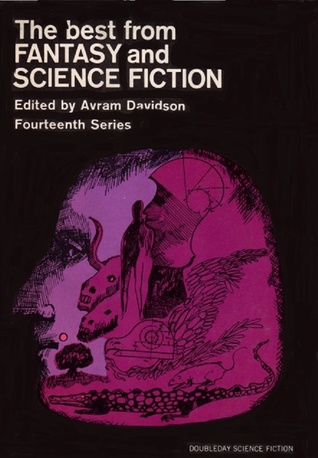
Avram Davidson ends his editing of The Best From Fantasy and Science Fiction series with this 14th volume. One of the most famous stories in this volume is J. G. Ballard’s haunting “The Illuminated Man” where the crystalizing of the world spells disaster (the Brits write the best End of the World SF!). Roger Zelazny’s “A Rose for Ecclesiastes” sends a poet to Mars to translate the story of the dying race and reveals a centuries old secret.
I also enjoyed Ron Goulart’s snarky “Into the Shop” where technology reveals its Dark Side. This 14th volume is another solid anthology in this successful series. GRADE: B+
TABLE OF CONTENTS:
- 3 • Time and Again (title page) • (1963) • interior artwork by Jack Gaughan
- 6 • Introduction (The Best from Fantasy and Science Fiction: 14th Series) • (1965) • essay by Avram Davidson
- 8 • Sacheverell • (1964) • short story by Avram Davidson
- 15 • Trade-In • (1964) • short story by Jack Sharkey
- 30 • The Illuminated Man • (1964) • novelette by J. G. Ballard
- 62 • A Bulletin from the Trustees of the Institute for Advanced Research at Marmouth, Mass. • (1964) • short story by Wilma Shore
- 71 • Automatic Tiger • (1964) • short story by Kit Reed
- 86 • The Court of Tartary • (1963) • short story by T. P. Caravan
- 94 • Touchstone • (1964) • short story by Terry Carr
- 108 • Thaw and Serve • (1964) • short story by Allen Kim Lang
- 118 • Nada • (1964) • short story by Thomas M. Disch
- 140 • Into the Shop • (1964) • short story by Ron Goulart
- 151 • A Rose for Ecclesiastes • (1963) • novelette by Roger Zelazny
- 190 • Olsen and the Gull • (1964) • short story by Eric St. Clair
- 197 • Dark Conception • (1964) • short story by Joe L. Hensley and Alexei Panshin [as by Louis J. A. Adams]
- 206 • The Compleat Consummators • (1964) • short story by Alan E. Nourse (variant of The Compleat Consumators)
- 211 • The House by the Crab Apple Tree • (1964) • novelette by S. S. Johnson
- 238 • The Girl with the Hundred Proof Eyes • (1964) • short story by Sharon Webb (variant of The Girl with the 100 Proof Eyes) [as by Ron Webb]
- 244 • Fred One • (1964) • short story by James Ransom