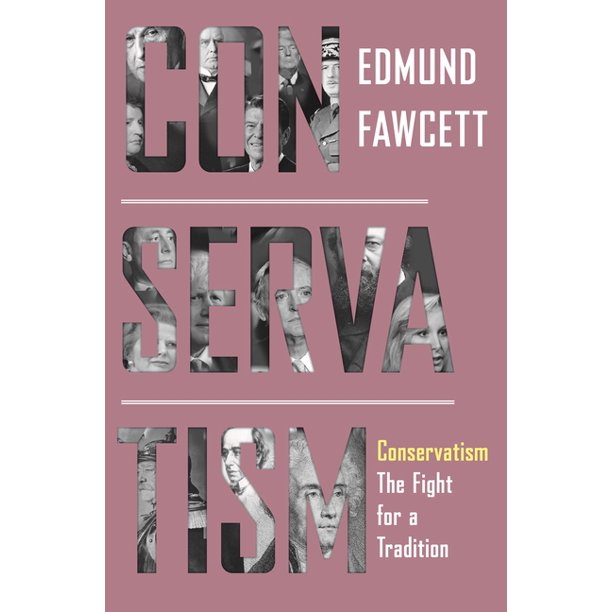
Edmund Fawcett, who wrote a book on Liberalism (you can read my review here), gives equal time to Conservatism. Fawcett sees these two political movements as Yin and Yang. They need each other and they also tend to counteract the other’s worst tendencies.
“Liberals, to schematize, embraced capital modernity. Conservatives responded by opposing the liberal embrace. The first liberals welcomed capitalism and critical thought, the twin turbines of a modern change. Liberals favored freer markets, moveable labor, and the self-generative force of money. They embraced religious indifference and social and cultural diversity, as well as the constructive power of disagreement.” (p. 42).
Conservatives resist change and embrace Tradition. “Popular distrust of higher education on the right is accordingly encouraged by conservative politicians. In 2016, Trump mocked universities for taking $200,000 of parents’ money to teach their children ‘zombie studies’ and how ‘to hate our country.’ ” (p. 371) The Right is also wary of experts. It’s painful to watch the ignorance of Rand Paul and Jim Jordan when they try to argue with Dr. Fauci.
If you want to understand the dynamics of Conservatism and where it is likely to go in the years ahead, I highly recommend Conservatism: The Fight for a Tradition (2020). GRADE: A
TABLE OF CONTENTS:
Preface xi
Acknowledgments xv
Part I Conservatism’s Forerunners
1 Critics of Revolution 3
i The Hard Authority of Punishment and Soft Authority of Custom: Maistre and Burke 3
ii The Call of Faith and Beauty: Chateaubriand 18
iii Order in Nations and among Nations: Gentz 25
iv Revolution to Prevent Revolution: Madison 31
v What the Critics Left to Conservatism 36
Part II What Conservatism Is
2 Character, Outlook, and Labelling of Conservatism 41
i Conservatism as a Political Practice 41
ii The Conservative Outlook 48
iii Conservative and Liberal Outlooks Contrasted 50
iv Bonding Spaces for Conservatives with Liberals 54
v The Adaptability of Conservative Ideas 56
vi “Conservatism,” “the Right” and Other Label Troubles 58
vii Dilemmas for Conservatives 62
viii Fighting for a Tradition 65
Part III Conservatism’s First Phase (1830-80): Resisting Liberalism: The Year 1830 71
3 Parties and Politicians: A Right without Authority 72
i Improvisations of the French Right 74
ii The British Right’s Divided Heart: Peel or Disraeli 80
iii German Conservatives without Caricature 88
iv United States: Whigs and Jacksonians; Republicans and Democrats 96
4 Ideas and Thinkers: Turning Reason against Liberalism 108
i Constitutions for Unacceptable Ends: Calhoun 111
ii Reason for the Right Replaces Nostalgia: Stahl 117
iii How Conservatives Should Defend Religion: Lamennais, Ketteler, Newman, Brownson, and Hodge 124
iv Conservatism’s Need for Intellectuals: Coleridge’s Clerisy 137
v Against Liberal Individualism: Stephen, Gierke, and Bradley 141
Part IV Conservatism’s Second Phase (1880-1945): Adaptation and Compromise: The Year 1880 159
5 Parties and Politicians: Authority Recovered and Squandered 160
i The Moderate Right in France’s Third Republic 164
ii British Conservatives Adapt 175
iii The Ambivalence of German Conservatives 186
iv The American Nonexception 194
6 Ideas and Thinkers: Distrust of Democracy and of Public Reason 205
i Defending Capitalism: Mallock, Sumner, and Schumpeter 207
ii Six Ways to Imagine the People: Treitschke, he Bon, Du Camp, Adams, Mencken, and Sorel 221
iii Cultural Decline and Ethical Anomie: Junger and Other Germans, Drieu la Rochelle, the Southern Agrarians, and Eliot 242
iv Funeral Oratory for Liberal Democracy: Schmitt and Maurras 255
Part V Conservatism’s Third Phase (1945-80): Political Command and Intellectual Recovery: The Year 1945 267
7 Parties and Politicians: Recovering Nerve and Rewinning Power 269
i Normality, Pride, and Rage in France: Pinay, de Gaulle, and Poujade 271
ii Tory Wets and Dries in Britain: Macmillan to Thatcher 277
iii Remaking the German Middle Ground: Adenauer and Christian Democracy 282
iv The US Right Divided: Eisenhower-Taft, Rockefeller-Goldwater, Ford-Reagan 288
8 Ideas and Thinkers: Answering Liberal Orthodoxies 295
i Herald of the Hard Right: Powell 297
ii Our Conservative Second Nature: Gehlen 300
iii The Liberal Moderns’ Fall from Grace: Weaver, Voegelin, and MacIntyre 305
iv Winning the US Stage: Kirk, Buckley, and Kristol 315
Part VI Conservatism’s Fourth Phase (1980-The Present): Hyper-Liberalism and the Hard Right: The Year 1980 327
9 Parties and Politicians: Letting in the Hard Right 328
i The Center-Right in the 1980s and 1990s 329
ii The Rise of the Hard Right: The Le Pens, AfD, Brexit, and Trump 339
iii The Theme Music of the Hard Right: Decline, Capture, Enemies, and Victimhood 349
iv What Populism Is and Isn’t 354
10 Ideas and Thinkers: Yes or No to a Hyper-liberal Status Quo 362
i Right-Wing Liberals, Antiglohalists, and Moral-Cultural Conservatives 364
ii The Hard Right in the American Grain: Buchanan, the Paleos, and Dreher 367
iii The New Voices of the Right in Germany and France 374
iv Three Unreconciled Thinkers: Finnis, Scruton, and Sloterdijk 383
v For the Status-Quo: Pragmatism, the Via Media, Anxiety, or “Realism” 406
Coda: Choices for the Right 415
Appendix A Conservative Keywords 419
Appendix B Philosophical Sources of Conservative Thought 424
Appendix C Conservative Lives: A Gazetteer 428
Works Consulted 467
Index of Names 495
Index of Subjects 507
No thanks…we see on a daily basis what the result of this “conservatism” is and where it’s taking us.
Deb, Conservatism has been perverted and turned into the MAGA mess. Long, long ago I was “conservative” when that meant a Balanced Budget and a Strong Defense. Now Conservatism is whatever Trump thinks today.
I miss the days when Conservative meant if it works, keep (conserve) it; if it doesn’t, change it. But those days, alas, never really existed except in theory. Today Conservative means destroy everything decent and reasonable before the Gods of Power and Money. The same, I suppose, could be said about Liberals if they were in power, but I doubt they be as blatantly mean-spirited and cruel.
There are perilous times for those with a conscience, a reasoning brain, and a modicum of humanity. **sigh**
Jerry, you’re right about Perilous Times. Can the November Elections make a difference? We’ll see…
What Deb said.
Very hard pass.
Jeff, true Conservatives are appalled at what Trump and his minions are doing.
I’m hoping for a blue wave after the election. I’m still amazed and disgusted by people who are with the orange idiot and his grifting and refusal to admit when he’s caught in his myriad of lies. I’ve heard from medical workers that ears don’t grow back, a perfect example of his deceit
Maggie, the prime reason the Blue Wave keeps getting reduced is: money. Millions of dollars from Trump and GOP PACs are flooding the swing states.
I’ll believe a blue surge in November when I see it. The party that consistently fields uninspiring candidates, prefers infighting to concerted action, and allowed itself to be pigeonholed as “tax and spend” sissies 40 years ago doesn’t inspire a lot of confidence in me. In Texas, the uneducated, frightened, and bigoted continue to be manipulated by dark money and opportunistic fraudsters who (forgive the imagery) have their heads firmly planted up DJT’s backside.
Fred. the Dems need to focus on Affordability. That’s what people are concerned about. And, if gas hits $5.00 by Election Day, there will be a Blue Wave!!