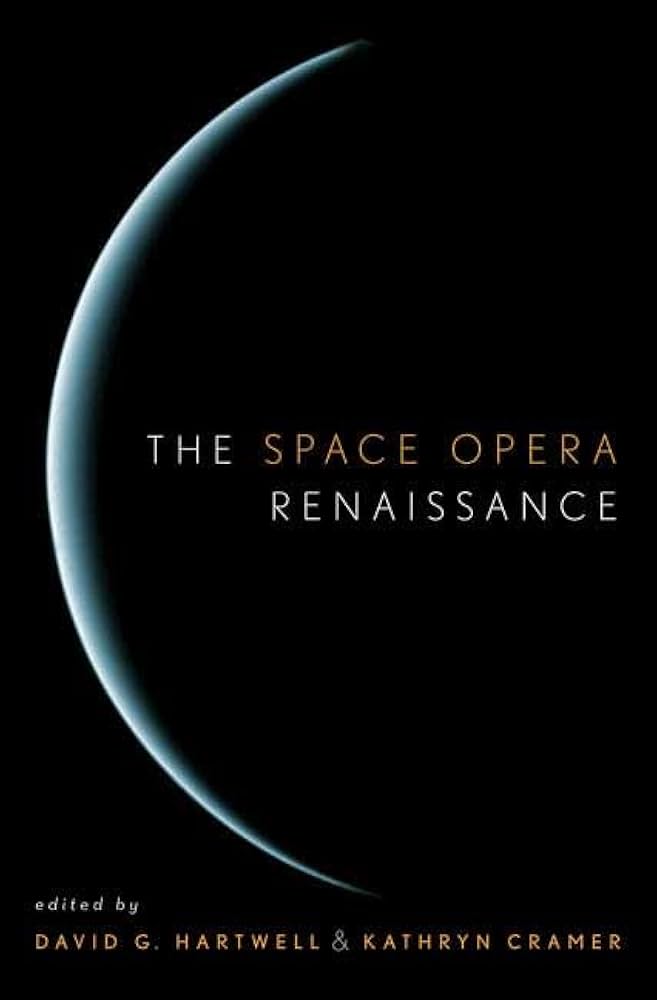
David G. Hartwell and Kathryn Cramer’s The Space Opera Renaissance, a 941 page mammoth volume from 2006, is divided into six sections. I’ve already reviewed Section 1 (you can read my review here) and you can read my reviews of Section 2 here and Section 3 here, Section 4 here, and Section 5 here. Finally, done!
Section 6 includes some of my favorite Space Opera writers. The best, in my opinion, is Alastair Reynolds whose first novel, Revelation Space (2000), launched a series of wonderful Space Opera books–I’ll be reviewing them in the months ahead.
While Charles Stross is best known for his Laundry series of fantasy thrillers with Lovecraftean overtones, he wrote some Space Opera in his early writing years like “Bear Trap.” I’m also a big fan of Scott Westerfeld’s Succession series–The Risen Empire (2003) and The Killing of Worlds (2003) (The two books were re-published in 2005 in one volume, also titled The Risen Empire). Westerfeld then shifted his writing to Young Adult novels which have been very successful.
While I enjoy John C. Wright’s Space Operas, I can understand why some readers might feel uncomfortable with Wright’s tendency to “Go Big.” As Wright wrote: “I am a space opera writer. I like large themes, thunder, fury, and wonder. Why blow up a city when you can blow up a world?” Do you see what I mean?
Although it took me a year to get through all 941 pages of The Space Opera Renaissance, it was worth it! GRADE: A
TABLE OF CONTENTS:
VI. NEXT WAVE (TWENTY-FIRST CENTURY)
* 833 • Grist • (1998) • novella by Tony Daniel
* 873 • The Movements of Her Eyes • (2000) • novelette by Scott Westerfeld
* 892 • Spirey and the Queen • (1996) • shortfiction by Alastair Reynolds
* 914 • Bear Trap • (2000) • novelette by Charles Stross
* 929 • Guest Law • (1997) • novelette by John C. Wright
I have a suspicion that George Scithers, the founding editor of ASIMOV’S SCIENCE FICTION magazine (initially ISAAC ASIMOV’S SCIENCE FICTION MAGAZINE) held its shorter-lived companion, ASIMOV’S SF ADVENTURE MAGAZINE, even closer to his heart…even as the latter only lasted a year or so…but it was an attempt to establish another locus for space opera fiction, in the tradition of PLANET STORIES and a few other magazines in the previous decades, which had been loci of space opera fiction. It also seemed a reasonably sensible chance to take in the years just after STAR WARS had demonstrated audiences existed for at least fairly simple and straightforward space opera. The examples gathered in this anthology were certainly more sophisticated work in similar modes to what Scithers had hoped to perpetuate, and certainly what inspired the relative bubblegum of the Lucas film mythos.
Todd, I think George Scithers had the Right Idea with ASIMOV’S SF ADVENTURE MAGAZINE, but the audience preferred Space Opera movies and TV shows.
Well, also, Scithers started SF ADV with a bang, with a Harry Harrison Stainless Steel Rat novella and a Poul Anderson novelet (a revised and perhaps restored version of a story he’d sold to PLANET STORIES when that magazine still existed), with some reasonable less memorable shorts…but soon turned the magazine over to his usual suspects, such as Barry Longyear and worse. That, and that it was in large format and therefore more expensive, but on non-slick paper and black and white beyond the outer wrappers, so no splashy color for the OMNI and HEAVY METAL (and other comics) readers, didn’t help in that direction. either.
Todd, plus magazines of all shapes and formats were in decline…
A correction…it did have, at least in early issues, a slick paper larger version of the cover illustration as a double-truck center spread (not quite a centerfold in the PLAYBOY/PLAYGIRL manner as it wasn’t a fold-out poster).
Todd, noted.
In the late ’70s, this was not quite as true as it soon would be (the die-off of magazines)…the Internet wasn’t a mass-medium till the mid-’80s, for example.
Todd, the Internet changed reading patters along with iPhones and iPads and Kindles!
I have not read much recent science fiction over the past couple of decades — finding much of it to bulky, too heavily detailed, too technical, and straying from the human connection. Lately, though — due in a large part to our current social and political climate — I find I am getting then urge to go back to a sense of wonder state of mind. This book might do it for me.
On another matter, CLOVIS came knocking at my door yesterday. Mucho gracias.
Jerry, I’m eager to read your review of CLOVIS! It is as unusual as FULLY DRESSED AND IN HIS RIGHT MIND! If you’re willing to wait, I’ll be happy to send you a copy of THE SPACE OPERA RENAISSANCE in your CHRISTMAS BOX.
I look forward to reading some stories from this anthology soon. It should keep me busy for a while.
Tracy, it took me about a year to read all of THE SPACE OPERA RENAISSANCE. It’s almost a 1000 pages!