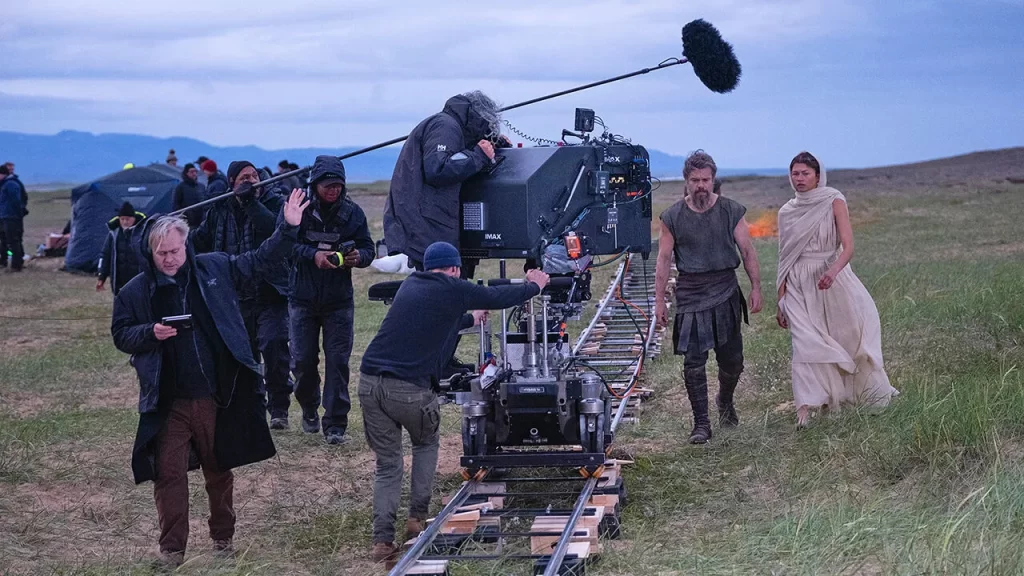
AN EPIC MISTAKE
The squabbles have been epic. Sir Christopher Nolan’s adaptation of “The Odyssey” was causing conniptions long before anyone had even seen the thing. Ahead of its release on July 17th, there was harrumphing over everything from the actress playing Helen (too black); the colour of the plume on Odysseus’s helmet (too red); the soldiers’ armour (also too black, and too Batman-like) and the vocabulary of Odysseus’s son (too American: at one point he says “Dad”). On YouTube the film’s trailer was met with criticism. “If I saw this on a plane, I’d still walk out,” reads one disgruntled comment.
The film itself is unlikely to allay any anxieties about anachronisms. In everything from its scenery to its psychology it says far more about the modern West than about ancient Greece. Startling liberties are taken with the plot to turn Odysseus, the archetypally flawed ancient hero, into a simple modern goody by flattening his flaws. Any bad behaviour is explained away either by drug use or hinted to be due to proto-ptsd (the overdiagnosis epidemic having apparently reached the ancient shores of Ithaca). The ending, which has him pierced by arrows and turned into a St Sebastian-style pincushion, is sillier still.
The scenery is similarly unsuitable, and often far too pretty. Soldiers in elegant gunmetal grey look less like ancient warriors than Warhammer toys. The ochre, candlelit palaces do not resemble warlords’ lairs but boutique hotels. During the beach scenes with the nymph Calypso (Charlize Theron), Odysseus (Matt Damon) seems less to be in agonising exile than on a Caribbean mini-break (they are wearing lots of linen). And the less said about the Cyclops, the better.
This is irksome but typical. Every adaptation of an ancient text is as much about its own era as the original work; less a lens than a mirror. The ancient Athenians transformed Homeric epic into psychologically acute tragedy. In the 18th century Alexander Pope’s translation managed to make Odysseus sound like an effete Enlightenment poet rather than an ancient warrior-king. In 1922 James Joyce’s version offered sex, stream of consciousness and that Modernist literary staple: boredom.
In this way, Sir Christopher’s retelling is part of a time-honoured tradition. It is manifestly a product of the present day. Female characters offer frequent apologias for feminism (not a noted strong suit of the ancients). The casus belli of the Trojan war is given as a desire to improve trade routes, as if Agamemnon were merely a blameless advocate for free trade rather than one of antiquity’s greatest thugs.
Adaptations have some latitude, for “The Odyssey” contains multitudes. In one of the most famous scenes, the god Proteus transforms into a lion, then a snake, then rushing water. “The Odyssey” is more protean still. In the three millennia since it was composed, it has been on an odyssey all its own.
The poem has become a noun (an odyssey) and an adjective (Odyssean). It has become a play, a tv series, a novel (“Ulysses”) and a porn film (“Odyssey: The Ultimate Trip”). It has become a lunar lander (im-1 Odysseus), a large asteroid (1143 Odysseus) and a body lotion (which, with notes of black pepper and sandalwood, no doubt smells better than its namesake would have).
It is therefore not surprising that Odysseus, the sacker of cities, has been transformed once again by Sir Christopher. In other ways it is surprising, as “The Odyssey” has been a wrecker of reputations. In 2024 a film starring Ralph Fiennes was dismissed as “dull” and a “slog”. A movie of 1954, starring Kirk Douglas, was described as “weird” and “vapid”.
Sir Christopher has form on tricky topics: his previous film, “Oppenheimer”, about particle physics and nuclear weapons, grossed almost $1bn at the box office. Still, he has learned that “The Odyssey” is not an easy book to film.
That porn flick hints at why: it describes itself, with admirable artistic honesty, as “Three unrelated stories”. The original “Odyssey” is not much better. It tells the tale of Odysseus’s ten-year journey home from the Trojan war and thus is commonly thought of as a kind of watery Greek road trip. But it is also a sex-and-sea-monsters film, a father-and-son film and a husband-and-wife film.
Its structure is fiendishly twisty. It is about Odysseus—but readers do not meet him for four books. Moreover, many of the stories that you think of as archetypally Odyssean are either not told at all or told in brisk narrative flashback: the Sirens slip by in some 60 lines and the Lotus-Eaters in about 20. It is, as Sir Christopher said, “the original non-linear narrative”. It is, says Emily Wilson, a classicist who published a dazzling translation in 2017, “complicated”.
It is also very famous. The second work of Western literature, it was once assumed to be secondary in seriousness to its more manly prequel, “The Iliad”. Yet in recent years its fame has far eclipsed it. The first Penguin Classic ever printed was “The Odyssey”. The pyramid of intellectual biomass resting upon it is vast. It is only 12,000 lines long, but look up “Odyssey” in the British Library and you are offered 34,000 titles: almost three for every line. “Iliad” returns a mere 9,000.
That it has become yet another film—and created yet more debates—is further proof of its permanence. There are two ways to see such squabbles. One is to engage with them on their own terms. These gripes have some validity: in Homer, Helen is clearly described as “white-armed”; Odysseus probably didn’t wear a red-plumed helmet (red was a Spartan habit); ancient Greek armour was bronze, not Batman-ish; and Odysseus’s son definitely didn’t say “Dad”. As Tim Whitmarsh, Regius professor of Greek at Cambridge University, points out: “The ancient Greeks spoke Greek.”
The other way to see these arguments is as proof of the malleability of “The Odyssey”. In an era in which people bristle at American influence in Europe, it lets people bristle at Americanisms (“Dad!”) in ancient Greece. In an era anxious about the excessively manly manosphere, people can fret over excessively manly armour. In an era riven by debates about race, people have engaged in bad-tempered rows over casting. We are not arguing about “The Odyssey” when we argue about “The Odyssey”. We are arguing about ourselves.
Each generation remakes “The Odyssey” in its own image: you get the version you deserve. The clever, quarrelsome ancient Athenians took Homer and transformed him into clever, quarrelsome tragedy. The Modernists turned him into Modernist prose and poetry. The simplistic, visual modern world has taken Homer and turned him into social-media spats and an absurd Cyclops—and thus into a tragedy that is all its own. ■
The Economist, July 18, 2026 p. 67-68
“If I saw this on a plane, I would still walk out” is just a ripoff of Amy Sedaris’s comic take on MELANIA
Jeff, I agree with Amy Seders on MELANIA (which I haven’t seen).
As if there aren’t plenty of real problems in the world to worry over. I am seriously concerned, though, about these bozos at Fox and elsewhere who keep complaining that Black actors were cast. Fanning the flames.
Fred, no just Black…but “too Black.”
I’d say the review is less snarky and more trying to hedge bets because the writer was still not sure how the film would be greeted. The main takeaway I took from the review is that Christopher Nolan was apparently knighted at some point—if the references to “Sir Christopher” are not themselves snark.
Yeah, I had to look that up, Deb, and yes, he used the title way too many times.
Still not interested in the movie. But I doubt it will get a screening at the White House. (Maybe MELANIA?)
The married couple Emma Thomas and Nolan were elevated, if that’s the term these days, to damehood and knighthood in 2024 by King Charles, for their service to and in the film industry. So, citation of that wasn’t inherently snark. (I certainly had to Go Look.)
“According to the The Economist Style Guide, knights and dames must have their full names and titles spelled out on first mention (e.g., Sir David Wilson). On subsequent references, they are referred to by Sir or Dame and their first name only (e.g., Sir David), and never by their surname alone.” https://tyrstylebook.hkbujournalism.com/wp-content/uploads/2017/08/TYR-style.pdf
Todd, good to know the Knight and Dames protocols.
Todd, I found the same conformation of Knighthood.
Well, at least at THE ECONOMIST’s stylebook…say, THE GURDIAN, might go a different way.
Yikes, GURDIAN is almost as bad, or worse, than their teasing typo-history nickname, THE GRAUNIAD.
Deb, Christopher Nolan was knighted by King Charles III at Buckingham Palace on December 18, 2024, for his extraordinary contributions to film. Apparently, King Charles didn’t see the BATMAN movies.
Ha. Or did see the taxes paid on those films, at least in terms of Nolan’s salary.
Todd, THE ECONOMIST and the GUARDIAN share opinions frequently. Both publications don’t seem to like Christopher Nolan or his movies…
Indeed, but THE ECONOMIST is much more aligned with Liberal-Democratic establishmentarianism…amusing, in a sense, given how shut-out the LDs have been for most of the past century. While THE GUARDIAN, while also institutional, probably doesn’t feel the same need to follow nobility title/naming rules as essentially the establishment leftist paper.
I believe the casus belli was the kidnapping of Helen, how that violated Zeus’s laws about respecting guests, and the purported need to punish the transgression so as to stay in Zeus’s good will. The unstated but more compelling motivation for persecuting the Trojan war was stated to be something about trade routes etc.
CW, saying the Trojan War was about trade routes is like saying the present IRAN WAR is about trade routes. Important, but not fundamental.
I’ve certainly read far more snarky reviews. This one seems to me to be trying to get at all the reasons, ranging from ridiculous to inherent in the source material to pandering on the part of the filmmakers, why this film might not fully suit any viewer.
Having thought about why I didn’t care for the Rouse prose translation a half-century ago, I think it was mostly that I found the prose unengaging, in fact dully-written. Considering all that’s going on…and we heard from another commenter who loved it, reread it several times. De gustibus.
Todd, I’ve read four different translations of THE ODYSSEY and each has strengths…and weaknesses. This reviewer of Christopher Nolan’s THE ODYSSEY brings up some valid issues. Matt Damon walking around with two arrows stick out of his back is one of them.
Coincidentally, there’s a more thoughtful piece on Nolan posted today on the VARIETY website called The “Elevated Fanboy Cult of Christopher Nolan” that pretty much mirrors my feelings about the man’s work and the public’s reaction to it. His films leave a bad, lingering taste to me so I’ll be skipping this and all of his future films. He’s no Kubrick (who was overrated) and he’s sure as hell no David Lean.
Byron, Christopher Nolan has the knack of making movies a lot of people want to see. On the Plus side, Nolan’s THE ODYSSEY has triggered a buying spree of Homer’s classic. How many people will actually read it…is debatable.
I am not interested in watching the film but this was very interesting, as were all the comments.
Tracy, I liked the detail in that review from THE ECONOMIST. I’ve read about a dozen reviews of Christopher Nolan’s THE ODYSSEY and only THE ECONOMIST review mentioned the two arrows in Matt Damon’s back. Also, I’m always thankful for the excellent comments on this blog. We have a knowledgeable and savvy group!
I saw an interview with Nolan on the daily show that was interesting. I’d be interested in seeing it on HBO etc, not sitting in a theater and with the ability to fast forward.
Maggie, in Nolan’s three hour THE ODYSSEY, you will be tempted to FAST FORWARD a lot! Plenty of scenes on ships!
As to the arrows in the back, I just assumed the armor mitigated much of their force.
I went into the theater hoping I would like it. I was a bit nervous about it, despite generally liking Christopher Nolan’s films a lot. (I still remember, way back when, the endorphin rush I got when I figured out what was happening in Memento.) Almost from the first frame of The Odyssey, I relaxed. I was liking it already. There was SO MUCH to it, I knew I wasn’t piecing it all together. It didn’t hit me until Odysseus said “WE are the People from the Sea” why that had been brought up so often. Seeing Zendaya as a mortal priestess instead of a goddess during the sack of Troy just had my brain saying “file away for later” instead of working to make sense of it right away. (This is twice now that filmmakers have cast as Athena an actress that I personally have found just breathtaking, though Zendaya is just so sad-looking — appropriately so — that I more enjoyed seeing her as Mary Jane in the preview for the upcoming Spider-man movie that showed before the main feature. The other was Isabella Rossellini in the Armand Asante tv mini-series.)
There were definitely times watching the movie that I thought, “I wouldn’t have done it this way,” though those scenes generally ended with me going “okay, that was interesting.”
I’ve enjoyed reading articles by people giving their interpretations. Comparisons to Oppenheimer have been interesting. Just the overall conclusions of so many people that Nolan was making a film about today, not about ancient Greece, are convincing. I admit that on my first watching I was getting confused about who was and wasn’t following the Laws of Zeus — and when. It was hard to think too deeply when you’re being presented with so much spectacle. The film is just so gorgeous. And the sound design is stellar.
George, I wish that you got as much out of it as I did. I had such a great time. Ann, who went hoping to like SOME of it, also surprised herself by loving it. We’ve been talking about at mealtimes for days.
Jeff, I’m just a literal guy. All four translations I’ve read of THE ODYSSEY were chronological. Nolan’s THE ODYSSEY jumps around. Matt Damon spends SEVEN YEARS with Calypso and Nolan gives it about five minutes. I think THE ODYSSEY is a good, but not great movie. Yes, its IMAX version is impressive. But a movie is more than just a spectacle.
Five minutes is about all that Homer gives Calypso — and most of it is Hermes telling her that Zeus wants her to let Odysseus go.
Jeff, good point!