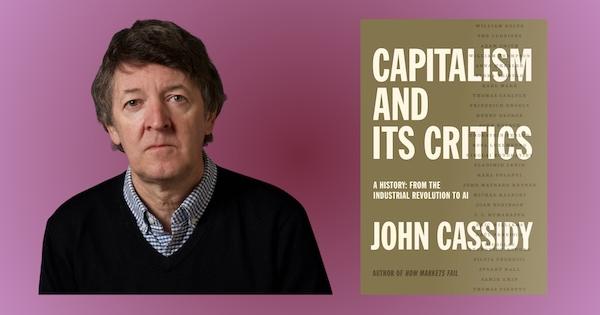
A while ago I reviewed Martin Wolf’s The Crisis of American Capitalism (you can read my review here). I decided to follow that up with John Cassidy’s new Capitalism and Its Critics which provides an excellent overview of the history Capitalism.
To alter Winston Churchill’s famous saying about Democracy, Capitalism is the worst economic system…except for all the others. No other economic system yet invented increases the standard of living as fast and can improve the Economy as consistently. In its 611 pages, Capitalism and Its Critics, John Cassidy covers a lot of ground. Some of the reactions to Capitalism in the Past will no doubt erupt again with the arrival of more powerful Artificial Intelligence software.
“This is not a Religious Age,” Thomas Carlyle remarked. “Only the material, the immediately practical, not the divine and spirtual, is important to us. The infinite, absolute character of Virtue has passed into a finite, conditional one: it is no longer a worship of the Beautiful and Good; but a calculation of the Profitable.” (p. 102). This partly explains the growing rate of mental illness in our country. Capitalism produces Winners (like Elon Musk and Jeff Bezos) and millions of “Losers” who struggle from pay check to pay check.
Cassidy warns that AI could produce the reaction that made the Luddites, bands of English workers who destroyed machinery especially in cotton and woolen mills–because they believed that technology was threatening their jobs (1811–16). When AI causes massive layoffs of workers in call centers, truck drivers and taxi drivers (because of self-driving trucks and cars), and millions of workers in other jobs there might be a violent response. Our Government hasn’t prepared for this yet.
“During much of the 20th Century, the forces of convergence–wars, tax policies, progressive social norms, public education, the enhancement of worker skills, labor unions–had held in check some of the capitalistic system’s darker tendencies. But by the new millennium the combination of neoliberal policies, globalization, labor-saving technological progress, and a shareholder value movement that glorified wealth creation had shifted the balance of power (and material rewards) back to Capitalism.” (p. 488)
As the number of Have-Nots grow–and it will–the capitalistic system will be increasingly under attack. Politicians like Bernie Sanders advocate for socialistic policies that are also problematic. Cassidy concludes: “The system can be reformed: the challenge is to summon the will and the means to do it. With the rise of right-wing populism, profit-driven AI, and a tech and finance oligarchy that was increasingly uninhibited about exerting its political influence, the task, going into the second quarter of the 21st Century, seems more formidable that ever.” (p. 518) GRADE: A
TABLE OF CONTENTS:
Introduction — 3
1 : “The roguery practiced in this department is beyond Imagination” : William Bolts and the East India Company — 13
2 : “The mean rapacity, the monopolizing spirit of merchants and manufacturers” : Adam Smith on Colonial Capitalism and Slavery — 26
3 : “On the brink of the last struggle” : The Logic of the Luddites — 40
4 : “It is time . . . to seek for a radical, a permanent cure of the evils that afflict society” : William Thompson’s Utilitarian Socialism — 52
5 : “In speaking of the degraded position of my sex” : Anna Wheeler and the Forgotten Half of Humanity — 69
6 : “Abandon your isolation : unite with each other!” : Flora Tristan and the Universal Worker’s Union — 82
7 : “One of the shabbiest Gospels ever preached on Earth” : Thomas Carlyle on Mammon and the Cash Nexus — 100
8 : “The war of the poor against the rich will be the bloodiest ever waged” : Friedrich Engels and The Communist Manifesto — 116
9 : “Our friend, Moneybags” : Karl Marx’s Capitalist Laws of Motion — 137
10 : “We must make land common property” : Henry George’s Moral Crusade — 159
11 : “The ideal pecuniary man is like the ideal delinquent” : Thorstein Veblen and the Captains of Industry — 179
12 : “A particularly crude form of capitalism” : John Hobson’s Theory of Imperialism — 199
13 : “Capital knows no other solution to the problem of violence” : Rosa Luxemburg on Capitalism, Colonialism, and War — 215
14 : “The rhythm of long cycles” : Nikolai Kondratiev and the Capitalist Development — 237
15 : “The more troublous the times, the word does a laissez-faire system work” : John Maynard Keynes’s Blueprint for Managed Capitalism — 256
16 : “The time was ripe for the fascist solution” : Karl Polanyi’s Warnings About Capitalism and Democracy — 276
17 : “The bankruptcy of reform” : Two Skeptics of Keynesianism : Paul Sweezy and Michal Kalecki — 295
18 : “Economics once more became political economy” : Joan Robinson and the “Bastard Keynesians” — 311
19 : “Nature . . . faithful and submissive to those who respect her” : J. C. Kumarappa and the Economics of Permanence –331
20 : “Vast sugar factories by a camarilla of absentee capitalist magnates and worked by a mass of alien proletarians” : Eric Williams on Slavery and Capitalism — 349
21 : “The periphery of the economic system” : The Rise and Fall of Dependency Theory in Latin America — 371
22 : “Shock treatment” : Milton Friedman and the Rise of Neoliberalism — 391
23 : “Any use of the natural resources for the satisfaction of non-vital needs means a smaller quantity of life in the future” : Nicholas Georgescu-Roegen and the Limits to Growth — 408
24 : “A true masterpiece at the expense of women” : Silvia Federici and Wages for Housework — 423
25 : “It is a form of regressive modernisation” : Theorists of Thatcherism : Stuard Hall vs. Friedrich Hayek — 439
26 : “Social disintegration is not a spectator sport” : Parsing Globalization : Samir Amiin, Dani Rodrik, and Joseph Stiglitz — 458
27 : “A historically unprecedented situation” : Thomas Piketty and Rising Inequality — 480
28 : “A confluence that could propel a new paradigm” : The End of Capitalism, or the Beginning? — 501
Notes — 519
Acknowledgements — 571
Index — 573
You can die from drinking too much water. Too much of anything is dangerous. unrestricted capitalism may the cancer that kills capitalism. Over-weaning greed and widening income gaps are just two of the issues that need to addressed if we are to continue as a free and thriving society. I don’t know what the answers are but I pray they are out there somewhere. Perhaps we just start by giving the oligarchs and the politicians some good swift kicks in the head.
Jerry, well stated! Capitalism in the U.S. has plenty of problems. Everything in Washington seems to be on Sale. “Conflict of Interest” is completely ignored. The Supreme Court has opened the door to Dark Money that skews our Elections. Insider Trading, betting on political events using inside knowledge, rampant corruption, and many other dysfunctional aspects of Life in America today need fixing…and fast!
Social democracy, when not just a slogan for neoliberalism with tax breaks for focused charities, helps. However, corruption usually manages to pollute every system…or always rather than usually, to some and mostly too great a degree. There are no panacea social democracies, but they Do tend to be better than every other system humanity has tried in recorded time…except the best anarchist communes, which are difficult to Scale Up.
Todd, some people are inherently greedy and use their position to cheat the Capitalistic system. It’s a flaw in the system that needs to be fixed.
And too many have been convinced, that that is a feature rather than a bug of capitalism, which they see as the Necessary Staging Ground of Necessary corporatism.
Todd, when Capitalism was beginning refined by Adam Smith back in 1776, corporations were rare. Now, the economy is dominated by trillion dollar corporations like Apple, GOOGLE, and Nvidia.
What Jerry said.
Jeff, the current Lords of Capitalism are perverting the system with their buying elections and turning Congress into a non-functioning factor in the balance of power. The Supreme Court has thrown a lot of power the President’s way and look at the result: a looming Recession and another foreign war that drags on…at a billion dollars per day!
Funny how that can happen, with toadies rewarding and enabling an increasingly senile malignant narcissist career embezzler and thug when he can get away with it (women, girls, his sons).
Todd, leaders who surround themselves with toadies and sycophants usually fail. Systems require competence to run successfully. Neglect sooner or later leads to failure.
Musk and Bezos are certainly, by some values, Winners, clearly…but by others, they are precisely the kind of Losers that makes the possibility of oligarchic hegemony Problematic, to say the very least. Drumpf that much moreso.
Todd, Musk is soon to become the first Trillionaire. Bezos needs Government funding for his space ventures. Both men have demonstrated the lengths they will go through to achieve their aims.
I’ve said it before, AI will destroy the world as we know it!
Bob, right now, Artificial Intelligence is destroying entry-level jobs. Students who are graduating now are finding it hard to find a good job.