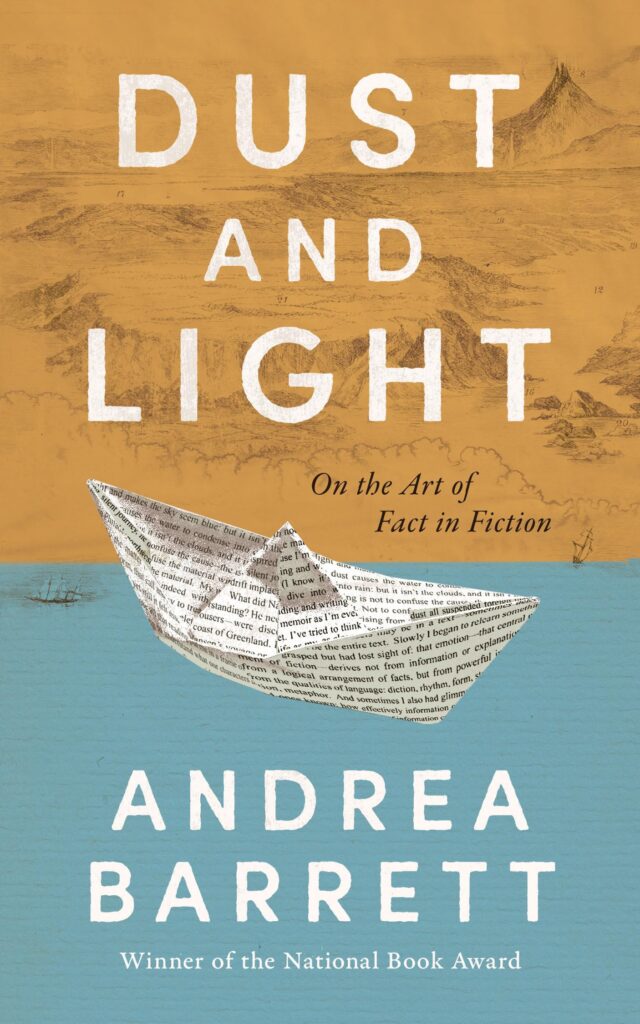
Andrea Barrett won a National Book Award for Ship Fever. Barrett has hit the Best Sellers List with Voyage of the Narwhal, Servants of the Map, and Natural History. In her new nonfiction book, Dust and Light: On the Art of Fact in Fiction, Barrett explores various means of injecting historical facts into novels.
One of my quibbles with many novels is that some authors do information dumps. The action of the novel is interrupted by a page or two (or more!) of fact after fact after fact. I find that trend annoying because it stalls the momentum of the novel and frequently bogs down the story.
Barrett’s techniques of weaving facts into fiction with grace and precision without grinding the story to a halt are both practical and clever. If you’re a fan of historical fiction, you’ll enjoy Barrett’s methods to keep novels lively and educational. GRADE: A
TABLE OF CONTENTS:
INTRODUCTION — 1
- The Floating Pants 19
- The Years and the Years 57
- Dust and Light 77
- Traveling Corpse 97
- Life Writing 125
- Life, Writing 167
ACKNOWLEDGEMENTS — 177
NOTES — 179
INDEX — 187
I hadn’t thought about this before, and I’ll soon lose track of it, but the metaphor that comes to mind is History as the cradle for a narrative: the factual events that become foundation and context for the stuff I make up. All this is vital to a story, but you didn’t come to admire the cradle–your eyes are on the Baby.
When I wrote ‘NADA, I set it in Mexico in 1935 because that time and place gave me the facts I needed for the tale I wanted to tell–the Great Depression, the Holocaust and the Jewish Exodus from Europe, even the national ban on owning Gold, all this seemed to shape the story, when in fact they were just chosen for effect, like the Murder Weapon in a Mystery.
Dan, that’s fascinating! Most writers talk about the importance of Character–or Plot–but Setting seldom gets the shout-out you just gave it!
Interesting-sounding book…I’ve missed her work.
Typo alert: “Barrett’s techniques of weaving facts into fiction with grace and precision with grinding the story to a halt […]”–I suspect you meant “without”
Happy Heat Wave War Footing Monday!
Todd, once again WORDPRESS’s spell checker is messing with me! Trump opened up a Pandora’s Box of trouble with his “spectacular” bombing of Iran. I watched that dolt J. D. Vance on MEET THE PRESS yesterday claiming the U.S. was NOT at war with Iran–we’re at war with Iran’s Nuclear Program!
Nice idea for a book.
Patti, DUST AND LIGHT is a quick read with gave me a lot to think about.
Nothing grinds a book to a halt faster than an info dump. I like a book that introduces information lightly and incorporates it as part of the plot. I recently read a book where the main characters were farriers (people who care for the hooves of horses). I knew nothing about this occupation, but through the actions of the characters in the book, I got an idea of what that sort of work entails. I even watched a few YouTube videos of farriers cleaning, trimming, and re-shoeing horses. It was quite interesting. But if the story had stopped every few pages to give me a “the job of a farrier is to…” lesson, I would have closed the book and never re-opened it.
Deb, a lot of SF novels feature info dumps: how a faster-than-light drive works, how Artificial Intelligence works, how anti-gravity works, etc. One of the reasons the later DUNE books by Frank Herbert are less popular than the early DUNE novels is Herbert’s constant info dumps in those 500+ page books.
It’s true. That can really pull a reader out of a book.
One book that I thought did a good job with that was something I read after George reviewed it a month or two ago. Rob Osler’s THE CASE OF THE MISSING MAID is set in 1888 Chicago, and I thought he did a good job with the setting and time period. My only complaint was, I kept feeling like Joan Cusack’s character in IN AND OUT, saying “Is EVERYBODY gay?”
Typo alert: 1898, not 1888.
Jeff, I liked THE CASE OF THE MISSING MAID and I hope Rob Osler learns from that book that many readers are more interested in the mystery than the gender bending.
I got this and her first short story collection from the library.
Jeff, Diane’s Book Club has read Andrea Barrett’s books with enthusiasm!
This book seems interesting. Like everybody over here, I too hate info dumps.
Neeru, I suspect writers think they’re doing the reader a favor by dumping a lot of information about the plot on them. But, the truth is that info dumps just slow the book down to a crawl.
“But I did all this research! And this gets up the page count!”