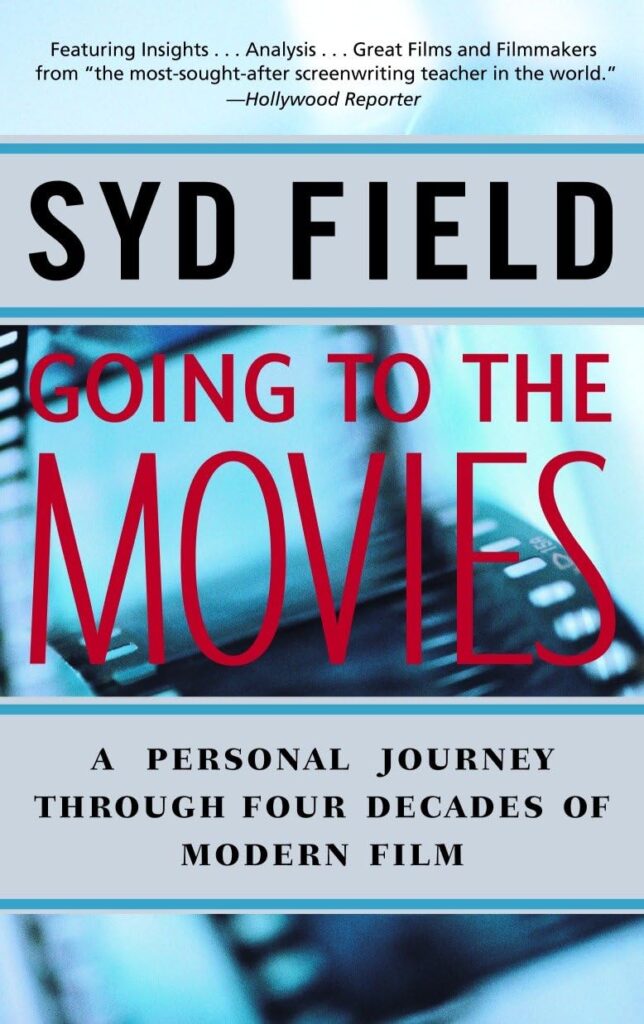
Syd Field, who has worked in the film industry for decades, tells the story of how he fell in love with movies. My favorite scene in Going to the Movies is when Syd Field, while soaking in a hot tub pondering Three Days of the Condor, comes up with a definition of a screenplay’s dramatic structure: “a linear arrangement of related incidents, episodes or events leading to dramatic resolution.”
While watching Chinatown and Manhattan, Field developed the idea of a “middle point” in Act II that turns a screenplay into two manageable 60-page units of dramatic action. More of Field’s lessons follow on the use of bookends, flashbacks, and the whammo,
One of the reasons Going to the Movies is such a fun experience is Field’s tendency, whenever he sees a good film, “to take it apart and see how and why it works.” Syd Field analyzes dozens of movies in this book and you’ll come away with a new appreciation for those fields after learning what makes them tick. What’s your favorite movie? GRADE: A
TABLE OF CONTENTS:
INTRODUCTION — xv
- La Grande Illusion — 1
- Movies 101 — 19
- Catching the Wave — 35
- Shadows on the Wall — 51
- Movies, Myths and Heroes — 69
- In Search of New Beginnings — 85
- The Wild Bunch — 103
- The Blank Page — 115
- Sunset Boulevard — 137
- Turning Pages — 155
- Sherwood Oaks –171
- Chinatown — 189
- The Paradigm — 207
- Second Time Around — 223
- Finding the Mid-Point — 239
- Time Past, Time Present — 255
- New Voices, New Visions — 269
- On Going to the Movies — 285
Index — 303
I love reading about films, especially well-written criticism from the much-missed lost golden era of magazines and newspapers. The problem with analyzing film structure though is it ignores the very messy business of filmmaking and imposes a contrived architecture on a movie that exists solely in the minds of academics and critics.
Scripts are rewritten on a daily basis, whole scenes are improvised on the spot, films are torn apart and reenvisioned in the editing booth with complete disregard for the shooting script. A good screenwriter or editor will often structure a movie more around an internal sense of rhythm than any regard for structure. The most meticulous of directors will plan a film down to the smallest detail then throw everything out the window the moment they walk onto the set. Some movies appeared to be hopelessly dead on the screen until the right composer breathed life into it with a powerful score. It’s why even the best candidates for auteurship tend to roll their eyes at the merest mention of film theory.
I’m sure this is an interesting read but I take his ideas with more than a grain of salt. Having said that, my favorite movie is probably “The Apartment ” which, like “Sunset Boulevard,” owes much of its beauty to the fact Billy Wilder understood screenwriting perhaps better than anyone in the trade, although he also realized the best script was just dead paper without the right actors to breathe lie into it. I’d also put “The Magnificent Ambersons” at the top of my list. It’s a notoriously damaged film but even so it has some of the lovelist moments of any movie I’ve seen.
Byron, I’m always interested in what insiders in Hollywood have to say about the movies they worked on. I’m amazed that anything gets made at all with all the problems movies have!
Pros adapt. Fools destroy.
Casablanca
Jeff, hard to argue with CASABLANCA.
Reminds me of Robert McKee (portrayed wonderfully—although I’m not sure McKee would agree—by Brian Cox in “Adaptation”) and his emphasis on “story structure”. McKee’s theory was that acting, dialogue, and the whole “feel” of a film was less important than the structure of the story—and he rode that train for all it was worth (for decades every aspiring screenwriter took McKee’s course and read his book). But I’m with Byron: a movie is a collaborative effort where the final result is always a unique combination of everything that has been thrown into the pot. I can’t pick a favorite movie, but if I’m channel-surfing (which, in the age of streaming services, we don’t do too much any more), I’ll always stop if I find “Close Encounters”, “Animal House”, “Moonstruck”, or “Fargo”. Many others too, no doubt, but those are the ones that pop into my head right now.
Deb, I can’t resist DIE HARD around Christmastime.
In the channel-surfing days, I could not resist SPEED, but I never considered it my favorite movie. That is a coin flip between CASABLANCA and DON’T LOOK NOW.
Jeff, the other Jeff is a big fan of CASABLANCA, too.
THE APARTMENT FOR sure. I can’t hear the theme song without wanting to watch it again. Followed by ALL THE PRESIDENT’S MEN, THREE DAYS OF THE CONDOR and BRINGING UP BABY.
Patii, all excellent choices!
I can probably answer the question What are your five favorite horror films, or five favorite mystery films, or five favorite westerns, or five contemporary (for their times) mimetic (more or less) dramas. rather easier.
Most of my favorite critics have been most interested in the narrative, or whatever has been highlighted in the place of narrative, in the films and other a/v they’ve reviewed.
While not ignoring all the other artistry involved at other levels…lighting, scoring, makeup and wardrobe, editing…
Todd, Syd Field discusses the importance of lighting, scoring, make-up, wardrobe, editing, etc.
Todd, I’m also interested in narrative, both in books and movies.
I don’t have a Favorite Film per se, but the Greatest Film Ever Made is–without a doubt and beyond all debate– THE FATAL GLASS OF BEER.
Dan, I’m also partial to THE GOOD, THE BAD, AND THE UGLY.
Two films inseparably linked in the minds of critics and the movie-going public.
Dan, I’m pleased that both SUPERMAN and THE FANTASTIC FOUR had large, enthusiastic audiences when Diane and I went to see them. It’s been a long time since I’ve seen our AMC Theater that active!