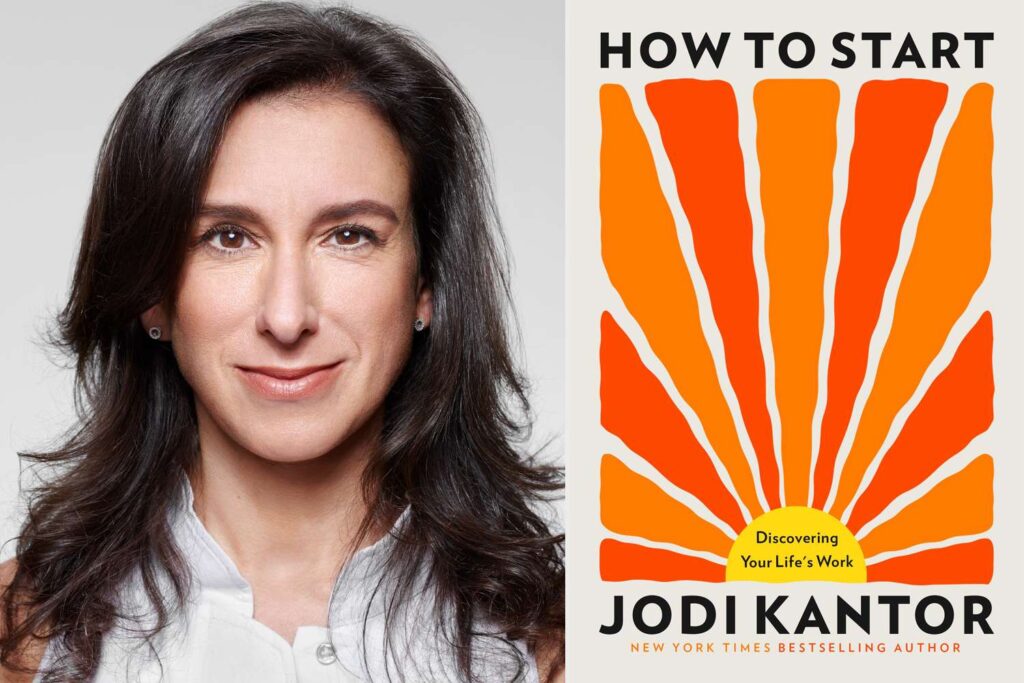
It’s Graduation Season and Jodi Kantor’s slim 100-page book, How to Start: Discovering Your Life’s Work (2026), shows up at exactly the Right Time. Jodi Kantor, a New York Times investigative reporter, won a Pulitzer Prize for Public Service by revealing the Dark Side of Harvey Weinstein’s abuse of women. When Columbia University, her alma mater, asked Kantor to deliver the Graduation Address, she agreed. When Kantor reached out to Columbia students about to graduate, she found them in a panic.
Cuts to internships, programs, and scholarships reduced options for students. The impact of Artificial Intelligence on the job market–effectively eliminating many entry level professional positions–caused many students to wonder if the years spent at Columbia University–and the money–were wasted.
Jodi Kantor uses her own career experience to deliver some sensible advice to these Columbia Graduates. Kantor originally went to Harvard Law School after graduating from Columbia University. But Kantor soon realized she wasn’t interested in becoming a lawyer. Her true passion was to become an investigative journalist…so she dropped out of Harvard to the dismay of her friends and parents. Instead, Kantor launched her successful career.
If you know some student who is graduating from college, I can’t think of a better gift than How to Start. It’s a book filled with practical suggestions, success examples, and…hope. GRADE: A
TABLE OF CONTENTS:
Introduction –1
Craft — 17
Need — 31
Money — 41
How to Start — 53
Why to Start — 85
Acknowledgements — 93
Follow your passion may not be the best career advice, but it is essential for having a meaningful life. Money, fame, and career success have never really interested me, but curiosity and compassion have made me a much better person, husband, father, neighbor, and citizen, so I think I have come out ahead of the game. Being worthy of your wage and being true to yourself are qualities we should all strive for.
Jerry, I first worked as a Librarian (since I love books) but after a couple of years, I realized Libraries were the first thing that got cut when Bad Economic Times hit (this was the early 1970s). So I changed my career path and got a Master’s of Business Administration and taught college classes in Business for almost 40 years. I enjoyed both jobs and was lucky to have worked with Good Friends who had my back when times occasionally got tough. The different between Then and Now: No AI in sight!
I was extraordinarily lucky in my career, finding good jobs and upward mobility in journalism and public affairs through a modicum of talent and a huge measure of luck and networking. And mentors! From the start, I had a long line of supportive mentors.
Fred, I love the fact you honor your mentors! I’ve had some professors who inspired me, too!
I would tend to join low-reward firms, do the best job I could and build more responsibility inton the job I had, and then leave mostly for external factors (my longest gig, public broadcasting Network Reporter at TV GUIDE, was cut off when Macrovision/Rovi liquidated its assets and scheduling reportage was no longer the purview of what had been TVG).
This is perhaps not the way to do it.
Todd, there are many roads to success…
I keep wandering into adjacent fields rather than following the paths. Not to distend the metaphor too severely. It is notable how many of the companies I’ve worked for are now gone.
Todd, the career path I took doesn’t exist any more. Most of the colleges and universities I taught for in my 40 year teaching career have downsized and eliminated programs I taught in. Many students today question whether the time and money for a college degree is worth it…
Too late for me, not that I’d have any use for this book!
Bob, but your kids mine find HOW TO START useful…
My kids are grown and invested in their careers! Besides, I hate these kinds of books!