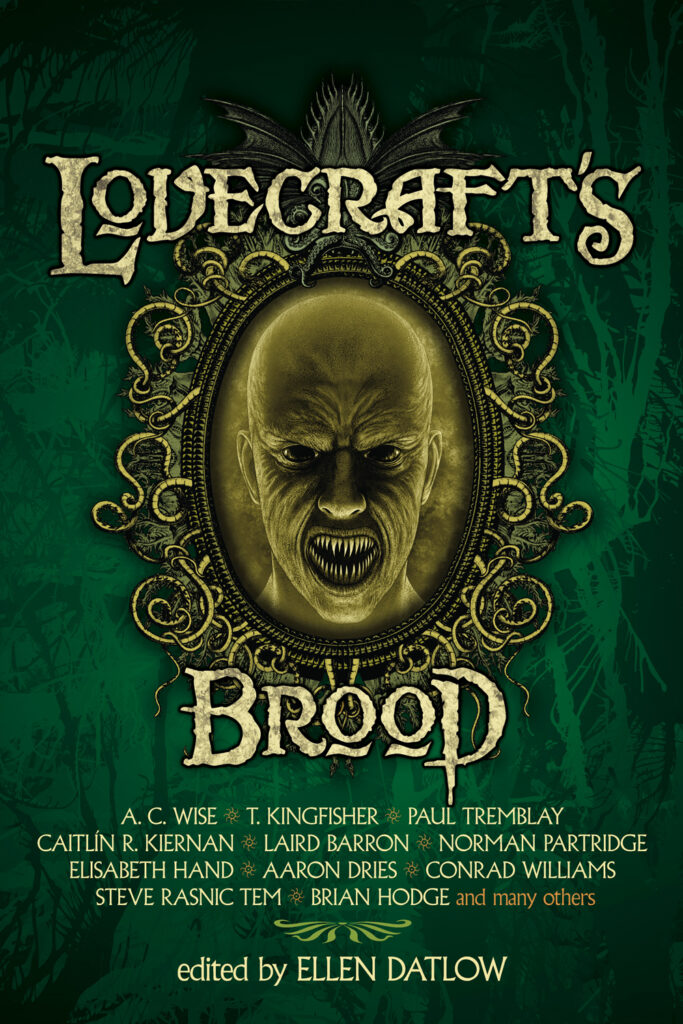
I’ve read over a dozen Ellen Datlow anthologies. In her “Introduction” Datlow claims “most of the stories collected here are infused with cosmic dread” (p. 8). Wrong! All of the stories–except one–are infused with dullness. Only one of the 19 stories captures the essence of a Lovecraft pastiche. That one story is Caitlin R. Kiernan’s “The Beholder’s Share.”
“The Beholder’s Share” starts out conventionally. The narrator’s friend Maggie buys a box of books at an estate sale. Maggie leaves the box of books with the narrator claiming she’s planning to sell the books on Ebay. As you can guess in a Lovecraft pastiche, the books in that box are not just any books.
The books have a history full of dread–the kind that Datlow claimed infused the stories in Lovecraft’s Brood (2026). Kiernan takes the reader through the strange history of the books and the implications that the books have the power to control human actions…in a Bad Way.
Other than “The Beholder’s Share,” I found the rest of the stories of Lovecraft’s Brood disappointing. This anthology is not a brood, but just an only child. GRADE: D (for dull)
TABLE OF CONTENTS:
INTRODUCTION by Ellen Datlow — 7
“Once Seen” by Conrad Williams — 11
“Mister Ainsley” by Steve Rasnic Tem — 27
“Sideways” by Ray Cluley — 37
“Empty Shells on a Cold Shore” by Jacob Steven Mohr — 65
“The Keep Quiet” by Aaron Dries — 73
“Agent of Chaos” by T. Kingfisher — 95
“The Beholder’s Share” by Caitlín R. Kiernan — 105
“Backbite” by Norman Partridge — 133
“Eat the Wyrm” by Elisabeth Hand — 153
“The Note” by Paul Tremblay — 159
“A strange form of life” by Laird Barron –179
“Call of the Void—L’appel du Vide” by Carol Gyzander — 191
“Hypnopompia” by L. Marie Wood — 203
“Volcano” by Livia Llewellyn — 207
“Halogen Sky” by Wendy N. Wagner — 233
“Wind Come Down the Mountain” by A. C. Wise — 247
“Infantum” by Ian Rogers — 261
“Diving Deep” by Gary McMahon — 275
“One Possible Shape of Things to Come” by Brian Hodge — 289
About the Authors — 310
About. the Editor — 315
As you note, George, it is very hard to imitate Lovecraft. Few writers have been able to capture his sense of cosmic horror. A few early stories by Frank Belknap Long and Robert Bloch, but not many others; even August Derleth, who tried to pick up Lovecraft’s mantle, fell flat. Far more successful are those writers who were influenced by Lovecraft in one way or another: Clark Ashton Smith, Robert E. Howard, and E. Hoffmann Price from back in the day, and more recently F. Paul Wilson, Fred Chappell, and Ramsay Campbell, among others. Imitating Lovecraft is a mug’s game; drawing on the Lovecraft tradition is not. Sadly, too many writers cannot discern the difference.
Jerry, “too many writers cannot discern the difference” is the reason LOVECRAFT’S BROOD was a flop. In my humble estimation, Fred Chappell’s “The Adder” Deathrealm (Summer 1989) is one of the best Lovecraft pastiche’s I’ve ever read. The best Lovecraft pastiche is Frank Belknap Long’s “The Hounds of Tindalos (1929). Charles Stross’s LAUNDRY series–especially the early titles–captured that Lovecraft dread.
I would add Donald Wandrei and Colin Wilson to Jerry’s list, but as he notes, it’s a select few who could come close to HPL. I enjoy Derleth’s pastiches for their pulpy vibe, but they’re about as scary as an episode of Ms. Rachel.
Fred, Derleth tried to emulate Lovecraft and fell short. He had more success emulating Sherlock Holmes with his Solar Pons series.
Man, Lovecraft really is an industry these days.
At one point, he lived in the area of Brooklyn where we lived when we first got married. I did once find the building where he had lived, but it looked surprisingly ordinary. No overgrown gardens or places for eldritch beings to lurk.
Jeff, I wish Ellen Datlow had told her contributors to Lovecraft’s Brood to infuse their stories with The Three D’s: Dread, Dark Forces, and Doom. They are at the heart of every Lovecraft story.
If you look up 169 Clinton Street on Google Maps, you’ll see the brownstone in pricy Brooklyn Heights where Lovecraft lived just 100 years ago.
Jeff, I checked it out. I’m sure it costs Big Bucks to live there today!
I wonder what it cost when Patty Duke lived there?
Bob, mucho dinero.
As a friendly acquaintance of ED, I don’t think I’ll be passing this review along. But, then, I like Bloch and Leiber and Chappell and Campbell and Kiernan and Hand and TED Klein ‘s work A Lot better than I do nearly all of HPL’s…even if I am, at this moment, sitting with a cat in my lap whom I’m humoring…
Todd, cats play important roles in Fritz Leiber’s works.
Lovecraft in his real life was very paternal with his cats. Definitely more comfortable with them than with most people.
I’m not a fan of Lovecraft and the rest of the horror/fantasy/you name it world but I like Fritz Leiber’ SF so I sometimes got angry – why did he spend his time on writing this?
I don’t read any of these Fantasy stuff – no money for it!
Wolf, I suspect the Leiber and other writers turned to Fantasy because of the publishing market demands.
Nope. Leiber loved to write nearly everything he sustainedly wrote…and there’s always been money in fantasy and horror, even more feliably than there has been in science fiction.
Todd, I’m sure Leiber was “persuaded” to write more Fafhrd and the Gray Mouser tales.
More reliably, that is, than my typing, particularly on this cheap laptop, which hates to be told where its cursor should be…
Todd, keyboards have a mind of their own…
Also, Leiber was inclined to use Fafhrd and Gray Mouser stories to find his way back out of alcoholic binges…not least upon the death of his wife, Jonquil, at a rather young middle-age. “The Price of Pain-Ease” one of the key stories of that period.
Fafhrd being modeled physically on himself, the Grey Mouser upon his friend Harry Fischer, with whom he devised the characters and the earliest stories in the cycle, back in the 1940s.