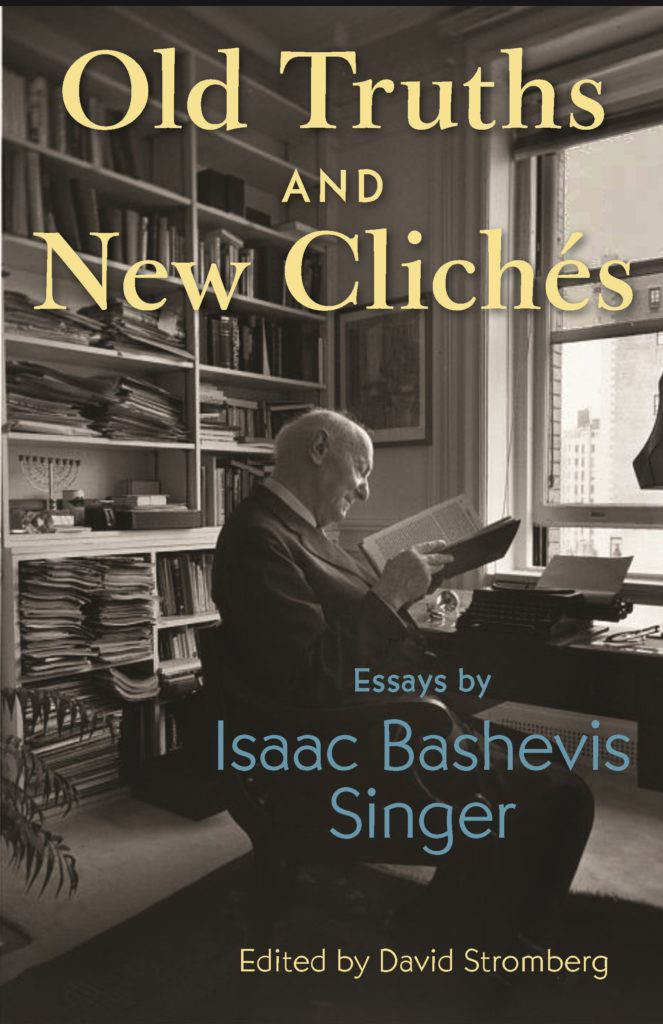
Old Truths and New Clichés collects nineteen essays—most of them previously unpublished in English—by Isaac Bashevis Singer on topics that were central to his artistic vision throughout an astonishing and prolific literary career spanning more than six decades.
Expanding on themes reflected in his best-known work—including the literary arts, Yiddish and Jewish life, and mysticism and philosophy—the book illuminates in new ways the rich intellectual, aesthetic, religious, and biographical background of Singer’s singular achievement as the first Yiddish-language author to be awarded the Nobel Prize for Literature.
Like a modern Montaigne, Singer studied human nature and created a body of work that contributed to a deeper understanding of the human spirit. Much of his philosophical thought was funneled into his stories. Yet these essays, which Singer himself translated into English or oversaw the translation of, present his ideas in a new way, as universal reflections on the role of the artist in modern society. Do you read Isaac Bashevis Singer? GRADE: A
TABLE OF CONTENTS:
PREFACE (pp. ix-x) David Stromberg
Writers Don’t Write for the Drawer: AN INTRODUCTION TO THE ESSAYS OF ISAAC BASHEVIS SINGERWriters Don’t Write for the Drawer: AN INTRODUCTION TO THE ESSAYS OF ISAAC BASHEVIS SINGER (pp. 1-16) Isaac Bashevis Singer has long been acknowledged as a master storyteller. But his critical writings have been largely passed over. One underlying reason is the sheer volume of Singer’s output. Starting in 1939, when he became a regular contributor to the Yiddish daily Forverts, he produced an incredible amount of text. He published his work under at least three pseudonyms, any number of which might appear in a single issue—sometimes on a single page—in a variety of genres: stories, novels, memoirs, essays, literary sketches, satires, dialogues, travel pieces, reviews, and even a popular media digest.
THE LITERARY ARTS
The Satan of Our TimeThe Satan of Our Time (pp. 19-19) A Yiddish writer in America is an unseen entity, almost a ghost. Perhaps this is why I am so interested in ghost stories and in the supernatural. I am inclined in all my writings to search for what is hidden from the eye. Somewhere I believe every human being to be possessed, and to me real writers are those who have the ability of exorcism.My first book, Satan in Goray, was published in Warsaw, Poland, in 1935, the year I came to the U.S.A., and since then I have struggled with devils and imps in all my works.
- Journalism and Literature (pp. 20-24) know of writers who consider it a tragedy to earn a living from journalism. They claim that it wastes their free time and that journalism is generally harmful to literary creativity. They argue that a journalist becomes accustomed to writing in a hurry and not weighing and measuring every word, and that the means and methods of journalism are altogether contrary to creativity. The experiences of this writer suggest a different approach to the question.It has been my experience that I wrote my best works in the midst of journalistic hullabaloo, often right in the editorial offices…
- Why Literary Censorship Is Harmful (pp. 25-31) Urbane people who have a preference for what they call “pure” literature and theater have in recent years been shocked by obscene language printed in books and newspapers, and vulgar speech heard in the theater. Those with daughters have especially strong feelings. They somehow cannot imagine them reading and hearing this sort of trash. This obviously concerns what is happening in English, French, German, and other such literatures. Some feel it’s foolish to remove virtually all censorship from literature and theater, while keeping a rather strict censorship on movies, radio, and television.
- Who Needs Literature? (pp. 32-42) There are times when I wonder what purpose fiction serves today. Why fabricate plots when life unfolds an inexhaustible wealth of events, stranger than anything literature might offer? Fantasy will never be able to match all the surprising twists that make up facts. No writer’s pen has been able to produce a work so true and free of imperfections as a case history, or the proceedings of a courtroom. Just as there is no perfect crime, so there is no perfect novel. Even Anna Karenina and Madame Bovary reveal flaws and inconsistencies that are part of all fiction.
- Old Truths and New Clichés (pp. 43-52) Is it possible for art not to look to nature and to learn from it? Before we can answer this question, we must clarify the question itself.In a broad sense, nobody—and especially no artist—can run away from nature. Writers who think up impossible and false situations, painters who paint abstract pictures, sculptors who create figures that have no resemblance to existing objects, composers who compose symphonies that have no rhythm orharmony—they all are united with nature. People, with their fantasies, caprices, and idiosyncrasies, are all a part of nature.
- Storytelling and Literature (pp. 53-63) I am going to speak about the importance of storytelling and literature. Actually, to say that storytelling is important to literature is like saying that food is necessary for human beings. Of course, everybody knows it. Take away the story and there is no literature. I am sorry that a number of writers have forgotten this simple fact. Sometimes people forget axioms, things that are so clear to all of us, and fall into a kind of amnesia. It is possible that maybe one day people may even forget that food is necessary for life!
- Literature for Children and Adults (pp. 64-74) One of the biggest biological enigmas is the great gift—or the great burden—of emotions that Nature has bestowed upon people. No matter how impoverished we might be in all other areas, we are millionaires in emotions. People need not study emotions the way they study languages or sciences. What’s more, all the intelligence we have accumulated over the centuries goes to serve these emotions, and sometimes to regulate them somewhat, so that in the mad impetus of our emotions, we don’t inundate ourselves. In this area, the beggar is as rich as the king.
- YIDDISH AND JEWISH LIFE
- The Kabbalah and Modern Times (pp. 77-89) What can a modern person learn from the Kabbalah? My definition of such a person is someone who does not believe in any authority, who does not rely on old texts, and who is looking for the truth in a scientific manner. When such people come to the higher questions, they are skeptical. I could therefore call my lecture, “What can skeptics learn from the Kabbalah?” Has it any value for them today? Or is it only a part of the history of human faith and superstition?I consider myself a skeptic as far as dogma and revelation are concerned,..
- The Ten Commandments and Modern Critics (pp. 90-98) What would happen if Moses were alive today and issued the Ten Commandments not on Mount Sinai with thunder and lightning, but in the form of a booklet or a brochure? How would he be received by the critics? The following are a few of the possibilities.Mr. Moses’s booklet, actually a proclamation (or leaflet), is difficult to categorize. It isn’t fiction in the usual sense of the word, nor is it a work of science. Perhaps it could best be labeled a religious tract—still, there is little of religion in it.
- The Spirit of Judaism (pp. 99-107) Before me lie dozens of photographs of religious Jews in the Williamsburg section of New York.1 I see fur-edged rabbinical hats, long gaberdines, big beards, sidelocks, women in wigs and in bonnets that were already obsolete even in my youth in Warsaw. I know that thousands of Jews and non-Jews who see these people want to know: What does this signify? Are they all rabbis? Does it say anywhere in the Torah or Talmud that Jews must dress this way? Do they belong to some special Jewish sect? Neither the Reform, the Conservative, nor even those Jews who attend Modern Orthodox…
- Yiddish, the Language of Exile (pp. 108-118) It is an accepted tenet of both our religious and secular literature that the exile was a calamity for the Jewish people. “And because of our sins we have been exiled from our land.”¹ Three times a day Jews pray that their eyes may see God’s return to Zion. Some of the extreme Zionists have expressed the opinion that the almost two-thousand-year period of the Diaspora was nothing more than an error and a void in our history. Others have even tried to belittle what Jews have created in exile: the Talmud, the Midrash, the Commentaries, the Zohar.
- Yiddish Theater Lives, Despite the Past (pp. 119-128) I was already a young writer and an ardent reader of world literature when I began to attend plays in Yiddish. Some of them were written by Polish-or Russian-Jewish playwrights, and many of them were imported from the golden land of America. I could see even then that we had not produced in Yiddish a Shakespeare, a Moliere, or a Strindberg. These plays were folkish, utterly naive and sometimes even ridiculous, but I enjoyed them and often laughed, not as much at the banal subject matter, but at the clumsiness of the writers, directors, and even the actors.
- Yiddish and Jewishness (pp. 129-144) Like grammar, nature has no exceptions. If something in nature appears to us as an exception, it means that the general law is yet unknown.The Jewish people appears to be an exception among peoples. As Balaam said about the Israelites, “The people shall dwell alone and shall not be reckoned among the nations.” In all the long history of our people, we have had our own country for only a relatively short time. We used to and continue to live in many different lands, just as we have spoken and still speak innumerable languages.
- PERSONAL WRITINGS AND PHILOSOPHY
- A Trip to the Circus (pp. 147-153) Looking back on my life, I can remember always being exceedingly curious about the unusual, the mysterious, the miraculous. My father constantly spoke about saints and wonder rabbis and the miracles they worked through the power of the Kabbalah and holy names. God himself was a super miracle worker. He said, “Let there be light,” and there was light. The men and women who served him, from the time of Moses to the Baal Shem Tov and Rabbi Nahman of Bratslav, were all people of magic. According to legend, those who opposed God could work magic too—Satan, Asmodeus, Lilith,…
- Why I Write As I Do: The Philosophy and Definition of a Jewish Writer (pp. 154-167) I know in advance that anything I have to write is either known to you already or available on the shelves of your library.¹ For that reason I have decided to forget modesty and write about myself. On that subject, at any rate, I am somewhat of an authority. I hope that you will find my case history of some value.I have in my lifetime lived through a number of epochs in Jewish history. I was brought up in a home where the old Jewish faith burned brightly. Ours was a house of Torah and holy books.
- A Personal Concept of Religion (pp. 168-175) People often ask me: Are you religious? And it isn’t easy for me to answer because the basic element of religion is divine revelation, whether God reveals himself in a burning bush or through the intervention of an angel. But can there also be a religion that does not rely upon revelation?The fact is that a number of philosophers preached this very kind of religion, but the God of philosophers never couldacquire prophets, temples, or priests. To the best of my knowledge, there is no temple where people pray to Spinoza’s Substance, 1 or Hegel’s Zeitgeist.
- A Story about a Collection of Stories(pp. 176-178) Since I am supposed to be a “born storyteller,” as one of my lenient critics called me, the introduction to this collection will contain two little stories. One facetious and one true. The first one is that when I was born my mother asked the midwife, “Is it a boy or a girl?” And the midwife answered, “A writer.” I have told this anecdote to so many people so many times that I am beginning to believe that it is true. This “event” took place, as you may know, in 1903. The other one happened about twenty-five years later.
- The Making of a First Book (pp. 179-193) From the day people could think, they dreamed of powers that would adjust the natural order of things to their desires and caprices. Among humanity’s greatest victories was the discovery of fire. What a miracle it was that rubbing two sticks together could light up the night, roast and cook meat, bring warmth into the cave, and frighten vicious beasts! Some imagined that human willpower in itself would work even greater miracles. Long before people discovered fire, they knew that an act of love was creative and that hatred was destructiveThe Jews who brought to the world the belief…
- To the True Protester (pp. 194-194)
- Singer the Editor: AN AFTERWORD ON THE EDITORIAL PROCESS (pp. 195-206) Isaac Bashevis Singer’s essays show that his artistry was grounded in a clearly articulated theoretical framework. Yet this articulation itself elides an aspect of Singer’s literary practice: his meticulous work as translator and editor. Apart from organizing and introducing Singer’s essays, collecting his work has also involved an intimate and thorough investigation of his complex creative process, which generally began in Yiddish, written by hand into small notebooks or on loose-leaf paper. These handwritten manuscripts were often sent directly to the Forverts for typesetting and printing without any intermediary stage.
- ACKNOWLEDGMENTS (pp. 207-210)
- NOTES (pp. 211-222)
- BIBLIOGRAPHY (pp. 223-226)
- INDEX (pp. 227-238)
I’ve read a little but always meant to read more.
Jeff, the stacks of books all over our house are testaments to my intentions to always read more.
And I see the blog has mass-dumped your entries…please be careful when reloading, if you do, for fear of killing the comments (clutches his pearls).
I’ve read Singer intermittently, since first reading “Jachid and Jachidna” in Judith Merril’s 10TH ANNUAL YEAR’S BEST SF [SPECULATIVE FICTION} (1965) when I was 13. (Merril decided to revised the title to “Yachid and Yachidna” to help goys with the pronunciation). I’ve tended to enjoy the work rather well.
Todd, WORDPRESS loves to blast a bunch of posts onto the blog intermittently. Very frustrating! This is one of the reasons I dislike AI.
Todd, I had the same introduction to Singer with that story in that anthology. It put Singer in the “I’d like him if I read him” category, where he remains. Every once in a while I do get around to reading one of those writers, but not often enough.
I have never kicked up a fuss about the more eclectic annual (and other) editors that some have…I’ve been more disappointed to have No interesting surprises among my BOTY (or other) anthologies. I’ve tended to go looking for more in cases such as Singer’s…at very least when they’ve impressed me at first encounter. The Harrison/Aldiss annual caught even more flack than Merril in that regard…yet no one seemed to whine too much in similar directions about Robert Arthur and Harold Masur’s “Hitchcock” anthologies…
Todd, Singer had his own world which could fit into the Harrison/Aldiss annual. I have no problem with it…but others did.