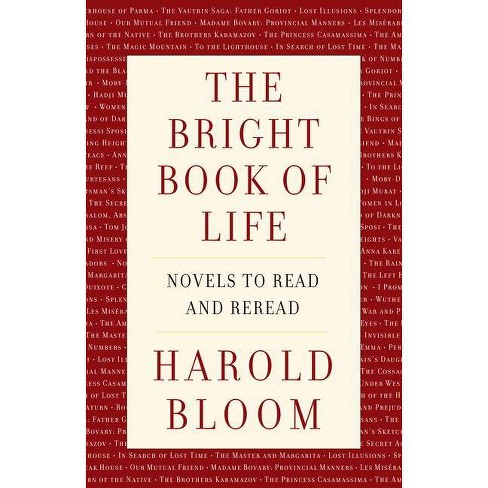
The Bright Book of Life is basically Harold Bloom’s choices of the best novels ever written. When you boil all these books down, Bloom think’s Moby-Dick and In Search of Lost Time are the two greatest novels. But I have a few quibbles. I’ve read most of these novels. I have never heard of Book of Numbers by Joshua Cohen. I like Ursula K. Le Guin but I would not consider The Left Hand of Darkness or The Dispossessed among the greatest novels. And where is Gabriel García Márquez’s One Hundred Years of Solitude?
Some of Bloom’s choices are a little strange, too. The Ambassadors is a very good Henry James novel, but is it really better than Wings of the Dove? Does Joseph Conrad deserve three novel choices while George Orwell’s 1984 is ignored?
How many of these novels have you read? What are your favorites? GRADE: B+
Table of Contents:
Preface The Lost Traveller’s Dream xi
1 Don Quixote Miguel De Cervantes 3
2 Clarissa Samuel Richardson 22
3 Tom Jones Henry Fielding 33
4 Pride and Prejudice Jane Austen 39
5 Emma Jane Austen 46
6 Persuasion Jane Austen 52
7 I Promessi Sposi (The Betrothed) Alessandro Manzoni 61
8 The Red and the Black Stendhal 66
9 The Charterhouse of Parma Stendhal 71
10 The Vautrin Saga: Old Goriot, Lost Illusions, The Splendor and Misery of the Courtesans Honore De Balzac 76
11 The Captains Daughter Alexander Pushkin 82
12 Wuthering Heights Emily Bronte 93
13 Vanity Fair William Makepeace Thackeray 101
14 Moby-Dick Herman Melville 112
15 Bleak House Charles Dickens 152
16 Our Mutual Friend Charles Dickens 156
17 Madame Bovary Gustave Flaubert 161
18 Les Miserables Victor Hugo 166
19 A Sportsman’s Notebook Ivan Turgenev 172
20 First Love Ivan Turgenev 181
21 The Cossacks Leo Tolstoy 190
22 War and Peace Leo Tolstoy 197
23 Anna Karenina Leo Tolstoy 215
24 Hadji Murat Leo Tolstoy 229
25 The Return of the Native Thomas Hardy 238
26 The Brothers Karamazov Fyodor Dostoevsky 244
27 The Princess Casamassima Henry James 254
28 The Ambassadors Henry James 258
29 Nostromo Joseph Conrad 261
30 The Secret Agent Joseph Conrad 268
31 Under Western Eyes Joseph Conrad 273
32 The Reef Edith Wharton 277
33 The Rainbow D.H. Lawrence 286
34 Women in Love D.H. Lawrence 291
35 Ulysses James Joyce 300
36 The Magic Mountain Thomas Mann 354
37 To the Lighthouse Virginia Woolf 377
38 In Search of Lost Time Marcel Proust 387
39 The Master and Margarita Mikhail Bulgakov 391
40 Absalom, Absalom! William Faulkner 411
41 The Death of the Heart Elizabeth Bowen 427
42 Invisible Man Ralph Ellison 434
43 The Left Hand of Darkness Ursula K. Le Guin 447
44 The Dispossessed Ursula K. Le Guin 460
45 The Loser Thomas Bernhard 466
46 Blood Meridian Cormac McCarthy 472
47 The Rings of Saturn W. G. Sebald 485
48 Book of Numbers Joshua Cohen 504
Afterword The Changeling 511