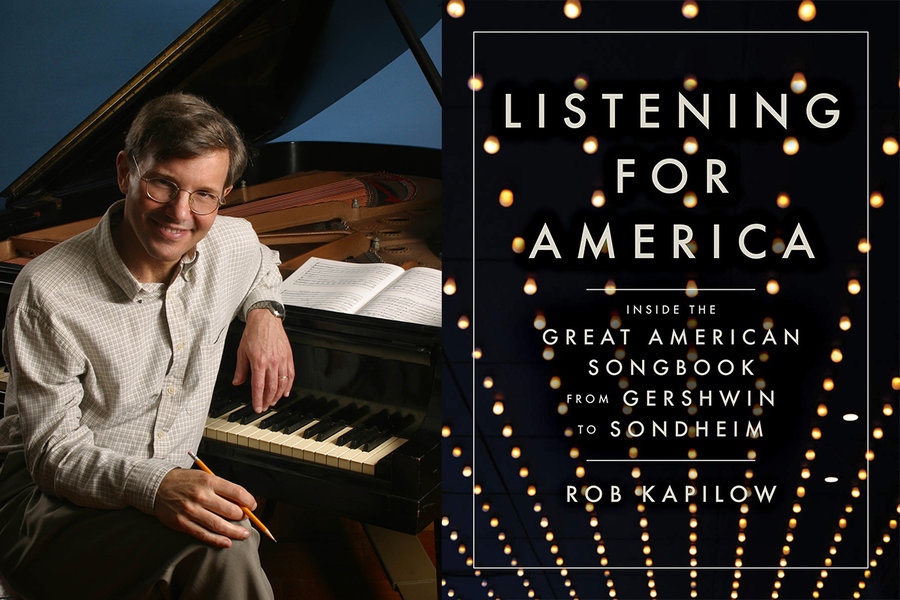
Rob Kapilow is a composer, conductor, and music commentator. He loves this music and it shows in each of the chapters he writes about these great songs. Kapilow first provides the context for each song–the historic significance, the song’s genesis–and then proceeds to show how the song “works.” Yes, there is actual music–notes and everything–on the page. But Kapilow adds to the musical notation the actual music a web site, Listeningforamerica.net, where you can hear the music that printed on the pages of Listening For America.
I particularly liked the chapter on “Send in the Clowns.” Stephen Sondheim, who has written hundreds of songs, can’t believe “Send in the Clowns” is his most famous song. “It sounds like a piano bar song,” Sondheim told Hal Prince. Kapilow shows why “Send in the Clowns” is much more than a piano bar song. If you’re interested in this music and want to know more about these classic songs, I highly recommend Listening For America. GRADE: A
TABLE OF CONTENTS:
PREFACE — xii
Prologue : Nothing Comes from Nothing — 1
Inventing America / Jerome Kern’s “Can’t Help Lovin’ Dat Man” — 21
The New Sexual Morality / Cole Porter’s “Let’s Do It” — 40
Airbrushing the Depression / George Gershwin’s “I Got Rhythm” — 57
Segregation and Opportunity in Harlem / Harold Arlen’s “Stormy Weather” — 82
Appropriation or Inspiration? / George Gershwin’s “Summertime” — 102
Immigration and the American Voice / Irving Berlin’s “Cheek to Cheek” — 133
How the Other Half Lived / Cole Porter’s “Begin the Beguine” — 156
Love in New York / Richard Rodgers’s “I Wish I Were in Love Again” — 181
The Impact of Recorded Sound / Jerome Kern’s “All the Things You Are” — 202
America Goes to the Movies / Harold Arlen’s “Over the Rainbow” — 227
World War II and the Integrated Musical / Richard Rodgers’s “If I Loved You” — 249
America Gets a Classical Voice / Leonard Bernstein’s “I Can Cook Too” — 279
Will the Real Annie Oakley Please Stand Up? / Irving Berlin’s “I Got the Sun in the Morning” — 309
Fantasy in New York / Leonard Bernstein’s “Tonight” — 334
Rock and Roll, Broadway, and the Me Decade / Stephen Sondheim’s “Send in the Clowns” — 364
New Directions On and Off Broadway / Stephen Sondheim’s “Finishing the Hat” — 393
Epilogue : The Broadway Musical Goes Global –419
Acknowledgements — 427
Notes — 431
Credits — 435
Index — 449