THE INCREDIBLES 2


It’s been 14 years since The Incredibles burst on the scene. Why it took Pixar so long to come up with a sequel to the original hit movie is a bit of a mystery. Holly Hunter is back as the voice of Elastigirl, Craig T. Nelson voices Mr. Incredible, Violet (Sarah Vowell) and Dash (Huck Milner) are back with their baby brother, Jack-Jack. In 14 years, the technology has advanced so The Incredibles 2 looks fabulous. My quibble is that the storyline borders on predictability. All the cool special effects and family angst doesn’t make up for that weakness. In Bill Crider’s famous words, The Incredibles 2 is good, but not great. GRADE: B+

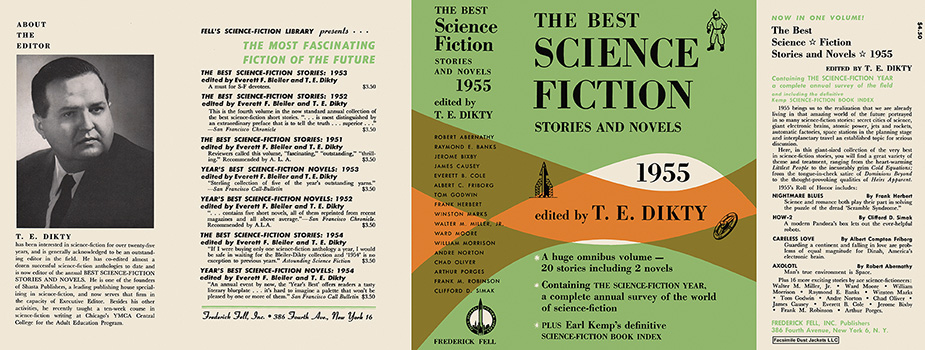
FRIDAY’S FORGOTTEN BOOKS #480: THE BEST SCIENCE FICTION STORIES: 1953 Edited by Everett F. Bleiler & T. E. Dikty


The 1953 anthology of The Year’s Best Science Fiction Stories demonstrates the increasing diversity of science fiction from that era. Zenna Henderson makes her first appearance with “Ararat.” John Jakes, who would later find fame writing the historical Kent Family Chronicles, explores the drama of “Machine.” John D. MacDonald, who would be best remembered for the Travis McGee series, plays a “Game for Blondes.” Of course, veteran SF writers like Murray Leinster, Erie Frank Russell, Fritz Leiber, and Alfred Bester are represented. But Brits like John Wyndham and William F. Temple make their presence known with strong stories. I continue to be impressed by these Bleiler & Dikty anthologies. GRADE: A
TABLE OF CONTENTS:
Trematode, a Critique of Modern Science-Fiction, by Alfred Bester
“The Fly”, by Arthur Porges
“Ararat”, by Zenna Henderson
“Counter-Transference”, by William F. Temple
“The Conqueror”, by Mark Clifton
“Machine”, by John W. Jakes
“The Middle of the Week After Next”, by Murray Leinster
“The Dreamer”, by Alfred Coppel
“The Moon Is Green”, by Fritz Leiber
“I Am Nothing”, by Eric Frank Russell
“Command Performance”, by Walter M. Miller, Jr.
“Survival”, by John Wyndham
“Game for Blondes”, by John D. MacDonald
“The Girls from Earth”, by Frank M. Robinson
“Lover, When You’re Near Me”, by Richard Matheson
“Fast Falls the Eventide”, by Eric Frank Russell
About the Authors

THE CURIOUS INCIDENT OF THE DOG IN THE NIGHT-TIME


The play version of The Curious Incident of the Dog in the Night-Time is based on the best selling novel with the same title by Mark Haddon. The story concerns an autistic 15-year-old named Christopher John Francis Boone. Christopher appears to be a mathematical genius, but he struggles with dealing with people. Christopher hates to be touched. He hates metaphors (which confuse him). Christopher loves Sherlock Holmes and when a dog is killed in his neighborhood, Christopher decides to investigate and solve “the murder.” Christopher’s parents are stressed by their son’s autism. Director Marianne Elliot creates an innovative set which allows the audience to experience second-hand what autism is like. Within these demanding conditions Luke Treadaway, playing Christopher, projects confusion with frustration as he tries to solve the mysteries of his Life. This National Theatre production was broadcast at our local Regal Theater as part of their Fathom Events series. Excellent! GRADE: A

VIZIO 29” 2.0 Sound Bar | SB2920-D6


About a month ago, I purchased a Samsung TV for our computer room. I like to have MORNING JOE or CNBC on in the background while I’m working on the computer. But, as we all know, the sound of flat screen TVs is tinny and weak. The Wall Street Journal recently featured an article on sound bars. They loved the Polk Command Bar ($300) and the new SONOS Beam ($400). But I was attracted to their review of the VIZIO 29″ 2.0 SOUND BAR. It lists for $99 but you can order it from AMAZON for $75. It’s perfect for a TV you occasional use. You’ll want better sound for your main 4K HDTV, perhaps a surround sound system. But, for TV in a guest room or computer room, the VIZIO 2.0 SOUND BAR improves the sound at a bargain price! You can read the Wall Street Journal article here. GRADE: B+

LEGION, SEASON TWO FINALE (FX)


This second season of Legion upped the ante with surrealism and Time Travel. Dan Stevens plays David Haller, a powerful mutant who has been treated as a schizophenic since childhood. He had also been infected by an alien presence who calls itself Amahl Farouk or Shadow King. David managed to oust Shadow King at the end of Season One, but now Shadow King is searching for his body which will restore his full, terrible powers.

I like the women in Legion. Jean Smart plays a telepath. Rachel Keller plays Sydney ‘Syd’ Barrett, David’s girlfriend in the present and the Future. Aubrey Plaza plays the psychopathic Lenny Busker. There’s also a guy with a basket on his head protected by female cyborgs with mustaches. Yeah, go figure.

If you’re looking for something far, far from ordinary, you might give Legion a try. It’s brilliant, confusing, and frequently baffling. But fun! Legion has been renewed for a Third Season. GRADE: B+

SHARP: The Women Who Made an Art of Having an Opinion By Michelle Dean


Michelle Dean Dedicates Sharp “For every person who’s ever been told, ‘You’re too smart for your own good'” Dean’s chapters about Dorothy Parker, Rebecca West, Hannah Arendt, Mary McCarthy, Susan Sontag, Pauline Kael, Joan Didion, Nora Ephron, Renata Adler, and Janet Malcolm present women who challenged the System and advanced the cause of women’s rights. Some, like Dorothy Parker, achieved her successes by using sardonic humor and wit. Yet, bad personal choices left her destitute. Hannah Arendt, who coined the term “the banality of evil” in her writings about the Eichmann trial, conducted a long affair with German philosopher Martin Heidegger (who was active in the Nazi Party). Rebecca West had a stormy relationship with H. G. Wells. As you can see from these examples of Michelle Dean’s focus, opinions don’t factor as highly as personal problems. I learned Dorothy Parker’s first husband was an alcoholic who introduced her to gin. Later, he fought in World War I and picked up a morphine addiction, too. Parker’s second husband might have been gay, according to Dean. Edmund Wilson, while drunk, punched Mary McCarty when she was two-and-a-half months pregnant. Susan Sontag had Stage 4 breast cancer. Michelle Dean provides plenty of information on personal relationships, literary feuds, and affairs. So Sharp is a bit of a mixed bag. I enjoyed learning about these women’s lives, but their opinions take second place to other factors. GRADE: B
Table of Contents
Preface ix
Chapter 1 Parker 1
Chapter 2 West 31
Chapter 3 West & Hurston 59
Chapter 4 Arendt 65
Chapter 5 McCarthy 92
Chapter 6 Parker & Arendt 122
Chapter 7 Arendt & McCarthy 132
Chapter 8 Sontag 146
Chapter 9 Kael 175
Chapter 10 Didion 203
Chapter 11 Ephron 229
Chapter 12 Arendt & McCarthy & Hellman 253
Chapter 13 Adler 260
Chapter 14 Malcolm 284
Afterword 309
Note on Sources 313
Bibliography 315
Notes 317
Index 349

OCEAN’S 8


Sandra Bullock plays Debbie Ocean, Danny Ocean’s sister. Debbie decides to rob the Met Gala to get the famous Cartier diamond necklace called the Jeanne Toussaint necklace (worth $150 million). Debbie recruits her old partner in crime, Lou (Cate Blanchett), jewelry maker Amita (Mindy Kaling), a fence Tammy (Sarah Paulson), a pick-pocket Constance (Awkwafina), a computer hacker Leslie (Rihanna), and a fashion designer Rose Weil (Helena Bonham Carter). Beating the best security system in the world is child’s play according to Gary Ross and Olivia Milch’s screenplay (Gary Ross of The Hunger Games also directed this movie). This is my major quibble with Ocean’s 8. It’s too easy.

In classic capers (both novels and movies) we see the team prepare for the crime, we see them commit the heist, but then…something goes wrong! The team has to improvise to overcome the unexpected problems. In Ocean’s 8 nothing goes wrong. There’s also the question of how Sandra Bullock and her crew will sell hundreds of millions of dollars in diamonds in a market controlled by the Diamond Cartel. I thought Ocean’s 8 had an excellent cast, but a flawed script. GRADE: B

FRIDAY’S FORGOTTEN BOOKS #479: YEAR’S BEST SCIENCE FICTION NOVELS: 1952 Edited By Everett F. Bleiler & T. E. Dikty


Back in 1952, Everett F. Bleiler and T.E. Dikty decided their yearly anthology of YEAR’S BEST SCIENCE FICTION STORIES wasn’t including some of best stories because of their length. Their solution was to edit a companion volume titled YEAR’S BEST SCIENCE FICTION NOVELS: 1952. What Bleiler and Dikty call “novels” we today would call “novellas.” These stories are about 70 pages long. Walter M. Miller, Jr.’s “Izzard and the Membrane” is a typical Cold War story where an American cyberneticist is tricked into helping the Soviets in World War III attack on America directed by an intelligent computer (we would call this Artificial Intelligence). Eric Frank Russell’s famous “…And Then There Were None” presents the dilemma of Freedom. “Flight to Forever” is one of Poul Anderson’s patented Time Travel stories. My favorite story in this anthology is another Cold War story, “The Hunting Season” by Frank M. Robinson. A totalitarian society punishes dissent by allowing “citizens” to hunt down dissidents and kill them. Arthur C. Clarke’s “Seeker of the Sphinx” explores the results of a lack of Progress in the Future. All in all, this is an entertaining collection of novellas. GRADE: A-
TABLE OF CONTENTS:
Introduction, by Everett F. Bleiler & T. E. Dikty 9
“Izzard and the Membrane”, by Walter M. Miller, Jr. (Astounding Science Fiction) 17
“…And Then There Were None”, by Eric Frank Russell (Astounding Science Fiction) 81
“Flight to Forever”, by Poul Anderson (Super Science Stories) 165
“The Hunting Season”, by Frank M. Robinson (Astounding Science Fiction) 225
“Seeker of the Sphinx”, by Arthur C. Clarke (Two Complete Science-Adventures) 295