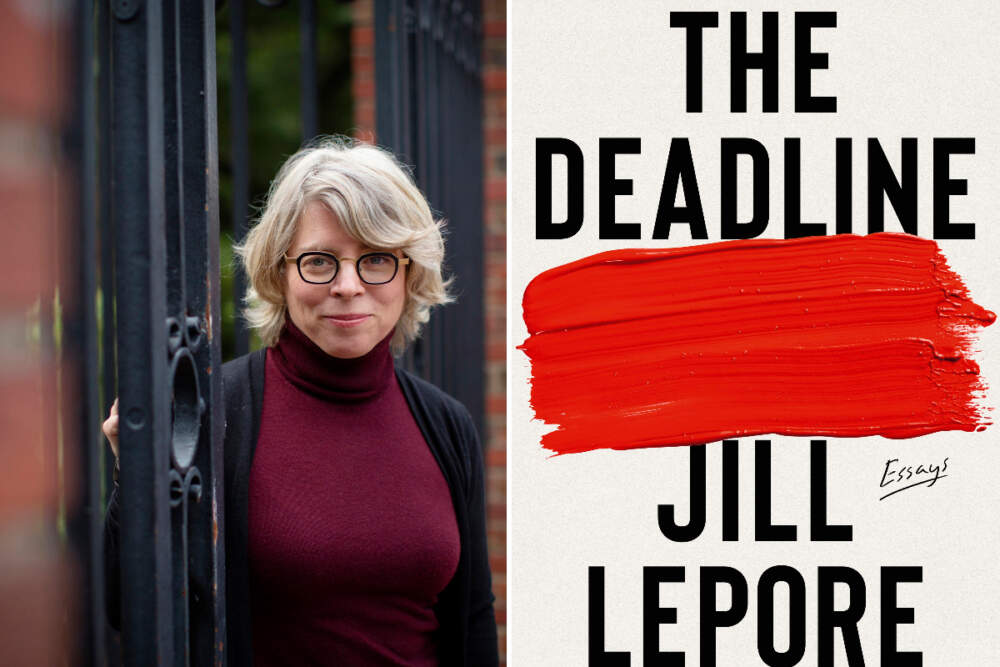
Jill Lepore is one of my favorite contemporary historians. History plays a big part in The Deadline: Essays (2023) but Lepore makes it clear that her attitude towards history is a little different. “I agreed with the heroine of Jane Austen’s Northhanger Abbey, when she complains about history, ‘It tells me nothing that does not either vex or weary me. The quarrels of popes and kings, with wars or pestilences, in every page; the men all so good for nothing, and hardly any women at all–it is very tiresome: and yet I often think it odd that it should be so dull, for a great deal of it must be invention.’ I have tried to write history differently.” (p. xviii)
As an example of Lepore’s writing history differently, take “The Man in the Box.” Lepore delivers a clever and informative essay about Doctor Who. “Doctor Who was the brainchild of Sydney Newman, a Canadian who became head of the BBC’s drama department in 1963. Newman, who had created The Avengers, for ITV, in 1961, was brought in to produce television that would meet the BBC’s remit as a government-owned broadcasting service as will as its need to win viewers from ITV, a commercial rival that had begun broadcasting in 1955. By 1960, the BBC had not a single program among the top ten ratings earners. Newman had an idea for something that could be both education and entertaining: science fiction.” (p. 152)
Jill Lepore goes on to explore the beginning of the program and the various Doctors who played the iconic role. But, Lepore doesn’t stop there. She reveals the origin story for the greatest villains The Doctor has to face: The Daleks. “The Daleks were invented by Terry Nation, who was born in Cardiff in 1930. …He took a job writing for Doctor Who in 1963. He once said that he got the name ‘Dalek’ from an encyclopedia volume that ran from ‘dal’ to ‘lek.’ …He invented a race of creatures mutated by an apocalyptic nuclear war who, in order to survive, live inside robotic shells and are so convinced of their own purity that their object is to exterminate every other race.” (p. 157)
Lepore’s essays deal with books and writers, politicians and voters, crises and triumphs. I read these essays with delight! If you’re in the mood for something different, give The Deadline a try. GRADE: A
TABLE OF CONTENTS:
Introduction — xvii
Part one
Prodigal daughter
Prodigal daughter — 1
The deadline — 17
Easy rider — 27
The Everyman library — 36
Part two
Misjudged
It’s still alive — 43
Ahab at home — 54
The fireman — 67
The shorebird — 78
Misjudged — 93
Part three
Valley of the dolls
The oddyssey — 111
The ice man — 121
Valley of the dolls — 137
The man in the box — 150
No, we cannot — 166
Buzz — 175
Part four
Just the facts, ma’am
Just the facts, ma’am –191
Bad news — 201
After the fact — 209
Hard news — 216
Part five
Battleground America
Battleground America — 235
Blood on the green — 255
The long blue line — 268
The riot report — 282
Part 6
The disruption machine
The cobweb — 299
The disruption machine — 314
The robot caravan — 331
Mission impossible — 343
Part seven
The rule of history
The rule of history — 355
The age of consent — 367
Benched — 381
The dark ages — 395
Drafted — 407
Part eight
The parent trap
Back to the blackboard — 413
To have and to hold — 426
The return of the pervert — 440
The parent trap — 451
Part nine
The isolation ward
Plague years — 467
These four walls — 478
The isolation ward — 488
Burned — 496
Part ten
In every dark hour
Politics and the new machine — 507
The war and the roses — 524
You’re fired — 541
The Trump papers — 554
In every dark hour — 571
The American beast — 583
Acknowledgements — 599
Index — 601
OK, you sold me.
Jeff, you’ll enjoy Jill Lepore’s work. She’s a good writer and a very knowledgable.
As a huge fan of Joseph Mitchell’s essays about Joe Gould, how could I resist Lepore’s book, JOE GOULD’S TEETH?
Jeff, you’ll find out some interesting facts about Joe Gould.
I’m familiar with the name but not her work. I’ll certainly check the library for this. Looks like a decent nightstand book.
In her essay on Dr. Who does she mention Delia Derbyshire?
Byron, Delia Derbyshire–best known for her 1963 electronic realization of the Doctor Who theme music while at the BBC Radiophonic Workshop–doesn’t appear in Jill Lepore’s essay. But you’ll learn a few new facts about Doctor Who from her essay.
I like Lepore’s work, but I’m pretty sure I haven’t owned a collection by her. A useful reminder…thanks.
Todd, true.
The Daleks not only sound like RFK Brainworm, but they also Sound like RFK2.
And, along that line of thought; https://www.theguardian.com/commentisfree/2026/apr/12/united-states-trump-destruction
Todd, thanks for the link!
Never heard of her.
Bob, Jill Lepore is worth reading.