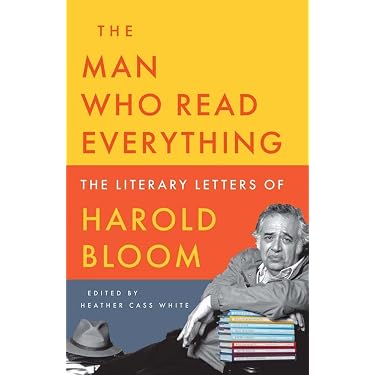
“In his sixty years as a working literary critic, he [Bloom] published nearly fifty original books, two of them later his death in 2019, several of which made the New York Times Best-Seller list. He published hundreds of critical collections, each with an introductory essay of his own. He lectured in countries around the world, and taught thousands of students.” (p. 2)
Heather Cass White, the editor of The Man Who Read Everything (2026), is a former student of Harold Bloom. In 2015, she approached Bloom about publishing a volume of his correspondence with poets and writers. Bloom agreed and this volume is the result. White notes that Harold Bloom could read a book in an hour and could cite passages from it because he had a photographic memory.
Some of Harold Bloom’s best letters can be found in the section on Northrop Frye, the world-famous professor at the University of Toronto that Bloom idolized. Bloom also idolized poets: Alvin Feinman, John Hollander, A.R. Ammons, John Ashbery, James Merrill, and Henri Cole.
Bloom believed John Ashbery was the best poet of the second half of the 20th Century (Yeats being the best poet of the first half). But I agree with Irvin Ehrenpreis’s review of Ashbery’s Self-Portrait (1975), “Mr. Ashbery may hope to surprise us agreeably with the leaps or turns of his mind from image to insight and back again; and he may challenge us to make the brightest of these connections ourselves. But most of his work will tire nearly all his readers.” (p. 138)
The letters and email texts from the Ursula K. Le Guin section were the most fun to read. “Her honors include eight Hugo Awards, and six Nebula Awards.” (p. 187)
Ursula K. Le Guin wrote “23 novels, 12 volumes of short stories, 11 volumes of poetry, 11 children’s books, five essay collections, and four works of translation.” (p. 187) Harold Bloom was an enthusiastic fan of Le Guin’s work and his productivity matches hers.
Reading these letters gives insights into a seminal critic of the 20th Century. GRADE: A
TABLE OF CONTENTS:
Introduction — 1
A Note on the Texts — 15
Alvin Feinman — 17
Northrop Frye — 31
John Hollander — 51
A. R. Ammons — 69
John Ashbery — 119
James Merrill — 157
Henri Cole — 179
Ursula K. Le Guin — 187
Works Cited — 215
Acknowledgements — 219
Index –– 221
I know you’re a fan of Bloom’s. I like books of letters.
I remember Frye from our days working at the Modern Language Association (MLA) headquarters in the early ’70s.
Jeff, Harold Bloom was an academic Super Star back in the day. These letters show why…
Gone in 2019. The years are flying by. And his later photos, he definitely consistently looked like death warmed over. I hope no one ever confuses him with Allan Bloom these years.
A. Bloom died at my current age of 61. Memento mori.
Todd, 61 is young…
Mild revision…the first obit I landed on cited him at 61, but he actually made it, barely,, to 62. Michael Conrad intones “Be careful, out there.”
Todd, I was watching a music show and the featured Minnie Riperton, who died of breast cancer at 31.
Todd, Allan Bloom had a completely different message from Harold Bloom.
Rather so. AB apparently died of AIDS, and might’ve been a closeted homosexual. The things people do to themselves, and to each other. The protection on this laptop, fwiw, hates that your address isn’t an https: address…
Ripperton was a great talent. Cancer, oddly enough, is no one’s friend..
Todd, many of our friends are battling cancer. It’s an epidemic!
He’s a cheerful-looking chap! Naturally, I’ve never heard of him, but anyone who can read a book as fast as you must be impressive!
Bob, I try to read a book a day. Harold Bloom could read a book in an hour! You bet I’m impressed!
He was an intimidating figure and was much quote 25 years ago. But criticism doesn’t get read years later as novels often do. I adored Lionel Trilling but who has heard his name in even more years.
Patti, I had Leslie Fiedler on my Doctoral Committee and working with him was a joy. I read Lionel Trilling’s books and was impressed by them. Harold Bloom had some Best Sellers with his Shakespeare book and THE WESTERN CANON. But those days are over…