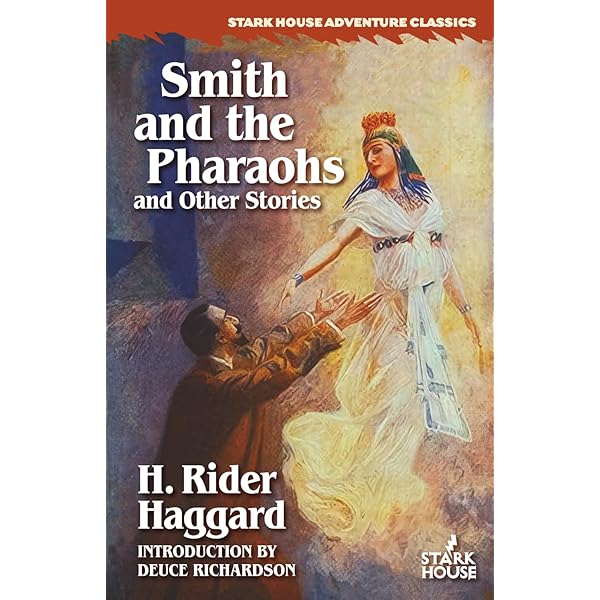
As Deuce Richardson points out in his informative “H. Rider Haggard: Imagination, Death, and Immortality,” H. Rider Haggard was one of the most influential writers of the 19th Century. His tales of High Adventure like King Solomon’s Mines and She impacted writers in the 19th and 20th Centuries.
Take Smith and the Pharaohs as an example. Smith becomes interested in the history of Egypt and finally travels there. In his tour of a museum, Smith becomes obsessed with the image of a beautiful Egyptian queen. When Smith is accidentally locked up one night in the Cairo Museum, he falls asleep and dreams that he is put on trial by the ghosts of Egypt’s pharaohs and queens. His crime: robbing their graves. The reader is left with the possibility that what Smith experience wasn’t just a dream.
“Magepa the Buck” is the ninth story in the Quatermain series and features Haggard’s blend of history and adventure. The story centers around heroic Zulu figure Magepa, detailing his incredible endurance to save a child, showing Haggard’s respect for Zulu bravery.
Haggard brings Africa to life in stories like “Long Odds (The Spring of the Lion),” “Hunter Quatermain’s Story,” and “A Tale of Three Lions.” If you’re looking for classic story-telling with exotic settings and occasional supernatural/ paranormal aspects blended in, give Smith and the Pharaohs and Other Stories a try. GRADE: B
TABLE OF CONTENTS:
H. Rider Haggard: Imagination, Death, and Immortality By Deuce Richardson — 7
Smith and the Pharaohs and Other Stories:
Smith and the Pharaohs –14
The Blue Curtains — 51
Little Flower — 75
Only a Dream — 127
Barbara Who Came Back — 133
Allan Quatrain Stories:
Magepa the Buck –179
Long Odds (The Spring of the Lion) — 190
Hunter Quatermain’s Story — 202
A Tale of Three Lions — 216
The Mahatma and the Hare — 239
Bibliography –285
Please not that only the first six stories were printed in Haggard’s 1920 edition of SMITH AND THE PHAROAHJS . The next three stories were taken from ALLEN’S WIFE AND OTHER TALES (1889), while the final story was published separately in 1911. “Little Flower” was first published separately in 1920 as THE MISSIONARY AND THE WITCH DOCTOR in an edition of twelve copies for copyright purposes. (Good luck finding that one!)
For Haggard fans, this Stark House edition is a bargain!
Jerry, thanks for the bibliographic breakdown! Yes, for Haggard fans, this STARK HOUSE edition is a must-buy!
Well, sure, you could spend $17.95 for this. Or you could get Haggard’s ULTIMATE COLLECTION (60+ works) for $1.99 on Kindle. Or the COMPLETE COLLECTION for $2.99.
You make the call.
Jeff, would it surprise you to learn I own both?
No!
Jeff, Diane wants me to jettison more books in 2026 so I’ll probably start with duplicates. When Patrick was shelving books during one of his visits, he was astonished that I had SEVEN copies of a Henry James book! I tried to explain the concept of variant editions…but Patrick–and Diane–weren’t buying it.
And there’s supporting fine projects such as Stark House…is the collection of your earlier donation no longer taking new volumes?
No offense, George, bit I think Patrick and Diane were being totally unreasonable.
Jerry, the sight of the Kelley Collection can produce some not-so-surprising reactions…
I read She a few years back and was greatly disappointed! The movies were better because they didn’t repeat the story line from each character’s point of view over and over!
Bob, SHE was a memorable film when I saw it back in 1965.
Smith and the pharaohs sounds interesting. I have always wanted to go to Egypt, but have realized it’s not happening. I still have hops for Australia and new Zealand, especially to see hobbit town which a friend really enjoyed
Maggie, my traveling days are over. Each night this week I’ve watched travelers on the TV news in despair over their delayed or cancelled flights. I don’t want to deal with that anymore.