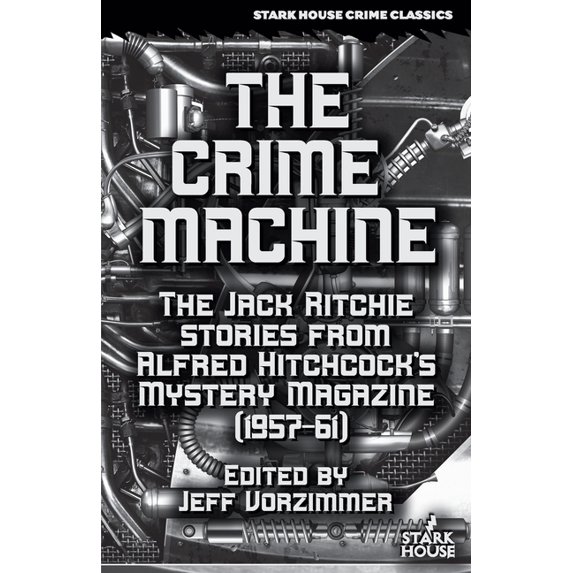
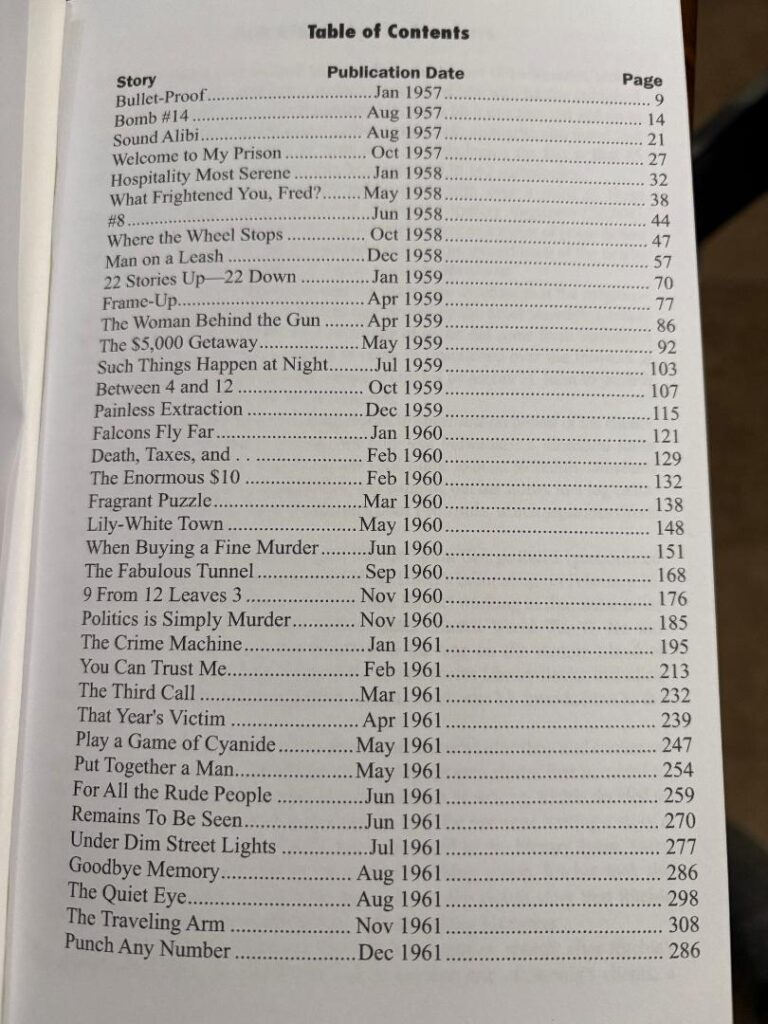
Jeff Vorzimmer’s brilliant Introduction “Jack Ritchie By the Numbers” (p. 7-8) opens the new Stark House collection of 38 stories by the master short story writer, Jack Ritchie. Vorzimmer provides some eye-popping numbers that illustrate the success of Ritchie’s writing career. Ritchie published 345 short stories. Vorzimmer says 85 of those stories were reprinted in 142 anthologies. Amazing!
Vorzimmer supplies more astonishing Ritchie numbers: 117 stories published in Alfred Hitchcock’s Mystery Magazine, 31 stories published in Ellery Queen Mystery Magazine, 19 stories published in Mike Shayne Mastery Magazine, and 23 stories published in Manhunt. Ritchie was prolific but the quality of his stories is consistently high.
Of the 38 stories in The Crime Machine, 16 have never been reprinted. That’s a bonanza for Jack Ritchie fans!
At the end of The Crime Machine you’ll find this blurb: “Jackie Ritchie died in 1983 but his stories live on. This STARK HOUSE edition brings some of Richie’s best stories to a new audience. It you’re a fan of well crafted short stories, The Best of Manhunt 4: The Jack Ritchie Stories should be high your your list of books to read. GRADE: A“.
Those words might ring a bell because I wrote them here.
The Crime Machine: The Jack Ritchie Stories From Alfred Hitchcock’s Mystery Magazine (1957-1961 is the best reprint collection of the year. GRADE: A+
Big Jack Ritchie fan here. For consistent, ingenious writing few did it better. He was one of the few writers who made AHMM a must rad back in the day, along with Ed Hoch, Henry Slesar, Bill Pronzini, and Clark Howard. It’s great that Stark House is bringing back so much of his work — I hope they will mine many more of his stories in the future.
Jerry, I’ve enjoyed the Jack Ritchie books STARK HOUSE has published and I hope they continue to reprint Ritchie’s wonderful stories!
By coincidence I read two Jack Ritchie collections already this year: first THE BEST OF MANHUNT 4: THE JACK RITCHIE STORIES, and then the Crippen & Landru collection, CARDULA AND THE LOCKED ROOMS.
I will be checking the new one out.
Jeff, I’ve reviewed both THE BEST OF MANHUNT4: THE JACK TRICHIE STORIES (http://georgekelley.org/wednesdays-short-stories-260-the-best-of-manhunt-4-the-jack-ritchie-stories/) and CARDULA AND THE LOCKED ROOMS (http://georgekelley.org/wednesdays-short-stories-262-cardula-and-the-locked-rooms-by-jack-ritchie/). THE CRIME MACHINE is a great collection!
There is only one appropriate response when a Ritchie book becomes available: TAKE MY MONEY NOW! I have ordered it. Thanks!
Robert, THE CRIME MACHINE is worth every cent!
I also picked up A NEW LEAF and Other Stories (Kindle edition, $2.99) after checking it was almost all different stories.
Jeff, I have a copy of A NEW LEAF around here somewhere. Or, it might be on my Kindle. Or, I might have it both in print and in Kindle format…
Though the first published title (maybe not Ritchie’s) for the title story was apparently “The Green Heart” in AHMM…I was already a JR fan when I first saw the film on TV in the late ’70s or early ’80s.
http://www.philsp.com/homeville/fmi/n02/n02843.htm#A133
The Green Heart, (ss) Alfred Hitchcock’s Mystery Magazine March 1963
Guaranteed Rest in Peace and Other Macabre Tales ed. Alfred Hitchcock, Four Square, November 1966
Alfred Hitchcock’s Anthology #4, Spring/Summer 1979
Little Boxes of Bewilderment by Jack Ritchie, St. Martin’s, 1989
Alfred Hitchcock’s Mystery Magazine December 1997 (HOF reprint)
Todd, I’m pleased so many of the commentators are Jack Ritchie fans!
Missed the last one:
The 50 Greatest Mysteries of All Time ed. Otto Penzler, Dove Books, May 1998, as “A New Leaf”
What’s not to love, George?
Ritchie was the master of the short story and to me, the heart and soul of AHMM. There were better stories in each issue, usually, but his were always, always clever, concise, and absorbing.
When I first read my Hitchcock anthology collections, before I knew who all the authors were, I recognized I liked Ritchie’s stories the best. For one they were short–even if I wasn’t a big fan of the actual story, it was quick and enjoyable to read (as opposed to if you got a novelette or a long story that were clunkers). I also liked that he perfectly got across the characters and story without using a lot of words or wasted time. He wasn’t exactly a master of deep characterization (and his female characters are superficial), but then again, neither were, say, Edward D. Hoch or James Holding (authors I really like), and they had much longer stories.
I also like that while Ritchie’s stories almost always have twist endings, and you can sometimes predict them, they don’t come off as too hackneyed or obvious. One, they’re (again) short. I think most people can predict the ending of “Number 8,” but it’s so short and fast moving, you don’t really care. Two, as he grew as an author, he learned to play on expectations–for example, there are a lot of stories, most famously “The Absence of Emily,” that play on the idea that the reader is making (incorrect) inferences. Finally, because Ritchie did not have an obvious template, the ending would sometimes be confounding–the supernatural or far-out elements might truly appear, the murderer might be totally get away, there might not be a clear crime…
Finally, a lot of the very memorable Ritchie stories do contain a thought-provoking or poignant aspect. “For All the Rude People” is the most notable of these, but even small, somewhat jokey stories like “Lily-White Town” also do.
Michael, thank you for that astute analysis of Jack Ritchie’s short stories! Like you, I’ve read Ritchie stories over the years and plenty of them thrilled me with their craftsmanship and cleverness. In THE CRIME MACHINE, you can trace the growth and increasing skill level from the stories from 1957 to 1961. Clearly, Ritchie got better over that stretch: the evidence is on the page!