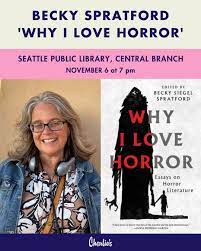
Librarian and book critic Becky Siegel Spratford’s Why I Love Horror arrives in the run-up to Halloween with 19 essays by writers of Horror explaining the attraction the genre holds for them.
I confess, I’m not familiar with most of the horror writers in this book–although their essays are fun to read–so I started by reading what two of the writers I was familiar with had to say: Victor LaValle and Grady Hendrix.
I’ve read THE SOUTHERN BOOK CLUB’S GUIDE TO SLAYING VAMPIRES (you can read my review here) and Paperback from Hell (you can read my review here). Hendrix cites Horace Walpole’s The Castle of Otranto as an influence (“I love horror because it’s the one genre that claims to be true.” (p. 136) He also mentions Henry James’ The Turn of the Screw.
I’m a fan of Victor LaValle’s The Ballad of Black Tom. LaValle cites Shirley Jackson, Clive barker, Peter Straub, Stephen King, Robert McCammon, John Saul, and Brian Lumley as influences on his horror writing.
I got a kick out of Hailey Piper’s “The Giant Footprint of Horror” as she explains how she got into Horror at a young age: “The obsession began in probably the best way I could’ve asked for–with Godzilla.” (p. 25). She goes on to explain that Godzilla was “kind of a gateway creature” that led her into her writing profession.
If you’re a fan of books where writers share their secrets and influences, Why I Love Horror will delight you! GRADE: A
TABLE OF CONTENTS:
| Introduction by Sadie Hartmann — 1 Why Ask Why by Becky Siegel Stratford — 9 |
| Brian Keenes GiantSize ManThing — Brian Keene | 9 |
| The Giant Footprint of Horror — Hailey Piper | 23 |
| In the Bermuda Triangle with Sasquatch Flesh Smoldering — John Lang | 33 |
| What You Can Learn From Horror: Don;t Run from Darkness; It’s Trying to Each You a Lesson — Alma Katsu | 49 |
| Horror Is Life: A Blood Soaked Love Letter — Gabino Iglesias | 59 |
| My Long Road to Horror — Tananarive Due | 75 |
| Monster Girl: How Horror Gave Me a Place to Belong — Jennifer McMahon | 89 |
| On the Amtrak Heading Home — Josh Malerman | 99 |
| Why Horror? — Paul Tremblay | 115 |
| Why I Love Horror — Grady Hendrix | 123 |
| My Mother Was Margaret White — Cynthia Pelayo | 129 |
| Why I Am Horror — Clay McLeod Chapman | 151 |
| A Day in My Psychedelic World — Nuxo Onoh | 167 |
| Permission to Scream — Rachel Harrison | 181 |
| Horror Saved My Life — Victor LaValle | 191 |
| Tales from My Crypt — Mary SanGiovanni | 203 |
| Of Men and Monsters — David Demchuk | 215 |
| Why Horror — Stephen Graham Jones | 227 |
| About the Authors | 243 |
| Acknowledgments | 251 |
I mentioned Neil McRobert’s “Talking Scared” podcast the other day on the post about Joe Lansdale. Many of the writers who contributed to this book have been interviewed on the podcast (Harrison, Tremblay, Malerman, Katsu, Due, Jones, etc.). It’s an interesting podcast—even if I rarely get around to reading the books discussed.
Deb, thanks for the recommendation of “Talking Scared.” Love the interviews!
I recognize all but five of the contributors — a stellar lineup, indeed. Yes, Godzilla can be a gateway creature into horror, as poor Bambi discovered in that classic cartoon.
Jerry, I’m surprised that so many of the writers in WHY I LOVE HORROR were attracted to the genre at an early age.
The twig tends to be bent early, George. It certainly was for me.
This looks like fun and also the podcast Deb mentioned.
Patti, I can recommend both enthusiastically!
For my part, I put the blame on WSAZ’s late nite Shock Watch package of old Universal horror films (age 10), Mario Bava’s BLACK SUNDAY (ditto), Roger Corman’s THE PIT AND THE PENDULUM (age 11), and Poe’s TEN GREAT MYSTERIES, edited by Groff Conklin, which I ordered from Scholastic Books’ Teenage Book Club (12). I’ll see if my library has the book of essays. I recognise about half the contributors. I suspect all of these writers are one, two, or three generations behind me. But Stephen King and slasher movies were their big influences. Stephen Graham Jones seems to be the current flavour of the day in horror.
Fred, I was freaked out by the movie version of FRANKENSTEIN as a kid. Later, in my teenage years, I became a big fan of H. P. Lovecraft and Robert Bloch. I was an early reader of Stephen King (not so much his later stuff).
Loved PAPERBACKS FROM HELL, despite the absence of Jack Maclane/Bill Crider.
Not familiar with most of the writers, and I rarely read horror these days. Instead, we’re living with it in our daily lives.
Jeff, I read a few horror novels each year. I agree with you: we’re living in horror-filled times!
I’m currently awaiting the imminent delivery of a new refrigerator, which is giving me an oddly anxious feeling…and while waiting, rewatching the last episode of PERSON OF INTEREST somehow didn’t settle the nerves. We do live in paranoia-making times, and perhaps always have.
Todd, to avoid anxiety, you might want to avoid the work of Thomas Pynchon.
Anxiety is ineluctable…might as well embrace it. Pynchon isn’t the most anxious of writers…even Vonnegut is moreso. Then there’s Kafka.
I liked the comment Harlan Ellison made in the introduction to PARTNERS IN WONDER, in noting that Robert Bloch’s work was often about, at some level “coming to grips with terror”…I think horror narrative/art helps us with this. Some of us need all the help we can get.
And, of course, horror adjoins suspense fiction on one side, and fantasy on another…and any fiction dealing with extinction on any level is imbued with a certain relevance to horror.
I almost died a couple of times in infancy, and then when infancy was almost over, a disastrous flood messed over my hometown of Fairbanks, AK, very much including my family’s house and almost every structure in the second-largest city in the state. I was old enough to understand this wasn’t right, and there was nothing we could do about it. My mother read crime fiction and watched a Lot of crime drama, my father was mostly a SF reader but also read a fair amount of suspense fiction, and loved THE HAUNTING, a rather sfnal horror film. Death played a major role in both their lives, not least in losing their fathers’ when they were children. I was primed to seek out horror.
That I learned to read with Dr. Seuss and EZ-Reader GRIMM”S volumes, among some more anodyne Little Golden Books, didn’t hurt.
Todd, I loved all of Dr. Seuss’s books especially THE CAT IN THE HAT.
Todd, you have lived an unusual Life! I have not knowingly been near Death. And, I want to keep it that way…
From what almost nothing I clearly remember (vs. subconsciously) of 105 degree fevers and convulsions, and the water and mud taking over our house and that of our relatives and neighbors, I can’t recommend it. But, of course, it awaits us.
Todd, I’ve managed to live a fairly health Life. A couple of knee replacement surgeries were the most serious medical matters I’ve had to deal with…so far.
And even THE CAT IN THE HAT has a sort of absurdist terror about it…
Todd, I would say THE CAT IN THE HAT has an undertone of dread.
Todd, Robert Bloch’s works are filled with terror. PYCHO is a prime example.
And with dealing, and how at times one can’t deal with what is horrific. Or only incompletely. Bloch, Leiber, Shirley Jackson, E. F. Benson,”Saki”, Highsmith, Sturgeon, Joanna Russ, C. B. Gilford, Joseph Payne Brennan, Kit Reed., J. B. Priestley, Joan Aiken (and her father)..Roald Dahl all among early favorites of mine. Watched as much horror drama as I could find as a youth, but was never too impressed with the likes of FAMOUS MONSTERS OF FILMLAND.
Todd, that’s a very impressive list of writers no matter how in complete!
Oh. I meant one can only incompletely deal with the horrors of life (and death, of course) at times…
“LaValle cites Shirley Jackson, Clive Barker, Peter Straub, Stephen King, Robert McCammon, John Saul, and Brian Lumley as influences on his horror writing.” Interesting mix. Jackson the only crucial one for me, like only a little of Lumley–his boy’s-adventure Lovecraftian tales bore me, but some of his suspense fiction is excellent; McCammon mostly good, but took King’s bugcrushing too much to heart, Straub also a bit hit and miss if usually more concise; Saul pedestrian and dull, on balance. Barker’s best work impressive, as is King’s when he isn’t self-indulgent…one of his best stories is “The Children of the Corn”, though I certainly believed the film was horrible readily enough to never catch it…while the Gunslinger stories and the likes of “The Cat from Hell” were utter bores…
Todd, Stephen King, like Henry James, wrote a lot of hits…and misses. I was never a John Saul fan, but his books sold well.