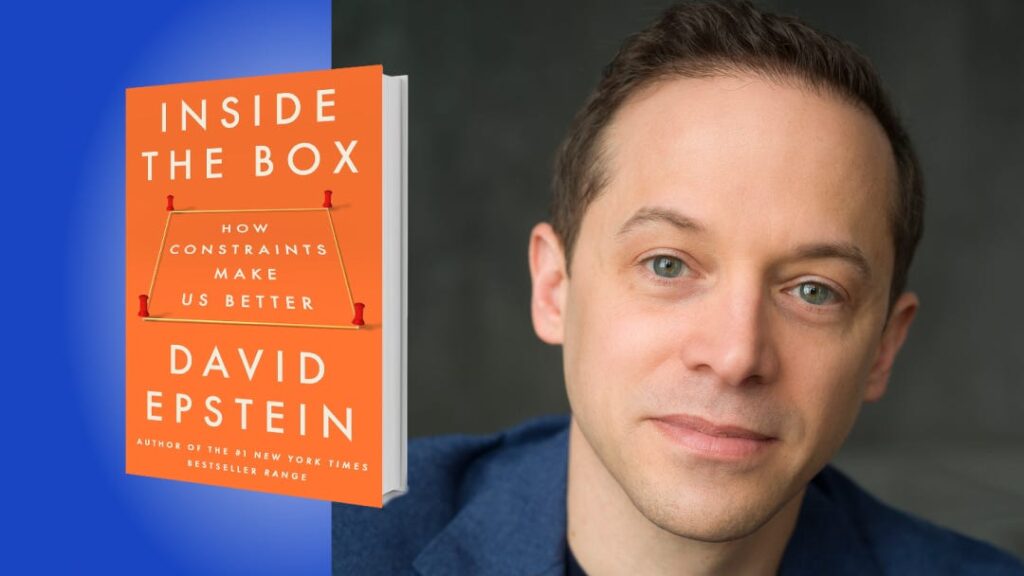
Both David Epstein–an expert in work design–and Herbert A. Simon–1978 Nobel Prize Winner for Economics–argue that work can be done more productively if we focus on how we do the work. Constraints, Epstein insists, can make the U.S. better. I remember taking a Psychology class in college where the professor told the class: “If you want to create a monster, just tell your child to do anything they want.”
Diane and I didn’t have a lot of rules for Patrick and Katie, but the rules we imposed we were strict about. Our key rules were: Don’t tell lies, Don’t steal, and Don’t cheat. We told our kids that if they did those things, they wouldn’t have any friends.
Diane and I also tried to model behavior for Patrick and Katie. Every night, we would all sit around the dining room table and do school work. Diane did her correcting of student papers, I did my lectures for the next day’s classes, and Patrick and Katie either did homework or read books. I think these good work habits carried over to our kids’ success in college and their careers.
Organization is another word for constraints. Both Epstein and Simon have worked with Artificial Intelligence and suggest models that might be used to integrate AI into the work flow.
Work environments will change radically in the years ahead. Inside the Box and Models of My Life provide insights into what the Future may look like. GRADE: A (for both books)
TABLE OF CONTENTS:
Introduction: A Textbook Case of Discovery — xiii
PART I: HOW BOUNDARIES CREATE BREAKTHROUGHS
- A World Without Limits — 1
- A World With Limits — 15
- Limit-Powered Learning — 33
PART II: CREATIVE CONSTRAINTS
INTERLUDE 1 — 47
4. The Green Eggs and Ham Effect — 51
5. Building a New Box — 71
6. The Remix of Everything — 87
PART III: WHERE (AND HOW) TO FOCUS
INTERLUDE 2 — 111
7. Designing for Constraints — 115
8. Widen the Bottleneck — 129
9. One Thing at a Time — 147
PART IV: COLLABORATION AND CONTENTMENT
INTERLUDE 3 — 171
10. The Rules of the Game — 175
11. Framing for Invention — 197
12. Maximizing by Satisfying — 213
Acknowledgements — 237
Notes — 241
Index — 265
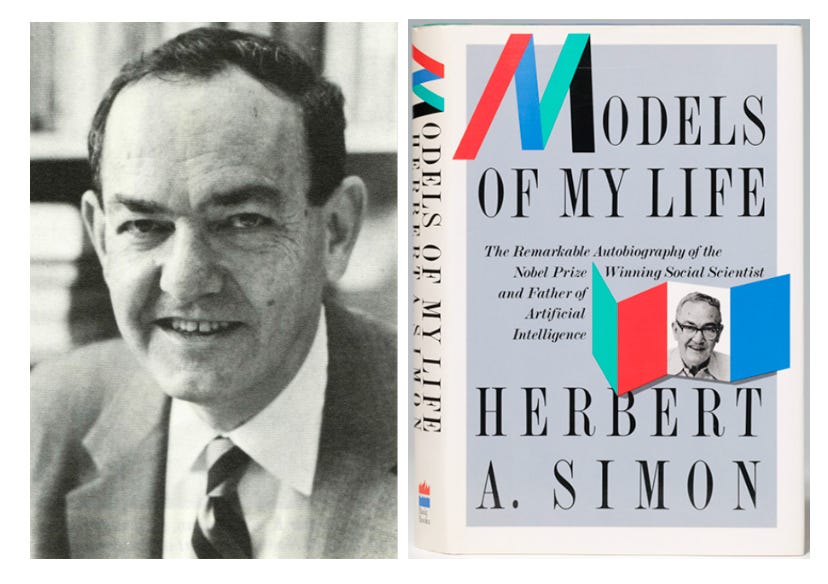
TABLE OF CONTENTS:
| PREFACE TO THE SERIES — xi Acknowledgements — xiii Introduction — xvii Prologue — xxiii The Boy in Wisconsin — 1 Forests and Fields | 24 |
| Education in Chicago | 36 |
| Encounter with a Scientific Revolution: | |
| Political Science at Chicago | 55 |
| THE SECOND PANEL | 67 |
| A Taste of Research: The City Manager’s Association | 69 |
| Managing Research: Berkeley | 78 |
| Teaching at Illinois Tech | 93 |
| A Matter of Loyalty | 117 |
| Building a Business School: The Graduate School of Industrial Administration | 135 |
| Research and Science Politics | 161 |
| Mazes Without Minotaurs Roots of Artificial Intelligence Climbing the Mountain Artificial Intelligence Achieved — 198 Exploring the Plain — 217 | 175 189 |
| Personal Threads in the Warp | 235 |
| Creating a University Environment for Cognitive Science and Α Ι | 248 |
| On Being Argumentative | 269 |
| The Student Troubles | 279 |
| The Scientist as Politician | 290 |
| Foreign Adventures | 305 |
| THE FOURTH PANEL RESEARCH AFTER SIXTY | 317 |
| From Nobel to Now | 319 |
| The Amateur Diplomat in China and the Soviet Union | 335 |
| Guides for Choice | 360 |
| The Scientist as Problem Solver | 368 |
| References | 389 |
| Index | 401 |
Yes! Our kids always had schedules and structure. In the afternoons, they would do their homework at the kitchen table while I made dinner. When John got home from work, we’d all sit down at the table for a family meal. Because I was a SAHM (and then worked part-time) during a good portion of our kids’ childhoods, bedtime stories were Daddy-Daughter time: over the years, John read the girls everything from myths to Shakespeare to Harry Potter to Anne of Green Gables to Huck Finn, etc. I’m so glad cell phones came along later—I see so much evidence at school of students being unable to keep their phones off, even at the cost of disciplinary action. That is what work of the future will have to take into account: employees will be literally addicted to their electronic devices.
Deb, well said! We have friends who’s raised their kids without many rules or routines. The son became a drug addict. The daughter got pregnant in High School, dropped out, and later…joined a cult.
Well…some of us probably would’ve liked a few more interactive times, but I was glad to have the opportunity to structure much of my young days as I chose… and still caught workaholism from my parents, or perhaps as a natural result did so.
Notable how few of my Cub Scout baseball league games either parent saw. Had the most RBIs on the team and possibly tied for that in the local league that year (half a century ago, man, and memory fades), nonetheless.
Todd, my parents went to every sport or educational event my three sisters, my brother, and I participated in. Diane and I did the same thing for Patrick and Katie’s orchestral concerts and dance recitals.
My kids did not need much of a heavy hand. They bickered a lot but neither got into much trouble. I read books to them while they did the dishes each night. Mostly books I thought highly of. Megan had to stand on a chair to reach the dishes. I can’t believe I let her do that. Josh went on to dishwash every year in college and he still does them now.
People need a book to tell them this!? Pfui!
Bob, a lot of people live without structure…to their detriment.
I had an uncle who could have benefitted from this book. Wait. CONSTRAINTS, not RESTRAINTS…Never mind.
Never had much problems with out girls. The youngest applied herself diligently, while the oldest kept trying to game the system –not sure which one I was more proud of.
Patti, Josh is welcome at our house anytime, but most preferably just as the dinner dishes are being cleared.
Jerry, my first “real” Job was as a dishwasher for a restaurant near the Niagara Falls. I did it one summer and couldn’t wait to get to College! Now we have a wonder Bosch dishwasher!
Irrelevant but true–Never buy a Miele dishwasher till the hills resound with reports that they’ve made them competently, at last.
Todd, a few of our friends bought a Miele dishwasher and sure enough, they turned around and bought a Bosch.