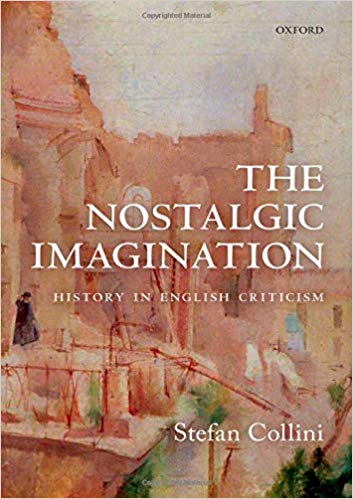
During his analysis of William Empson’s The Structure of Complex Words, Stefan Collins writes: “At first meeting, the book can seem deliberately uninviting. One way to describe its structure would be to say that an outer ring of barbed wire surrounds an inner ring of ditches…at the heart of which there is a labyrinth.” (p. 116). If you enjoy this kind of snarky academic writing, you’ll enjoy The Nostalgic Imagination. Stefan Collins writes about both English history and major critics like F. R. Leavis, Q. D. Leavis, Richard Hoggart, Raymond Williams, and T. S. Eliot.
Of course, these people and their criticisms of English Literature are mostly forgotten now. We’ve moved on to obsessing over cat videos and the Kardashians. Collins captures a time when books were taken seriously and literary criticism was an honored profession. If you’re nostalgic for more serious and sensible times, The Nostalgic Imagination will meet you half-way. GRADE: B+
TABLE OF CONTENTS:
Introduction p. 1
1 Whig History and the Mind of England p. 25
2 Scrutinizing the Present Phase of Human History p. 48
3 Science and Capitalism as ‘Background’ p. 77
4 Rationalism, Christianity, and Ambiguity p. 102
5 The History of ‘the Reading Public’ p. 126
6 The Long Industrial Revolution p. 156
7 Literary History as Cultural History p. 183
Postscript p. 207
Notes p. 211
Index p. 235