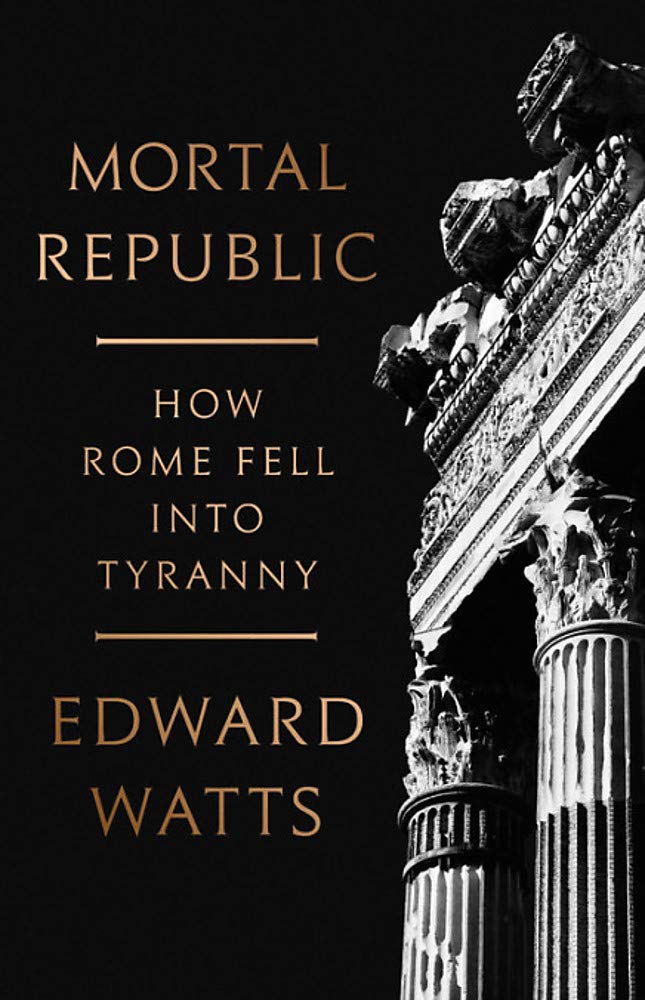
Mortal Republic starts off with these words: “We live in a time of political crisis, when the structures of republics as diverse as the United States, Venezuela, France, and Turkey are threatened. Many of these these republics are the constitutional descendants of Rom and, as such, they have inherited both the tremendous structural strengths that allowed the Roman Republic to thrive for so long and some of the same structural weaves that led eventually to its demise.” (p. 7)
Edward J. Watts’ history of the Roman Republic offers plenty of parallels with our present situation. The erosion of the Republic led to the cruel and mentally unstable autocrats like Caligula, Nero, and Commodus. Watts also shows that autocrats like Sulla relied on fear and brutality to force their will on Rome: “Sulla ordered the massacre of six thousand Samnites, who were murdered in the circus at Rome, with the executions timed so that the cries of the condemned would echo through the Temple of Bellona right when Sulla rose to address a terrified Roman Senate. As the dying Samnites creamed outside, Sulla promised to repair the Republic…” (p. 140)
Table of Contents
Maps viii
Preface 1
Chapter 1 Autocratic Freedom 5
Chapter 2 The New World Order 13
Chapter 3 Empire and Inequality 45
Chapter 4 The Politics of Frustration 69
Chapter 5 The Rise of the Outsider 97
Chapter 6 The Republic Breaks 119
Chapter 7 Rebuilding amid the Wreckage 145
Chapter 8 The Republic of the Mediocre 169
Chapter 9 Stumbling Toward Dictatorship 191
Chapter 10 The Birth and Death of Caesar’s Republic 219
Chapter 11 The Republic of Octavian 241
Chapter 12 Choosing Augustan Liberty 271
Notes 283
Index 323