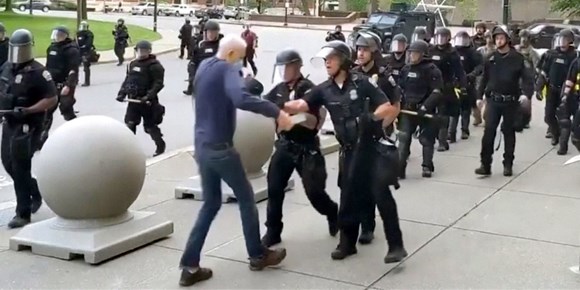
“Prosecutors are investigating the actions of two Buffalo police officers who were suspended without pay on Thursday night after a video showed them shoving a 75-year-old protester, who was hospitalized with a head injury.
The video taken by WBFO, a local radio station, shows the man, identified on Friday as Martin Gugino, approaching a group of officers during a protest stemming from the death of George Floyd. He was identified by the Western New York Peace Center, a nonprofit that named him in a Facebook post, saying he is a peace activist and a member.
After the video shows Mr. Gugino stopping in front of the officers to talk, an officer yells “push him back” three times; one officer pushes his arm into Mr. Gugino’s chest, while another extends his baton toward him with both hands. Mr. Gugino flails backward, landing just out of range of the camera, with blood immediately leaking from his right ear.
An officer leans down to examine him, the video shows, but another officer then pulls the first officer away. Several other officers are seen walking by the man, motionless on the ground, without checking on him.”
That’s the story that made the New York Times and most major news outlets. The video of the incident has been viewed 70 million times. Buffalo has been under a curfew for most of the week after some stores were looted earlier in the week.
What’s the state of the protests in your neighborhood?