Author Archives: george

FRIDAY’S FORGOTTEN BOOKS #524: THE PAPERBACK FANATIC #41


I stumbled across The Paperback Fanatic #41 while browsing in AMAZON. I ordered a copy and within a week I was enjoying some great reading about paperbacks! The cover artwork for the Conan paperbacks caught my eye. I own most of the Conan paperbacks, but I wanted to learn more about them. Richard Toogood’s essay on the Conan series provided many details that I wasn’t aware of. The article on E. V. Cunningham (aka, Howard Fast) proved to be fascinating, too. Howard Fast wrote a dozen crime novels under his “E. V. Cunningham” pseudonym from 1960 to 1973. All the crime novels had women’s names as their titles: Sylvia, Phyllis, Helen, Alice, Lydia, Shirley, Penelope, Helen, Margie, Sally, Samantha, Cynthia, and Millie.

Of course, once I read the E. V. Cunningham and Conan articles, I wanted to drop everything and read some of those paperbacks! If you’re a fan of paperbacks, you’ll enjoy The Paperback Fanatic. I’ve order some back issues before they go out-of-print! GRADE: B+
TABLE OF CONTENTS:
Heads Up 4
Doom-Mongerers 6
E. V. Cunningham 8
The Hitt Squad 10
Australian Movie Novelizations 14
Raymond Kursar on Manor Books 20
All Hail the King 25
The Plantation Pulps of N.E.L. 32
Segretissimo: The Second Assignment 44
Crom’s Tomes: Conan in Paperback 54

TEN DRUGS: HOW PLANTS, POWDERS, AND PILLS HAVE SHAPED THE HISTORY OF MEDICINE By Thomas Hager


Americans make up 5% of the world’s population, but we take 50% of the pills. Hager says the average Senior Citizen in the U.S. takes 10 pills a day (he’s counting vitamins, too).

In Chapter One, Hager say “the most important drug humans have ever found” is opium. “Dried and eaten or smoked,” writes Hager, “it was early man’s strongest, most soothing medicine. Today it is among the most controversial.” Since prehistoric times, opium spread across the world. Its addictive property was no secret, but considered only a modest drawback because, unlike many alcoholics, most users of opium were rarely violent.

In the 19th century, opium’s refined versions—-morphine and heroin—-produced an addiction epidemic similar to what we’re seeing today. Government efforts to suppress opiate and opioid misuse have been ineffective. Hager points out that modern medicine uses opium-based drugs every day. Much of pain-management is based on synthetic opioids which are cheap and effective…but very addictive. Change will come slowly.

My favorite chapter was on the history of vaccines, mostly the story of smallpox eradication. It was news to me that a woman, Lady Mary, discovered the connection between vaccination and surviving small-pox.

Hager goes on to provide exciting stories of discovery of important drugs that have an international flavor: antibiotics in Germany, antipsychotics in France, and cholesterol-lowering drugs in Japan.

Sadly, Hager concludes with a warning that Big Phama’s attentions are now focused on drugs that improve the quality of life—- Viagra, Botox, contraceptives, and tranquilizers–and generate plenty of profits. Do you have a favorite drug? GRADE: A
Table of Contents
Introduction 50,000 Pills 1
Chapter 1 The Joy Plant 11
Chapter 2 Lady Mary’s Monster 49
Chapter 3 The Mickey Finn 75
Chapter 4 How to Soothe Your Cough with Heroin 85
Chapter 5 Magic Bullets 99
Chapter 6 The Least Explored Territory on the Planet 123
Interlude The Golden Age 159
Chapter 7 Sex, Drags, and More Drugs 163
Chapter 8 The Enchanted Ring 187
Chapter 9 Statins: A Personal Story 211
Chapter 10 A Perfection of Blood 241
Epilogue The Future of Drugs 259
Source Notes 271
Bibliography 277
Index 287

YEAR OF WONDER: CLASSICAL MUSIC TO ENJOY DAY BY DAY By Clemency Burton-Hill


Clemency Burton-Hill loves classical music and listens to it every day. To share her love of classical music, Clemency Burton-Hill wrote Year of Wonder: Classical Music to Enjoy Day By Day (2018). Each day of the year gets a recommended piece of classic music to delight the reader/listener. For example, the April 11 recommendation is Mozart’s Concerto no. 7 in F major for three pianos, K. 242. For my birthday on June 9, the recommendation is another Mozart piece: Sinfonia concertante for violin and viola in E last major, K. 364.

Clemency Burton-Hill writes introductions to all the music she recommends. She provides some history of the composer and the piece. Burton-Hill also provides some speculation; for example, she suggests that Mozart’s favorite instrument was the viola.

My only quibble with this wonderful book is that Clemency Burton-Hill recommends music, but not the performer. For example, I would appreciate two or three recommendations for Mozart’s Concerto #7. I like Jenő Jandó’s version on NAXOS. But I’d be willing to listen to other recommended versions. But this is a minor point. All in all, A Year of Wonder delights and informs in equal measure. Highly recommended! Do you have a favorite piece of classic music? GRADE: A

THE AVENGERS ASSEMBLE! SEASON ONE [DVD]


With The Avengers: Endgame just a couple of weeks away (we have our tickets!), I decided to get into the mood with this animated version of the group from 2011. MARVEL provides 90 minutes of action and thrills as The Avengers battle super villains, time traveling conquerors, alien invaders, mythical beasts, and robots bent on world domination. No single superhero could handle these threats so Iron Man, Thor, Captain America, and the Hulk band together to face these powerful opponents. Yes, these animated adventures are aimed at 12-year-olds, but the sense of wonder of the comic books and movies find their way into these animated tales. Fun! Do you have a favorite Avenger? GRADE: B+

THE LIAR IN THE LIBRARY By Simon Brett


The second week in April is traditionally National Library Week–although in some places April has become National Library Month. No matter. I want to honor all the libraries I use by reviewing a book that celebrates libraries: Simon Brett’s The Liar in the Library (2017). Burton St. Clair, author of the best selling Stray Leaves in Autumn, visits the little Fethering library to do a presentation and sign some books. Jude, a former model, is now a healer living in Fethering. Jude knew Burton St. Clair when he was simply Al Sinclair, husband of an actress named Megan Georgeson. But that was 15 years ago. Megan and Al divorced years ago and Jude fell out of touch with both of them.

After the library event, Burton S. Clair offers to give Jude a ride home since it’s raining. Jude reluctantly accepts the offer and as soon as Jude straps on her seat belt, Burton starts groping Jude. Jude leaves the car in a huff. But, the next morning Burton St. Clair is found dead in his car. Jude was the last person to see him alive–except for the killer. But, the police decide Jude is their prime suspect since she knew the victim 15 years ago. Jude and her friend Carole Seddon start their own investigations to clear Jude of suspicion in Burton St. Clair’s death. Yes, this is a traditional, old fashioned mystery with interesting suspects and cunning red herrings. What better way to celebrate National Library Week (or Month) than by reading a good book with a library connection! Do you have a favorite book that involves a library? GRADE: B+

HOME FIRE By Kamila Shamsie


My daughter Katie recommended Home Fire by Kamila Shamsie so I read it. I had read some reviews of Home Fire where I found out it tells an updated story of Sophocles’s play Antigone.

For those of you who have forgotten your Greek plays, King Creon insists the traitorous Polynices cannot be buried within the walls of Thebes. Antigone fights that decision.

In Home Fire Polynices is renamed Parvaiz. Parvaiz is a British Muslim boy who becomes radicalized and heeds the call of Islamic State in Iraq and the Levant. Although Parvaiz and his two sisters, Aneeka and Isma, grew up in Wembley, West London, they have not assimilated. Also, their father was a jihadist who died being transferred to Guantánamo.

An Isil recruiter tells Parvaiz that his father was tortured by the Americans in Bagram, Afghanistan. To avenge his father’s death, Parvaiz must join Isil and join the jihad against the West.

Antigone is renamed Aneeka in Home Fires. Aneeka freaks out when she finds that her brother has left for Syria to join the Jihadists. By chance, Aneeka meets Eamonn, the son of the Home Secretary. Eamonn comes from a very different Muslim background than Aneeka. Karamat (who serves as the Creon character) is Eamonn’s wealthy, politically powerful father.

Eamonn is a trust-fund baby. Aneeka seduces him. This seems to be cunning tactic by Aneeka to get Eamonn’s powerful family to help her rescue her brother. Meanwhile, Parvaiz is shocked and dismayed by what he discovers in the murderous caliphate. Parvaiz wants to return home to England.

Home Fire explores the political dimensions of terrorism using the power of Sophoceles’s play to highlight the tensions of class, wealth, and religion.

Happy Birthday, Katie! Thanks for the recommendation! GRADE: A

SHAZAM!


The superhero now called Shazam appeared in a comic book 80 years ago. As you might suspect, there have been changes over the years. In the original version, a young boy named Billy Batson would say “Shazam!” and turn into an adult superhero very much like Superman called…Captain Marvel. Later, in a lawsuit with MARVEL Comics, DC Comics agreed that MARVEL owned the Captain Marvel name and the Shazam character morphed.

Now, this movie version introduces us to a trouble teenager, Billy Batson (played by Asher Angel), who is searching for his mother. Billy was at a carnival as a toddler and got lost in the crowd. For the past decade, Billy has been going from foster home to foster home while trying to find his mother. In this latest foster home, Billy rooms with a disabled boy named Freddy (Jack Dylan Grazer) who idolizes Superman and other DC superheroes. Through some magic, Bill Batson gets transformed into Shazam (played by Zachery Levi). Of course, the comedy occurs immediately as Billy finds himself inside an adult’s body…with superpowers!

And of course, there’s a Bad Guy. He’s Thaddeus Sivana (played by Mark Strong), a guy with serious Daddy issues. A half-dozen ghoulish creatures have taken up residence in Sivana’s body and motivate him to take the powers in Shazam. Many action/fighting sequences follow. I enjoyed this spoof of superhero movies. I think Director David F. Sandberg could have cut 15 minutes or so from the film to make it tighter. Action, adventure, and humor…what more do you need from a superhero movie? GRADE: B+

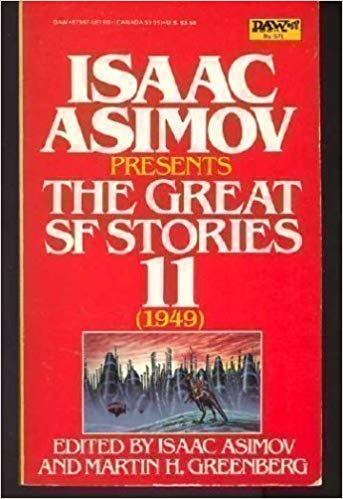
FRIDAY’S FORGOTTEN BOOKS #523: THE GREAT SF STORIES #8 (1946): By Isaac Asimov & Martin H. Greenberg


You can see subtle changes in Science Fiction in 1946. Sure, ASTOUNDING still dominated the genre, but SF was becoming more international. Asimov and Greenberg included THREE stories by Arthur C. Clarke! Will F. Jenkins (aka, “Murray Leinster”) captured the essence of computers in “A Logic Named Joe.” My two favorite stories in The Great SF Stories #8 are Ray Bradbury and Leigh Brackett’s dreamy “Lorelei of the Red Mist” and Henry Kuttner and C.L. Moore’s classic “Vintage Season.” With World War II over, big changes to the Science Fiction world were right around the corner. But this anthology does a great job in capturing the essence of the SF genre in the mid-1940s. GRADE: A-
TABLE OF CONTENTS:
INTRODUCTION By Martin H. Greenberg & Isaac Asimov 9
“A Logic Named Joe” by Will F. Jenkins (ASTOUNDING SCIENCE FICTION, March 1946) 13
“Memorial” by Theodore Sturgeon (ASTOUNDING SCIENCE FICTION, April 1946) 30
Loophole” by Arthur C. Clarke (ASTOUNDING SCIENCE FICTION, April 1946) 45
The Nightmare” by Chan Davis (ASTOUNDING SCIENCE FICTION, May 1946) 53
Rescue Party” by Arthur C. Clarke (ASTOUNDING SCIENCE FICTION, May 1946) 74
Placet is a Crazy Place” by Fredric Brown (ASTOUNDING SCIENCE FICTION, May 1946) 101
Conqueror’s Isle” by Nelson S. Bond (BLUE BOOK MAGAZINE, June 1946) 116
“Lorelei of the Red Mist” by Ray Bradbury and Leigh Brackett (Planet Stories, Summer 1946) 131
The Million Year Picnic” by Ray Bradbury (PLANET STORIES, Summer 1946) 189
“The Last Objective” by Paul A. Carter (ASTOUNDING SCIENCE FICTION, August 1946) 199
Meihem in ce Klasrum” by Dolton Edwards (ASTOUNDING SCIENCE FICTION, September 1946) 228
Vintage Season” by Lawrence O’Donnell (aka, Henry Kuttner & C.L. Moore) (ASTOUNDING SCIENCE FICTION, September 1946) 232
Evidence” by Isaac Asimov (ASTOUNDING SCIENCE FICTION, September 1946) 276
Absalom” by Henry Kuttner (STARTLING STORIES, Fall 1946) 299
“Mewhu’s Jet” by Theodore Sturgeon (ASTOUNDING SCIENCE FICTION, November 1946) 316
Technical Error” by Arthur C. Clarke (FANTASY [Great Britain], December 1946) 351

PERMAFROST By Alastair Reynolds


Alastair Reynolds’s new Time Travel short novel, Permafrost, presents us with a dying world in 2080. An environmental disaster has killed all insects and now the plants are dying. Humanity is slowly starving to death. Dr. Cho of the World Health Organization assembles a small team to try a desperate experiment: send the consciousnesses of the team members back to 2029 and try to avert the environmental catastrophe. As usual in these kind of Time Travel stories, Something Goes Wrong.

Alastair Reynolds packs a lot of excitement in his slim 176-page novel. This is a quick and thrilling read! Do you like Time Travel stories? GRADE: B+