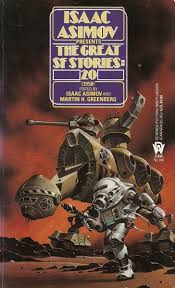
This volume of THE GREAT SF STORIES series features two iconic stories. The first, Clifford D. Simak’s wonderful “The Big Front Yard,” brings back memories of reading the story in ASTOUNDING SCIENCE FICTION in the late 1950s. That issue had a brilliant Kelly Freas cover illustrating “The Big Front Yard” that remains etched in my memory.
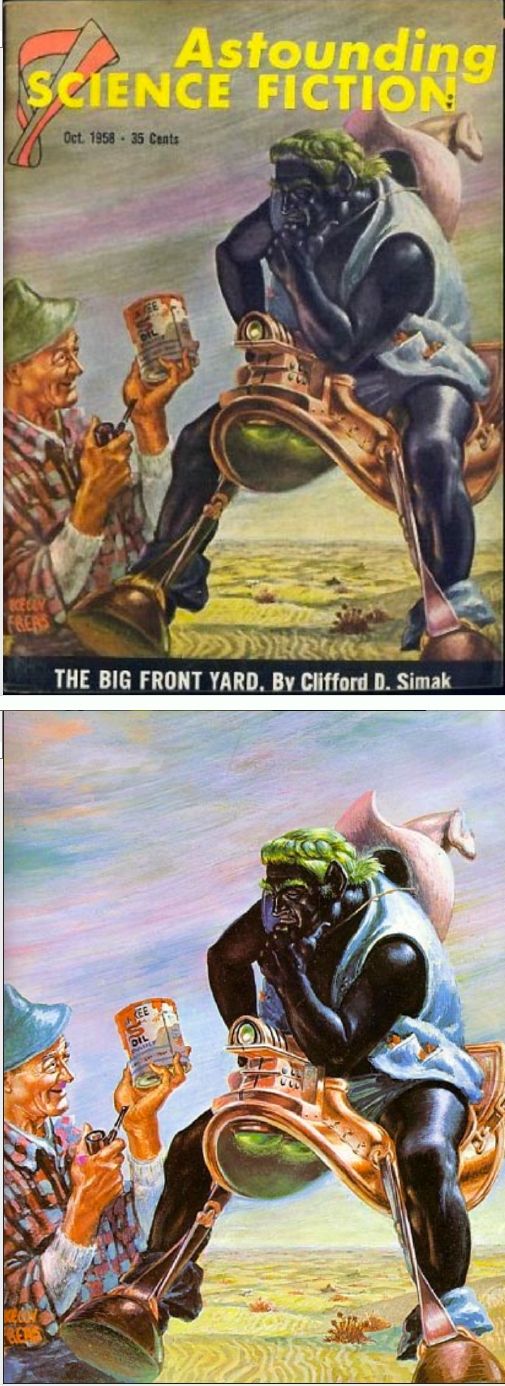
The second story, C. M. Kornbluth’s dark “Two Dooms,” rocked my world when I first read it in the 1960s. Later, I learned Kornbluth died shortly after “Two Dooms” was published at the age of 34. Kornbluth shoveled snow from his driveway, which delayed him. Then, running to meet his train, Kornbluth suffered a fatal heart attack on the platform of the train station. What a tragic loss of a great talent!
Avram Davidson’s “All the Seas with Oysters, Silverberg’s “The Iron Chancellor,” and Sheckley’s “The Prize of Peril” still entertain after all the decades. But my favorite surprise in this anthology is Rog Phillips’s “The Yellow Pill” which cleverly explores the nature of Reality. Volume #20 of THE GREAT SF STORIES series is a winner! GRADE: A
TABLE OF CONTENTS:
Introduction 9
The Last of the Deliverers by Poul Anderson (MAGAZINE OF FANTASY & SCIENCE FICTION, February 1958) 13
The Feeling of Power by Isaac Asimov (MAGAZINE OF FANTASY & SCIENCE FICTION, February 1958) 29
Poor Little Warrior! by Brian W. Aldiss (MAGAZINE OF FANTASY & SCIENCE FICTION, April 1958) 41
The Iron Chancellor by Robert Silverberg (GALAXY, May 1958) 49
The Prize of Peril by Robert Sheckley (MAGAZINE OF FANTASY & SCIENCE FICTION, May 1958) 77
Or All the Seas with Oysters by Avram Davidson (GALAXY, May 1958) 99
Two Dooms by C. M. Kornbluth (Venture Science Fiction, July 1958) 111
The Big Front Yard by Clifford D. Simak (ASTOUNDING SCIENCE FICTION, October 1958) 167
The Burning of the Brain by Cordwainer Smith (IF, October 1958) 229
The Yellow Pill by Rog Phillips (ASTOUNDING SCIENCE FICTION, October 1958) 243
Unhuman Sacrifice by Katherine MacLean (ASTOUNDING SCIENCE FICITON, November 1958) 259
The Immortals by James E. Gunn (STAR SCIENCE FICTION #4) 297