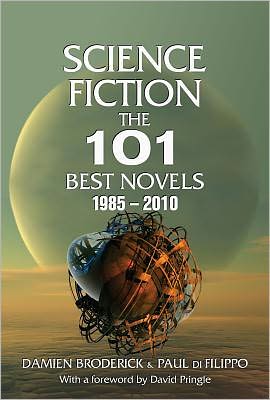
 Nonstop Press has to be complemented for publishing this sequel to David Pringle’s classic Science Fiction: The 100 Best Novels, 1949-1984. Although I’ve only read 22 of the 101 best novels, I have plenty of the unread books in various stacks around the house. Lists generally generate controversy so let me dive in with my quibbles. Broderick and Di Filippo include mainstream novels that really don’t belong on a Best SF Novels list: Philip Roth’s The Plot Against America and Cormac McCarthy’s The Road. Yes, both books have SF elements, but better choices could have been made. My other quibble is that the Table of Contents merely lists the books by title and publication date. What happened to the authors? Lastly, the authors have a disturbing habit of including spoilers in their mini-summaries of the novels. So, if you don’t want your reading experience ruined, you’ll need to read their essays AFTER you read the book. Other than those flaws, I highly recommend Science Fiction: The 101 Best Novels, 1985-2010! GRADE: A
TABLE OF CONTENTS:
Foreword 6
Introduction 8
The Handmaid’s Tale (1985) 13
Ender’s Game (1985) 16
Radio Free Albemuth (1985) 19
Always Coming Home (1985) 21
This Is the Way the World Ends (1985) 24
Galápagos (1985) 27
The Falling Woman (1986) 30
The Shore of Women (1986) 32
A Door Into Ocean (1986) 35
Soldiers of Paradise (1987) 38
Life During Wartime (1987) 41
The Sea and Summer (1987) 44
Cyteen (1988) 47
Neverness (1988) 50
The Steerswoman (1989) 53
Grass (1989) 56
Use of Weapons (1990) 58
Queen of Angels (1990) 61
Barrayar (1991) 64
Synners (1991) 67
Sarah Canary (1991) 70
White Queen (1991) 73
Eternal Light (1991) 76
Stations of the Tide (1991) 79
Timelike Infinity (1992) 82
Dead Girls (1992) 85
Jumper (1992) 87
China Mountain Zhang (1992) 89
Red Mars (1992) 91
A Fire Upon the Deep (1992) 94
Aristoi (1992) 97
Doomsday Book (1992) 100
Parable of the Sower (1993) 103
Ammonite (1993) 105
Chimera (1993) 107
Nightside the Long Sun (1993) 109
Brittle Innings (1994) 113
Permutation City (1994) 115
Blood (1994) 118
Mother of Storms (1995) 121
Sailing Bright Eternity (1995) 124
Galatea 2.2 (1995) 127
The Diamond Age (1995) 130
The Transmigration of Souls (1996) 133
The Fortunate Fall (1996) 135
The Sparrow/Children of God (1996/1998) 138
Holy Fire (1996) 141
Night Lamp (1996) 143
In the Garden of Iden (1997) 146
Forever Peace (1997) 149
Glimmering (1997) 152
As She Climbed Across the Table (1997) 154
The Cassini Division (1998) 156
Bloom (1998) 159
Vast (1998) 162
The Golden Globe (1998) 165
Headlong (1999) 168
Cave of Stars (1999) 170
Genesis (2000) 173
Super-Cannes (2000) 176
Under the Skin (2000) 179
Perdido Street Station (2000) 182
Distance Haze (2000) 185
Revelation Space trilogy (2000) 188
Salt (2000) 190
Ventus (2001) 192
The Cassandra Complex (2001) 195
Light (2002) 198
Altered Carbon (2002) 201
The Separation (2002) 203
The Golden Age (2002) 205
The Time Traveler’s Wife (2003) 208
Natural History (2003) 211
The Labyrinth Key / Spears of God 214
River of Gods (2004) 217
The Plot Against America (2004) 220
Never Let Me Go (2005) 223
The House of Storms (2005) 226
Counting Heads (2005) 229
Air (Or, Have Not Have) (2005) 231
Accelerando (2005) 234
Spin (2005) 237
My Dirty Little Book of Stolen Time (2006) 240
The Road (2006) 243
Temeraire /His Majesty’s Dragon (2006) 245
Blindsight (2006) 248
HARM (2007) 251
The Yiddish Policemen’s Union (2007) 253
The Secret City (2007) 255
In War Times (2007) 257
Postsingular (2007) 260
Shadow of the Scorpion (2008) 263
The Hunger Games trilogy (2008-2010) 265
Little Brother (2008) 268
The Alchemy of Stone (2008) 271
The Windup Girl (2009) 273
Steal Across the Sky(2009) 275
Boneshaker (2009) 277
Zoo City (2010) 280
Zero History (2010) 283
The Quantum Thief (2010) 286
I have actually read a few of these but probably the most marginally SF ones. Looks like fun even to a interloper in the field.
There are plenty of excellent books on this list, Patti. I’m building a Want List right now.
First of all, it just shows (as if I didn’t know that already) how out of it I am when it comes to current science fiction.
Second, much as I liked the Roth book you’re right – it is not science fiction. Chabon’s YIDDISH POLICEMEN’S UNION is an ‘alternate universe’ story, true, but I wouldn’t characterize it as science fiction either. It’s a mystery, just set in a different reality.
I think I’ll look for the 1949-1984 book first.
David Pringle’s SCIENCE FICTION: THE 100 BEST NOVELS, 1949-1984 is more traditional, Jeff. But there are some head-scratchers on Pringle’s list, too.
OK – got a copy on ABE for $3!
Gotta love the internet.
The Internet provides instant gratification, Jeff!
I’ve read a few and I probably won’t read any of the others. Can’t keep up anymore.
I’m disappointed Jack McDevitt’s SEEKER isn’t on this list, Bill. I know we both read SEEKER and enjoyed it.
There are interesting omissions, such as Dan Simmons, but I am intrigued. I have read 20 since much of my current reading is for Forgotten Books each week. There are many on there I will read, though, including the Roth and McCarthy.
I’ve read the Roth and the McCarthy, Scott. Yes, they are worth reading but I wouldn’t classify either of them as SF. Dan Simmons should be on this list. So should John Scalzi’s OLD MAN’S WAR.
George, even though it was marketed otherwise, how is THE ROAD not a piece of post-apocalypse science fiction like, say, THE LONG LOUD SILENCE or THROUGH DARKEST AMERICA?
It’s a judgment call, Drongo. I don’t consider Nevil Shute’s ON THE BEACH to be SF even though it deals with the same diaster that THE ROAD does. I don’t consider 1984 to be SF, either. It’s more of a political novel. Just because mainstream writers “borrow” some SF elements like a post-apocalyptic future that doesn’t make their work SF. For one person’s choices for the 10 best post-apocalyptic novels, check out: http://listverse.com/2009/02/12/10-great-post-apocalyptic-science-fiction-novels/
For those of you who might be interested, here’s David Pringle’s list:
David Pringle’s Best 100 Science Fiction Novels, 1949-1984:
George Orwell – Nineteen Eighty-Four
George R. Stewart – Earth Abides
Ray Bradbury – The Martian Chronicles
Robert A. Heinlein – The Puppet Masters
John Wyndham – The Day of the Triffids
Bernard Wolfe – Limbo
Alfred Bester – The Demolished Man
Ray Bradbury – Fahrenheit 451
Arthur C. Clarke – Childhood’s End
Charles L. Harness – The Paradox men
Ward Moore – Bring the Jubilee
Frederik Pohl & C.M. Kornbluth – The Space Merchants
Clifford D. Simak – Ring Around the Sun
Theodore Sturgeon – More than Human
Hal Clement – Mission of Gravity
Edgar Pangborn – A Mirror for Observers
Isaac Asimov – The End of Eternity
Leigh Brackett – The Long Tomorrow
William Golding – The Inheritors
Alfred Bester – The Stars My Destination
John Christopher – The Death of Grass
Arthur C. Clarke – The City and the Stars
Robert A. Heinlein – The Door Into Summer
John Wyndham – The Midwich cuckoos
Brian W. Aldiss – Non-Stop
James Blish – A Case of Conscience
Robert A. Heinlein – Have Space-Suit — Will Travel
Philip K. Dick – Time Out of Joint
Pat Frank – Alas, Babylon
Walter M. Miller – A Canticle for Leibowitz
Kurt Vonnegut – The Sirens of Titan
Algis Budrys – Rogue Moon
Theodore Sturgeon – Venus Plus X
Brian W. Aldiss – Hothouse
J.G. Ballard – The Drowned World
Anthony Burgess – A Clockwork Orange
Philip K. Dick – The Man in the High Castle
Robert Sheckley – Journey Beyond Tomorrow
Clifford D. Simak – Way Station
Kurt Vonnegut – Cat’s Cradle
Brian W. Aldiss – Greybeard
William S. Burroughs – Nova Express
Philip K. Dick – Martian Time-Slip
Philip K. Dick – The Three Stigmata of Palmer Eldritch
Fritz Leiber – The Wanderer
Cordwainer Smith – Nostrilia
Philip K. Dick – Dr Bloodmoney
Frank Herbert – Dune
J.G. Ballard – The Crystal World
Harry Harrison – Make Room! Make Room!
Daniel Keyes – Flowers for Algernon
Roger Zelazny – The Dream Master
John Brunner – Stand on Zanzibar
Samuel R. Delany – Nova
Philip K. Dick – Do Androids Dream of Electric Sheep?
Thomas M. Disch – Camp Concentration
Michael Moorcock – The Final Programme
Keith Roberts – Pavane
Angela Carter – Heroes and Villains
Ursula K. Le Guin – The Left Hand of Darkness
Bob Shaw – The Palace of Eternity
Norman Spinrad – Bug Jack Barron
Poul Anderson – Tau Zero
Robert Silverberg – Downward to the Earth
Wilson Tucker – The Year of the Quiet Sun
Thomas M. Disch – 334
Gene Wolfe – The Fifth Head of Cerberus
Michael Moorcock – The Dancers at the End of Time
J.G. Ballard – Crash
Mack Reynolds – Looking Backward from the Year 2000
Ian Watson – The Embedding
Suzy McKee Charnas – Walk to the End of the World
M. John Harrison – The Centauri Device
Ursula K. Le Guin – The Dispossessed
Christopher Priest – Inverted World
J.G. Ballard – High-Rise
Barry N. Malzberg – Galaxies
Joanna Russ – The Female Man
Bob Shaw – Orbitsville
Kingsley Amis – The Alteration
Marge Piercy – Woman on the Edge of Time
Frederik Pohl – Man Plus
Algis Budrys – Michaelmas
John Varley – The Ophiuchi Hotline
Ian Watson – Miracle Visitors
John Crowley – Engine Summer
Thomas M. Disch – On Wings of Song
Brian Stableford – The Walking Shadow
Kate Wilhelm – Juniper Time
Gregory Benford – Timescape
Damien Broderick – The Dreaming Dragons
Octavia Butler – Wild Seed
Russell Hoban – Riddley Walker
John Sladek – Roderick and Roderick at Random
Gene Wolfe – The Book of the New Sun
Philip Jose Farmer – The Unreasoning Mask
Larry Niven & Jerry Pournelle – Oath of Fealty
Michael Bishop – No Enemy but Time
John Calvin Batchelor – The Birth of the People’s Republic of Antarctica
William Gibson – Neuromancer
George, funny you mentioned ON THE BEACH. I almost used that as an example of a post-apocalypic sf novel. (And I do consider it sf. Of course, the late Mr. Shute might disagree with my assesment.)
Thanks for the link. Although I wouldn’t have ranked ALAS BABYLON at number one, it was an interesting list.
I wouldn’t put ALAS BABYLON at #1 either, Drongo. One of my favorite post-apocalyptic SF novels is Hiero’s Journey by Sterling E. Lanier. Excellent!
It’s clearly a reflection of my age that I’ve read better than 4/5 of the older list but less than 1/5 of the newer one.
That’s about the same percentages of my reading of the two lists, Rick.
I was going to mention OLD MAN’S WAR too. And what about THE FOREVER WAR on the earlier list?
THE FOREVER WAR should be on one or the other list, Jeff.
I didn’t comment on this yesterday because I’d read so few of the books on the 1985-2010 list, but I’ve read plenty on the 1949-1984 list. I don’t think this has anything to do with the SF genre but much more with the age of the book. A lot of the books on the list were “old” when I read them. In any genre, I’m much more likely to read an older book than a more recently-published one.
Deb, none of the books I’ve read on the 1985-2010 list equals the pleasure I’ve had reading the books on 1949-1984 list.
While by me, sf isn’t necessarily an approach so much as a content matter, so all these novels by “outsiders” are sf, indeed…even if they are not always cognizant of all the developments within the magazine-born sf field…in fact, usually aren’t. Though that is improving, these days. Many of the sf novels you have no problem with are utterly political novels, as well, after all.
The boundaries of the SF genre is what is at issue here, Todd. THE ROAD is not a SF novel to me.
Exactly. I don’t believe that version of “genre” is particularly useful, and because THE ROAD is about sfnal matters, it counts. Whether it’s particularly good, even on its own terms much less compared to DAVY or to “By the Waters of Babylon” or to THE BED SITTING ROOM is quite another set of matters.